
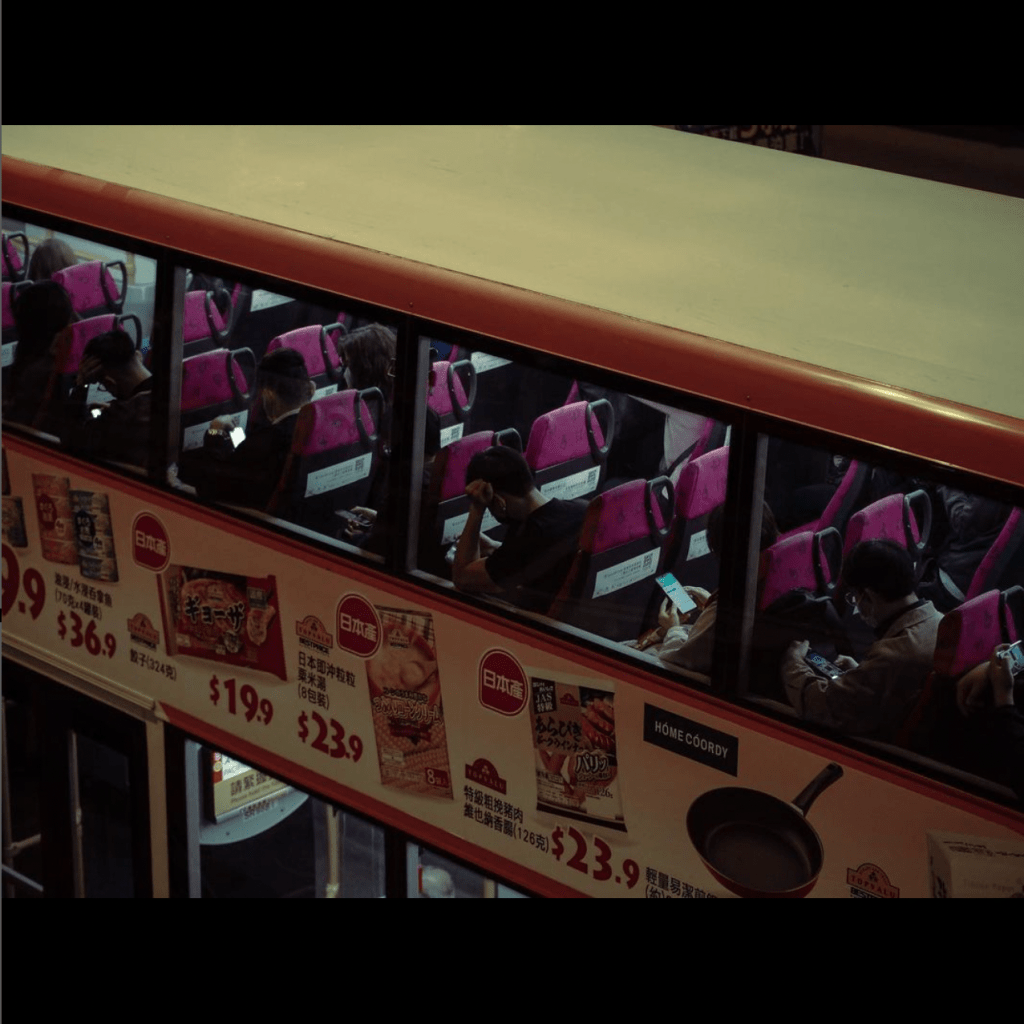

“What would you think about moving here?”
We were on a bus heading to Hong Kong International Airport on Lantau Island. It was dark outside. We were going to catch an early-morning flight back home to Seattle. The motion of the bus plunging along in the predawn hour had been lulling me to sleep. My wife’s sudden question brought me back from my doze.
“Hmmm?”
She asked her question again.
“Move here?”
“Yes,” she said. “What do you think?”
I looked out the window. The bus rocked as it hurried on. I like Hong Kong, the city where she was born. But the noise. The crowded streets. The push and pull of the heaving city. I didn’t need to think long on her inquiry.
“No,” I said.
She gave me that wide-eyed questioning look of hers. I guess I had been a kind of abrupt in my response.
“Maybe just for a few months,” she said. “What do you think? Maybe just the summer.”
I looked out the window, thinking.
“Or the winter,” she said. “Yes, you would like that better. Maybe winter or spring. Summer might be too hot and humid.”
I watched the lights of the city zip by and thought about the idea of living in Hong Kong from winter into spring.
“If we were to decide to live here,” I said. “I think I would rather live on one of the outlying islands. Away from the city. Perhaps Cheung Chau.”
Cheung Chau is one of more than two-hundred small islands around Hong Kong. It is about six miles from Hong Kong island. Sometimes called Dumbbell Island, it is separated into two halves, joined in the middle by a tombolo, or isthmus, that forms a sandy stretch called Tung Wan Beach. The beach is paralleled by a boardwalk and lined with shops and small restaurants. There are many small fishing vessels, in bright flamboyant colours that anchor in the harbour and the island is known for its seafood.
The bus juddered. The bus throbbed. The bus hurtled on.
The roads and alleyways on the island are narrow. People walk everywhere or ride bicycles. They can also ride in village vehicles, resembling golf carts. Life is slower and quieter than in the teeming hectic city.It would be nice to get up in the morning and not hear the sounds of traffic or the honking of horns. Have a quiet cup of tea and look out at the water. We could be away from the crush and scrabble of Hong Kong itself and my wife could visit her family in the city any time.
The bus swayed and pitched, moving fast along the highway.
“You could swim in the mornings,” she said. “When the water is calm.”
“Yes. That would be nice.”
“And after that,” she said, joining the narrative. “We could buy some frozen watermelon and fresh shrimp dumplings from a little place along the waterfront, and we could sit outside and eat. And you could dip the dumplings in that sweet chilli oil that you like.”
“And we could eat and read the morning paper and look out at the bay,” I said.
“There might not be an English newspaper on the island.”
“We could have it sent over from Hong Kong Island on the morning boat.”
“And we could drink chrysanthemum tea,” I said.
She looked out the window of the bus at the buildings rushing by. Her hair was as black as calligraphy ink, and it moved in the breeze that came in through the bus window. The bus raced on, thrusting toward the airport.
“And in the afternoons, you could write,” she said. “You could write about being an American living in Hong Kong.”
I considered that as I watched her hair move in the wind.
“I could write about you,” I said.
“Me?”
“Yes,” I said. “I could write about being an American married to a Chinese girl.”
“Nobody would want to read that.”
“Sure, they would. How about the book A Many-Splendoured Thing?”
“A Many-Splendoured Thing?”
“It was written by a Chinese woman,” I said. “It is about a Chinese woman and an American journalist. They even made a movie.”
“I have not read that,” she said.
“You could read it in the afternoons while I write. And I could call my book The Chinese Girl.”
She giggled and looked out the bus window. The bus vibrated. The bus trembled. The highway sped by. The bus rumbled and shuddered.
“And after, we could walk along the beach,” she said.
“Yes,” I said. “After all, it is an island.”
“And we could gather shells and display them on our windowsills.”
The bus careened and tore down the freeway.
“And we could hold hands as we walked,” she continued, smiling.
“That sounds good to me,” I said. “And in the evening, after dinner, we could read some more.”
The road zipped by in a flurry. The bus lumbered on.
“And we can listen to Miles Davis,” I continued. “And rock and roll. Led Zeppelin. We can turn the volume up loud and our neighbours would wonder who the heck we are.”
“Yes,” she clucked and then she formed a silly frown. “The poor Amah two doors down would wonder.” She laughed.
“We could tell her that I’m Jimmy Page.”
“She would not know who Jimmy Page is.”
“And we could go for another walk,” I said. “Later, in the dark, along the beach.”
“And then we can walk back home,” she said. “And we can make love with the windows open and the curtains moving in the breeze and the moonlight coming in through the curtains.”
I looked over at the Chinese Girl. She was looking out the bus window. Her hair gleamed in the streetlights like black lacquer. She looked back at me and smiled.
The bus rushed onward. Vibrating and rocking and jarring toward morning.
Header image “Hong Kong Bus” (2022) by Oliver Farry.
How to cite: Beyl, Jeff. “The Chinese Girl.” Cha: An Asian Literary Journal, 3 Jul. 2024, chajournal.blog/2024/07/03/chinese-girl.



Jeff Beyl writes about nature, fly-fishing, music, geology, surfing, and the ocean. He has been published in several magazines such as Big Sky Journal, Outside Bozeman, Montana Fly-fishing, Idaho Magazine, Northwest Sportsman, Ocean Magazine, Snowy Egret Literary Journal. His book, A Conversation With the Earth, was published in 2020. He has travelled widely through Asia, Hong Kong, Japan, Europe, the Caribbean and the Mediterranean. He is a jazz guitarist and photographer, scuba diver and fly-fisherman. He lives in Seattle with his wife. [All contributions by Jeff Beyl.]
 Cha
Cha 