
📁 RETURN TO FIRST IMPRESSIONS
📁 RETURN TO CHA REVIEW OF BOOKS AND FILMS
Click HERE to read all entries in Cha on The Perils of Interpreting.
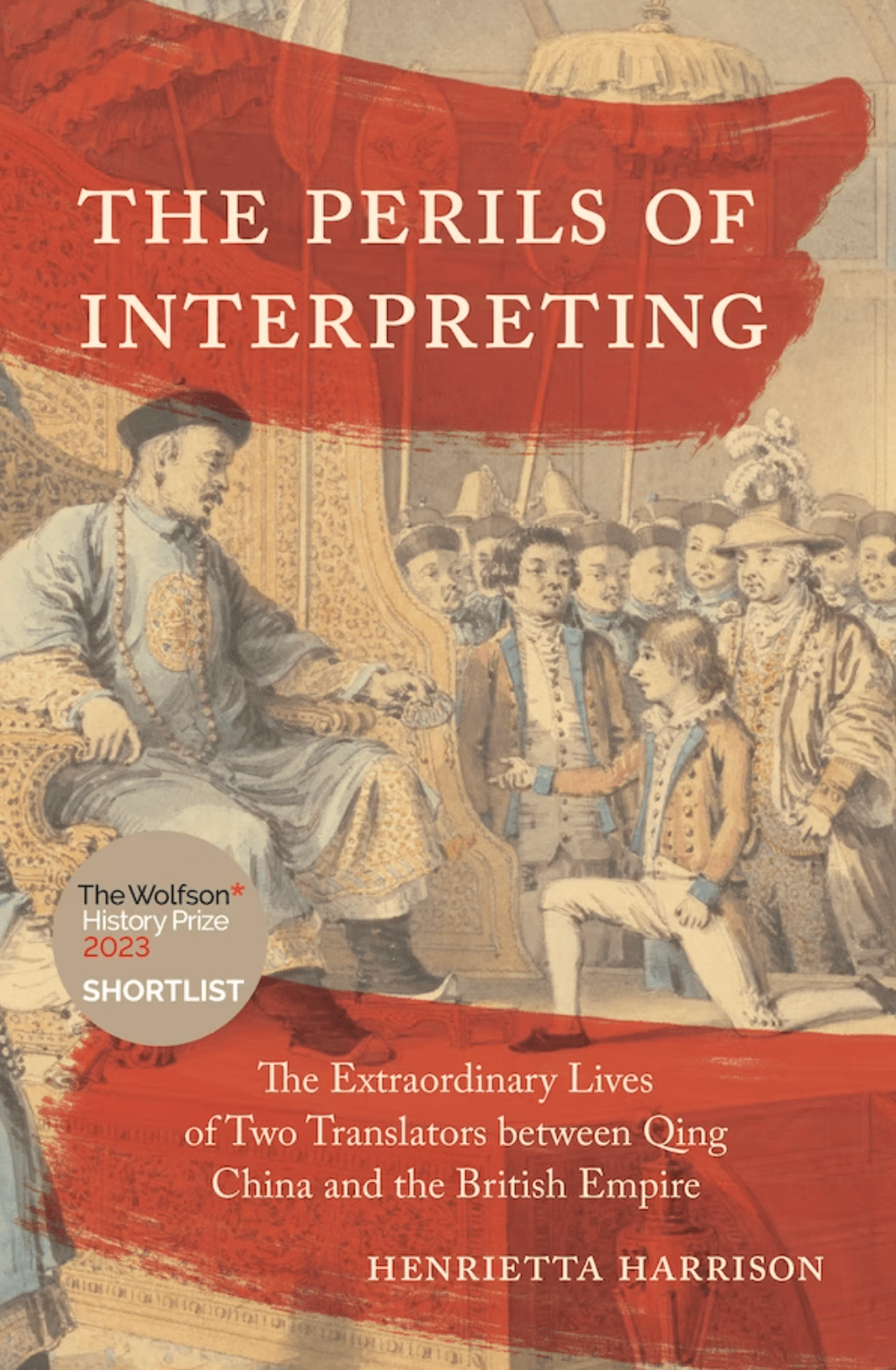
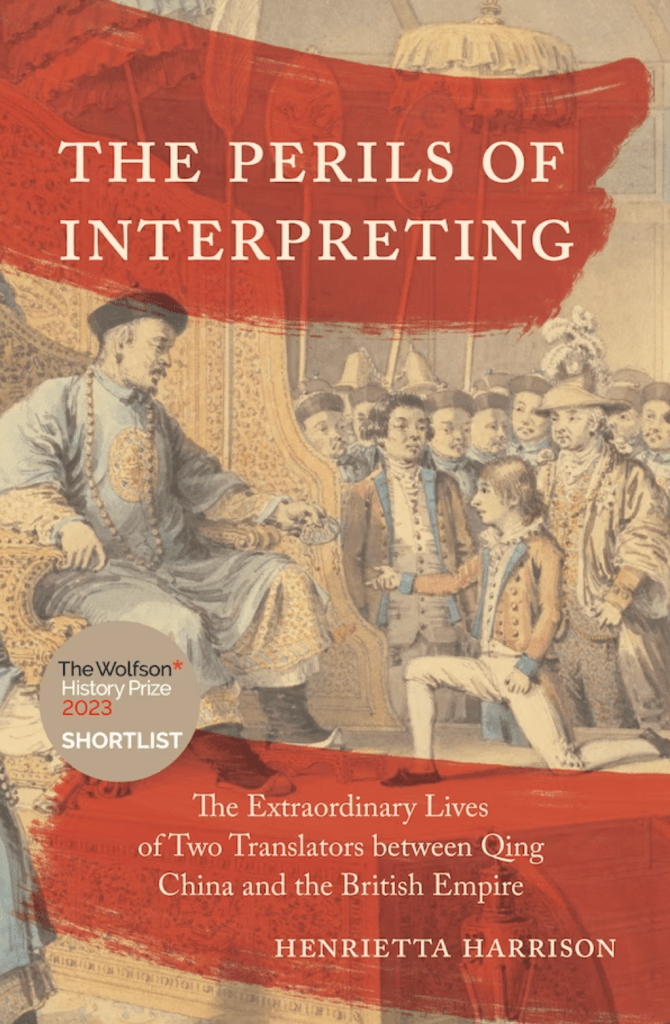
Henrietta Harrison, The Perils of Interpreting: The Extraordinary Lives of Two Translators between Qing China and the British Empire, Princeton University Press, 2021. 312 pgs.
“Translation is not a simple process.” (270)
The translation profession seems to be facing an existential crisis. How can human interpreters—with our fallible knowledge, susceptibility to fatigue, and unappealing demands for payment—ever hope to compete against supposedly astonishing Large Language Models such as ChatGPT? AI-fuelled machine translation no doubt is a powerful tool in the hands of a skilled linguist, speeding up and improving the accuracy of translations, and a “good-enough” output from Google Translate will suffice in many situations. But when the stakes are truly high—like in official negotiations between nation states—might eventually even the most experienced human interpreters be cast aside in favour of machines?
In The Perils of Interpreting: The Extraordinary Lives of Two Translators between Qing China and the British Empire, Henrietta Harrison explores the lives of two translators who faced far greater dangers than mere job insecurity. Shipwreck, disease, and even imprisonment by the Chinese authorities were serious risks run by Chinese-speaking foreign interpreters during diplomatic missions such as the Macartney Embassy of 1793, suggests Harrison. First and foremost a dual biography, The Perils of Interpreting also raises deeper questions about the role of human translation in international diplomacy, and whether human beings separated by language and culture can ever hope to truly understand each other.
The main details of the 1793 Macartney Embassy will already be familiar to many. Facing an unfavourable balance of trade driven primarily by thirst for Chinese tea, the British government sought greater access to Chinese markets for the British East India Company, which was then restricted by the Canton Trade system. An official envoy led by Lord George Macartney was dispatched to ask the Qianlong emperor to open more Qing ports to British ships and establish a permanent British embassy in Beijing, among other entreaties. The emperor refused all of London’s requests. Nearly fifty years later, the Great Qing would be defeated by Britain in the First Opium War (1839–1942).
The image of an arrogant imperial ruler turning his nose up at the requests of barbarians from distant shores is an alluring one. When viewed as foreshadowing the Opium Wars, it helps construct a neat and tidy historical narrative that plays into British self-conceptions of underdog-turned-champion—an imperial power having no alternative but to force the Great Qing to enter modernity at gun(boat)point. It also bolsters the “Century of Humiliation” propaganda myth that serves the Chinese Communist Party’s vitriolic anti-Western discourse today: Qing intransigence resulted in China becoming a “semi-feudal, semi-colonial society” that could only be “liberated” by the Chinese “People’s Democratic Dictatorship”—or so China’s Central Propaganda Ministry would like us to believe.
The Perils of Interpreting shatters the foundations of these crudely self-serving narratives by presenting the detailed and well-researched biographies of two individuals. George Thomas Staunton, son of Sir George Leonard Staunton (who served as the Macartney’s right-hand man), was just twelve years old when he met the Qianlong emperor in 1793. Staunton would later work for the British East India Company, translating texts, including much of the legal code of the Great Qing, and even become a less-than-impressive Member of the British Parliament. Li Zibiao, the other main figure in Harrison’s book, was born in Gansu, China, but trained as a Catholic missionary priest in Naples, Italy, during his youth. He was recommended by the Church to serve as translator on the Macartney Embassy due to his polylingual and interpersonal skills, and he later had a “successful missionary career” in China (141). The Perils of Interpreting recounts both men’s lives from birth to death, hopping between these dual stories throughout the book to explore early modern Sino-British relations as well as the “increasing global interconnections of the early modern world.” (4)
Alongside these two main protagonists, an extensive cast of supporting characters is featured as well: various Qing officials serving the Qianlong, Jiaqing, and Daoguang emperors; lords, earls, and ministers under George III and George IV; the friends, family, teachers, and classmates of the Li family of Liangzhou and the Stauntons of Galway; priests and priests-in-training in Italy; foreign merchants and local compradors in various port cities in China… Harrison’s descriptions bring to life an astonishingly wide array of individuals, and she skilfully highlights details that bring many individuals’ idiosyncrasies to the fore. Helpfully, the book also includes a list of dramatis personae to assist a less-than-attentive reader keep track of who’s who.
The Perils of Interpreting is not the first time Harrison has adopted the lens of the individual to cast light on immense historical changes. In her 2005 book The Man Awakened from Dreams: One Man’s Life in a North China Village 1857-1942, Harrison recounted the life of schoolteacher and merchant Liu Dapeng, a provincial-level degree holder whose civil service career ambitions never fully came to fruition due to a number of factors. By focusing on the life of one man as he confronted everyday challenges such as career obstacles and family relationships, Harrison masterfully humanised the great transformations and disruptions that were happening in China at that time: China’s early industrial modernisation, the ideological shift from Confucianism to Western scientific modes of thinking, the collapse of the Great Qing and creation of the Republic of China, and the First and Second Sino-Japanese Wars. The Man Awakened from Dreams is a poignant reminder that all human individuals may be forced to endure and adapt to colossal historical events and processes that are almost always beyond our control.
Compared with The Man Awakened from Dreams, The Perils of Interpreting is a more ambitious work that narrates not just the life of a single individual based largely on his diaries, but the lives of multiple men based on a vast array of personal writings, correspondence, and “the archives of the three great institutions that dominated China’s relations with the West in this period: the Chinese state, the Catholic Church, and the British East India Company.” (12) Where controversy in the documentary evidence remains, Harrison presents multiple accounts to enable the reader to come to their own conclusion. The “evidence is contradictory,” (10) for instance, as to whether Macartney performed a full kowtow or merely bent down on one knee during his meeting with the Qianlong emperor. Harrison’s cautious approach of drawing attention to potential deceptions or problems in the historical record points to her deep respect for the textual evidence as well as her faith in the reader to reasonably interpret the facts of history.
Harrison likewise expertly guides the reader to understand how different interpreters of the period approached the task of translation. On the one hand, some translators including Staunton and Li generally “aimed to minimise differences and make the text acceptable to its readers.” (166) Others, including Protestant missionary Robert Morrison and merchant Hugh Lindsay, felt that the interpreter’s job was instead to directly convey the literal meaning of the original text. For instance, Morrison directly rendered yi as “barbarian.” (245) Though an accurate literal conversion, Staunton felt it inappropriate and argued that any “translation should be judged in terms of its contemporary political impact.” (245-246) During the Macartney Embassy, Li’s approach mirrored Staunton’s: He translated yi, not as “barbarian,” but as “foreigner.” Examples such as these presented in The Perils of Interpreting are fascinating glimpses into the “intellectual choices” (265) that translators frequently and inevitably face in the course of their work. The reader may perhaps at times feel like a student at one of Harrison’s seminars at the University of Oxford, where she teaches courses such as China and the World in her role as Professor of Modern Chinese Studies.
The interpreters of that age also possessed a significant degree of power, as Harrison shows. Indeed, the Qing considered those who translated for foreign delegations to be high-ranking officials, rather than merely servants or employees of a diplomat. This is demonstrated by how Li was provided with his own carriage and presented with lavish gifts alongside the higher-ranking officials on the 1793 Macartney Embassy. (The lower-ranking members of the British party were expected to travel on foot.) Macartney himself also recognised the “power of the interpreter”, as Harrison puts it (8). He consciously attempted to form a bond between himself and Li during the ocean voyage from Europe to China by involving Li in the affairs of the ship’s officers as well as alcohol-fuelled camaraderie-building rituals. Wary that Li might have conflicts of interest—Li was ethnically Chinese and a Catholic priest—Macartney hoped to establish bonds that would make Li loyal to him personally and thus support the position of the British government. Much like the Qianlong emperor, Macartney was wary of commercial interests interfering with national interests and thus chose Li Zibiao “in large part because he […] wanted to avoid an interpreter connected to the East India Company.” (9)
No matter whether one relies on a human translator or machine translation tool, faith in the translator’s ability and willingness to accurately convey the intended meaning is crucial. As The Perils of Interpreting shows, this inevitable dependence on others led to “problems of trust.” (9) Harrison’s examination of the Macartney Embassy shows that a certain amount of distrust was legitimate: while accurately delivering Macartney’s requests to the Qianlong emperor in his capacity as interpreter, Li also surreptitiously added a further request of his own. By asking for Catholic toleration, Li was boldly deceiving both his British employer and the Qing ruler in order to serve what he felt was a greater good: his Christian faith. Harrison captures some of “nerve-wracking” (127) anxiety Li must have felt when he made this risky gamble—though as usual Harrison dutifully reminds us that exactly how Li achieved this “clever” deception is not forthcoming in the historical record. In the end, the Qing emperor rejected Li’s supplementary request along with all the others Macartney had raised. Nonetheless, Li’s daring deception is but one example that Harrison skilfully presents of the myriad overlapping or competing loyalties that existed in many of the individuals whose lives or livelihoods depending on them striking a balance between competing states, institutions, and beliefs in early modern Sino-British relations.
The Perils of Interpreting is not without its shortcomings, however. Perhaps most significantly, Harrison’s work may be read as a warning about the perils of expanding an academic paper into a book. Harrison previously published an article in International History Review in 2018 on Li Zibiao’s role in the Macartney Embassy in which George Thomas Staunton did not feature significantly. By enlarging the project to encompass both Li and Staunton’s full life stories, the 1793 Macartney Embassy—the clear focus of the paper—occupies a more ambiguous position in the book. Despite being present at the Macartney Embassy and subsequently maintaining a friendship through correspondence, it’s not entirely clear why the biographies of these two interpreters should be written together as one narrative as Harrison chose to do. Indeed, Staunton only became an interpreter years after meeting the Qianlong emperor, and Staunton and Li’s personalities and life trajectories were very different. And by centring the lifespans of these men as the narrative extent of the study—rather than historical events or processes that instead serve as a backdrop to these non-fiction protagonists in the book—the work seems to lack a certain power or sense of purpose.
The Perils of Interpreting doesn’t exactly live up to its title either, with Harrison perhaps exaggerating how much mortal danger these interpreters encountered. Certainly, Li faced imprisonment or exile as a missionary in Shanxi before the legalisation of Christianity, and his duplicity as missionary-interpreter during the Macartney Embassy sounds extraordinarily risky. But, as this dual biography shows, both Staunton and Li died in old age. By contrast, Harrison notes that “Macartney began a list of those [sailors] who had died or run away in his notebook, but his writing got smaller and smaller until he ran out of space and stopped”—though Harrison herself doesn’t mention any of these deceased sailors by name (83). Why did Li and Staunton live to old age while many of the anonymous sailors who brought them across the oceans perished? Aside from having better luck than those unfortunate sailors, both Li and Staunton had been born into affluent families: Li’s family wealth enabled him to be sent to Italy for missionary training, and Staunton’s family had political connections even before he applied his later fortune to purchase a seat in Parliament. (He is quoted as describing the House of Commons as “the best club in London!”) It is questionable whether Staunton ever encountered much peril at all during his thoroughly privileged life, above and beyond the risks faced by anyone who sometimes traveled on long ocean voyages in an age before the invention of modern sanitation and the discovery of antibiotics.
Indeed, The Perils of Interpreting largely overlooks the many less-privileged sailors, soldiers, servants, and porters who made the Macartney Embassy possible, not to mention other invaluably skilled but lower-class multi-linguists whose contributions to Sino-British relations at a grassroots level apparently leave little trace in the historical record. Briefly drawing attention to the community of Chinese sailors that existed in London (“seamen regularly died on long voyages and needed to be replaced”), for example, Harrison somewhat ironically comments that “no one considered these Chinese seamen as possible sources of information.” (70) Of course, it’s not entirely fair to criticise Harrison’s emphasis on the privileged, given he is as reliant as any historian is on written historical evidence: Wealthy highly educated men like Staunton and Li no doubt produced copious writings whereas, for instance, the less-literate sailors who enabled their voyages almost certainly did not. Nonetheless, this gap in Harrison’s account is an important reminder of the perils of interpreting history from the narrow perspective of the privileged.
The two men whose lives are detailed in the book are far from dislikable, however, and their multi-cultural backgrounds make them figures deserving empathy. In telling the life stories of George Thomas Staunton and Li Zibiao, Harrison captures the unfortunate truth that profoundly understanding two cultural-linguistic communities can engender suspicion that makes someone unwelcome in both. After the Macartney Embassy, Staunton felt isolated from his British coworkers at the East India Company offices in Canton (i.e., modern-day Guangzhou). As particularly undeservingly privileged upper-class gentlemen, they resented Staunton’s non-aristocratic background and his competency in Chinese, so he preferred to spend time studying the language alone in his private quarters. Later, after expanding his fortune through the China trade and becoming a member of the British House of Commons, Staunton was also “excluded and mocked in ways that played on his links with China,” (233) with the press using “chinoiserie imagery” to deride his political positions (241). In China, Li Zibiao also had to downplay his European connections, in public at least: Christianity was punishable by imprisonment or exile until after the First Opium War, a fact that must have made proselytising exceptionally difficult, even for native Chinese priests like Li. Harrison describes how Li changed his name and “lived in hiding” (143) in the homes of his wealthy parishioners to avoid being detected by the Qing authorities. Though very different people, both Staunton and Li were committed to bridging the gap between east and west.
Harrison further ends on a rather melancholic note in the book’s penultimate chapter, Forgetting. She describes how George Thomas Staunton spent his days working in his library or entertaining guests on his estate after retiring from his unremarkable career in politics, and about how Li’s “legacy in Shanxi was also being dismantled” on account of a new surge of foreign missionaries that came following the Xianfeng emperor’s formal edict announcing the toleration of Christianity (267). Their lives impacted by era-defining transformations—the industrial revolution in Britain, the decline of the Great Qing—both Li and Staunton found their life’s work drifting into irrelevancy. As Harrison puts it: “Their lives did indeed seem to be no more than the shadow of a passing cloud on a summer day.” (269)
While pondering the great waves of history that washed away the legacies of George Thomas Staunton and Li Zibiao, the mighty billows of our times kept surging to mind—especially the rise of the People’s Republic of China and the tremendous advances in artificial intelligence. Who are the Stauntons and Lis of our era, who must today mediate between east and west? How do their “intellectual choices”, loyalties, beliefs, and experiences shape negotiations in the era of Xi Jinping Thought on Diplomacy? Had Lord George Macartney possessed ChatGPT or Google Translate in 1793, would the Qianlong emperor still have refused all of the British side’s requests? Could the Opium Wars have been averted? (For what it’s worth, ChatGPT says it’s “unlikely”.)
The Perils of Interpreting suggests that AI-driven machine translation alone cannot be trusted to mediate important human affairs, and personal bonds and idiosyncrasies inevitably play a role in the diplomacy of nation states. For every reason we may have to doubt a human translator, there are just as many reasons to distrust the output of an AI-powered translation tool. At any rate, Harrison argues that “deception has always been part of diplomatic negotiations,” (10) and “interpreting is crucial to diplomacy because translation between two languages as different as Chinese and English can never be a simple or transparent process.” (7) In addition to being a detailed dual biography that illuminates Sino-British relations in the late eighteenth and early nineteenth centuries, The Perils of Interpreting reminds us that individual human endeavours are always subject to the immense tides of historical change.
How to cite: Thompson, James. “Deception and Distrust: Henrietta Harrison’s The Perils of Interpreting.” Cha: An Asian Literary Journal, 2 Jul. 2024, chajournal.blog/2024/07/02/interpreting.


James Thompson is a British translator and editor based in Taipei. He holds an MA in History from the University of Southampton and is currently studying for an MSc at National Taiwan Normal University’s Department of East Asian Studies. He lived in China for eight years and has been living in Taiwan since 2020. He once studied Chinese language at Hong Kong Polytechnic University in 2007. [Read all contributions by James Thompson.]
 Cha
Cha 