
📁 RETURN TO FIRST IMPRESSIONS
📁 RETURN TO CHA REVIEW OF BOOKS AND FILMS
Lee Sol-hui (director), Greenhouse, 2022. 100 min.

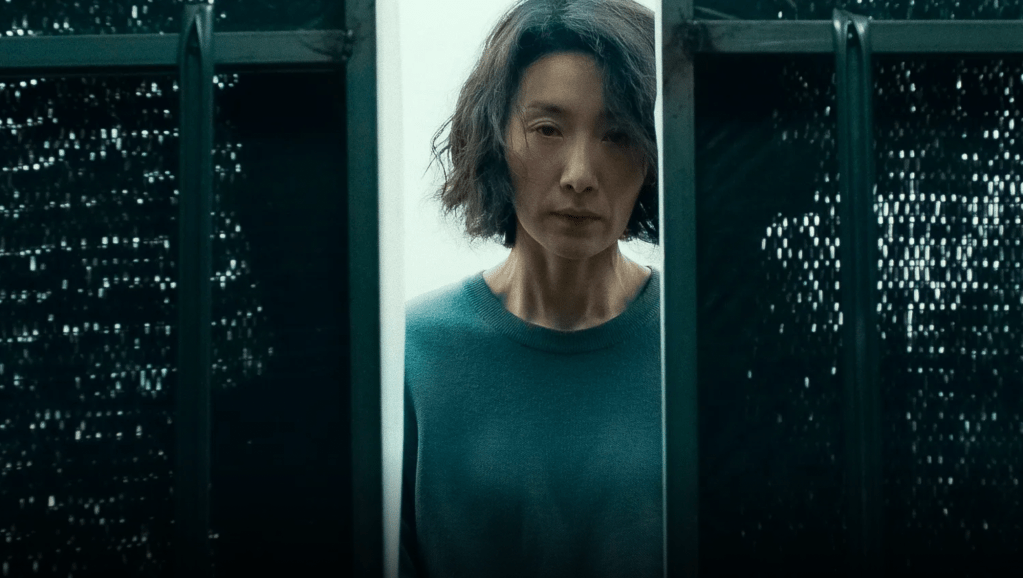
Lee Sol-hui’s film Greenhouse is a domain of sickness. There is illness everywhere, physical, mental, social, degenerative. The only character who appears immune is an elderly doctor (Jeong Jong-joon), who cheerfully smokes as he dispenses his diagnoses, yet he also seems ill-adapted to realising what is going on around him. The greenhouse of the title is the home of Mun-jung (Kim Seo-hyung), a middle-aged carer. She lives in a polytunnel converted for residential use, of the sort familiar from Lee Chang-dong’s Burning, situated on a similar barren plane to the greenhouses in that film. Mun-jung is a self-harmer, given to sudden bouts of slapping herself, even in public, and she takes care of an elderly intellectual couple Tae-gang (Yang Jae-seong), who is blind and Hwa-ok (Shin Yun-sook), senile and given to fits of paranoid violence. Also in her charge is her own mother (Won Mi-won), who is herself drifting off into mental oblivion. She starts to attend a support group, where a young intellectually impaired woman Soon-name (Ahn So-yo) latches onto her, in the hope of finding a escape route from an abusive relationship.
Mu-jung’s teenage son is in a juvenile detention centre for reasons that are never made clear and he is disenchanted with her, saying he prefers to live with his uncle on his release because “I will only remind you of Dad”. The absent father we never see, nor are we told much more about him, but there is a clear implication that the rupture of the relationship has sent both mother and son’s lives spiralling into chaos. Nonetheless, Mu-jung keeps her hopes of a better life alive, gradually accumulating enough of a nest egg to buy a small apartment.
This reticence surrounding Mu-jung’s family breakdown is at odds with the garrulousness of the plot development, particularly in the film’s second half, much to the detriment of a film that starts off promisingly. As the plot’s catastrophe takes hold, Greenhouse begins to straddle two genres—social drama and psychological thriller—as if it can’t decide which one it is more comfortable in. This generic ambivalence would be forgivable if the plotting was a little credible. Unfortunately, there are just too many plot coincidences and contrivances that stretch belief. Likewise, the illness mentioned at the start of this review is handled in a way that leaves an overwhelming feeling of exploitativeness. There is not much sympathy throughout for the predicaments of its characters, which are largely vehicles for the plot. Greenhouse is ultimately a gotcha thriller in the thin gauze of an arthouse film, and it leaves an unusually bad taste in the mouth.
How to cite: Farry, Oliver. “A Domain of Sickness: Lee Sol-hui’s Greenhouse.” Cha: An Asian Literary Journal, 11 Jun. 2024, chajournal.blog/2024/06/11/greenhouse.



Oliver Farry is from Sligo, Ireland. He works as a writer, journalist, translator and photographer. His writing has appeared in The Guardian, The New Statesman, The New Republic, The Irish Times, Winter Papers, The Dublin Review, The Stinging Fly and gorse, among other publications. Visit his website for more information. [All texts by Oliver Farry.] [Oliver Farry and chajournal.blog.]
 Cha
Cha 