
📁 RETURN TO FIRST IMPRESSIONS
📁 RETURN TO CHA REVIEW OF BOOKS AND FILMS
Click HERE to read all entries in Cha on Life Ceremony.
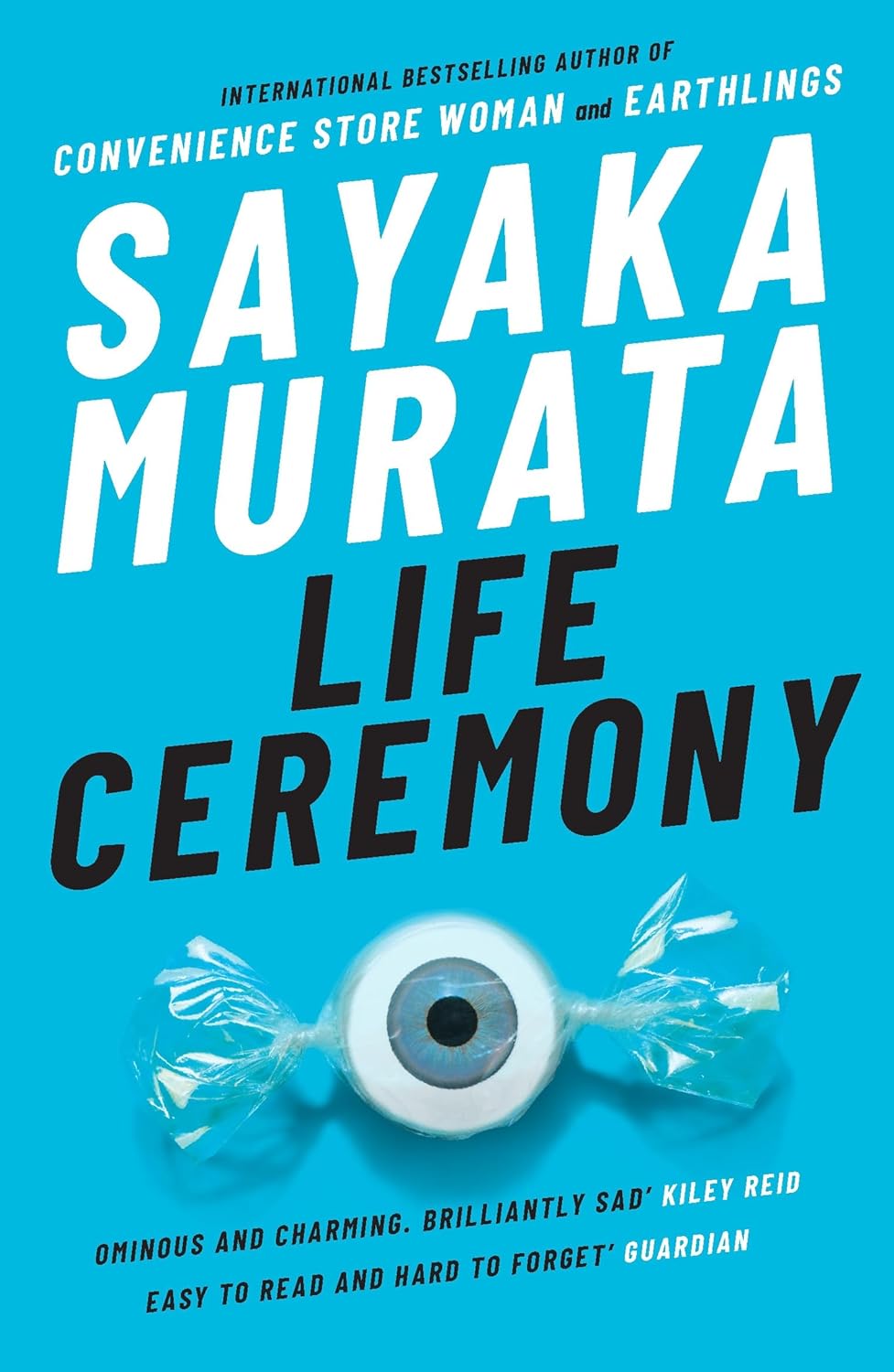
Sayaka Murata (author), Ginny Tapley Takemori (translator), Life Ceremony, Granta Books, 2022. 266 pgs.

Dubbed “Crazy Sayaka” (クレイジー沙耶香) by her readers, Sayaka Murata has enthralled audiences at home and abroad with her mind-bending narratives. Notable among them are Murder-Birth 殺人出産, which depicts a society where one can take another’s life upon the birth of ten individuals, and Earthlings 地球星人, a gripping tale that explores disturbing themes including incest, rape, and cannibalism.
Life Ceremony 生命式, a recently published English translation of Murata’s collection of short stories, brings international readers one step closer to experiencing her quirky charm firsthand. Ginny Tapley Takemori’s translation effectively communicates the mood of Murata’s prose, with some playful choices to represent moments of absurdity and even untranslatability; for instance, she mirrors a monologue originally written solely in hiragana without the facilitatory presence of kanji by translating it into a block of letters without space to conjure up a similar reading experience. These creative decisions not only resonate with the Japanese text but also ensure a smooth immersion of English readers in the storylines. Overall, despite occasional lapses in sophistication compared to the original, the translation is very readable and superbly executed, making it highly recommended for general readers, scholars, and university courses.
Through thirteen tales, with a tone that is hardly distinguishable between wide-eyed innocence and well-seasoned cynicism, Murata’s book navigates core elements of our existence—birth, death, and the everyday in between—in a thrillingly bizarre fashion. The stories are teeming with eccentric characters and surprising twists. From a bride-to-be gifted with a wedding veil made from human skin to a 75-year-old virgin who experiences an unusual first kiss, and even a schoolgirl whose pet is a middle-aged man—these are just a few glimpses into the intriguing world crafted by Sayaka Murata. She delineates vivid slice-of-life stories about odd characters, making them relatable in a refreshing way. As we tap into the intimate details of their lives, we find an avenue towards understanding the so-called weirdos, misfits, and marginal beings in society.
What makes the characters accessible is Murata’s meticulous depiction of their culinary experiences, which feature in nearly every story. As the age-old saying goes, “You are what you eat.” Food consumption mirrors one’s identity. Dietary choices are not solely about taste; our decisions on what to eat and what not to eat result from negotiating social values, beliefs, and meanings attached to food. With an acute awareness of food’s rich connotations, Murata uses it as a semiotic tool to unveil how the characters navigate the weight of societal influences and personal desires.
In “A Magnificent Spread”, a married woman assists her sister, a self-proclaimed superhuman, in showcasing her unearthly diet to her fiancé’s family, while her own meals with her husband, mostly consisting of freeze-dried “space food”, are just as surreal. The meet-and-greet luncheon takes an unexpected turn, resulting in a plethora of wacky concoctions contributed by the individual diners, who eventually decide to stick to their own culinary delights. The story humorously subverts the notion of “a family that eats together, stays together”, promoting a food culture of unflinching idiosyncrasy within the family context, where compromise is too often swallowed as a staple.
Another story that portrays a peculiar way of eating is “Eating the City”, where an office lady, fed up with highly processed food, scavenges wild plants in an urban area, hoping to rekindle her bond with nature. Foraging her way around cigarette butts, empty coffee cans, and dog waste “like an animal,” she gains a renewed vision of the city. Here, food serves as a lens to probe the disconnected lifestyle of urbanites, who have lost touch with their surroundings in a fast-moving and alienating consumer society. As the main protagonist takes on the mission of hunting and gathering in the urban landscape, she breaks free from the monotony of the work-home routine and reclaims a childlike vitality in relishing nature.
The most striking food scene occurs in “Life Ceremony”, the titular centerpiece of the collection, where Murata illustrates a funeral ritual in which participants eat the deceased in a hot pot and then perform inseminations (by opting for the term “inseminations” over more emotionally charged language like “sex”, Murata seems to emphasise the reproductive nature of this process). This ceremony, intended to generate life from death, strips away cultural trappings from the human body, spotlighting it in its rawest form— pure biological, as a vessel for birthing, eating, and dying. The body becomes a piece of public property, consumed communally for its reproductive function and sustenance.
Under Murata’s pen, food is personal, political, and sexual all at once. It is symbolic of how the individual bodies are enmeshed in their societal surroundings. But food is not the only thing that is mesmerising in Life Ceremony. What renders the collection truly captivating is its creation of a parallel universe, where a series of “what-if” scenarios are teased, questioning the politics of normality in our current reality. Within this imaginative realm, Murata ingeniously addresses some of the most provocative issues of our times—late-stage capitalism, urban alienation, female agency, and reproductive rights. Through these themes, she suggests that conforming to societal norms is a kind of madness, and in contrast, embracing a self-centred lifestyle outside of mainstream acceptance might offer a unique remedy for collective insanity.
Murata’s proposition is bold, yet it is delivered in an endearing way. Almost all the stories in Life Ceremony revolve around everyday people, whom readers will find both familiar and compelling. Even the more unconventional narratives, such as one piece told from the perspective of a curtain, unfold in a tone that is resonant and engaging. Murata masterfully paints mundane details, and her descriptions of sounds and smells transport readers to the small corners of Japanese society. Because of the abundant realistic details fed to us throughout the stories, Murata’s crazy world feels so tangible that we might find ourselves pausing to do a reality check: is this not real?
In fact, the seemingly absurd near-future world presented by Murata is not too far off from our own. In “A Magnificent Spread”, the main character’s consistent purchases from “Happy Future Foods” are reminiscent of Soylent, a real company founded by a software engineer who was too busy to eat, which produces time-saving, nutrient-rich meal replacements. And although young urban Japanese may not be rooting around for vegetables like in “Eating the City”, many are retreating from corporate life to adopt a hybrid agricultural lifestyle in rural areas, known as “half-agriculture, half-X (半農半X)”, where they grow their own food and pursue personal hobbies. The issues on reproduction and gender equality in Life Ceremony, of course echo Japan’s contemporary challenges, where Japanese women are increasingly drawn to single lifestyles and “friendships marriage” (友情結婚) devoid of sexual intimacy, while the government diligently devises new initiatives to tackle the plunging fertility rate— perhaps one day, something as horrific as “life ceremony” will be invented out of desperation.
In many ways, Life Ceremony is a feast of whimsical thoughts. The bite-sized stories offer readers delicacies made from the most unexpected ingredients. Interestingly, the feast has a different serving order in its Japanese and English editions; while the former starts with the funeral ritual, the latter begins with a wedding. Both are ceremonies charged with heightened emotions, and readers might enter this feast with entirely different feelings.
How to cite: Wang, Zifei. “Feasting on Futuristic Melancholia: Sayaka Murata’s Life Ceremony.” Cha: An Asian Literary Journal, 7 Jun. 2024, chajournal.blog/2024/06/07/sayaka-murata-life-ceremony.


Zifei Wang is a PhD candidate at the Centre for Asian and Transcultural Studies at Heidelberg University. As a student of literary, film, and cultural studies, her research interests are varied and eclectic, with her recent work focusing on the aesthetics of discomfort.
 Cha
Cha 