
📁 RETURN TO FIRST IMPRESSIONS
📁 RETURN TO CHA REVIEW OF BOOKS AND FILMS
Click HERE to read all entries in Cha on Tongueless.
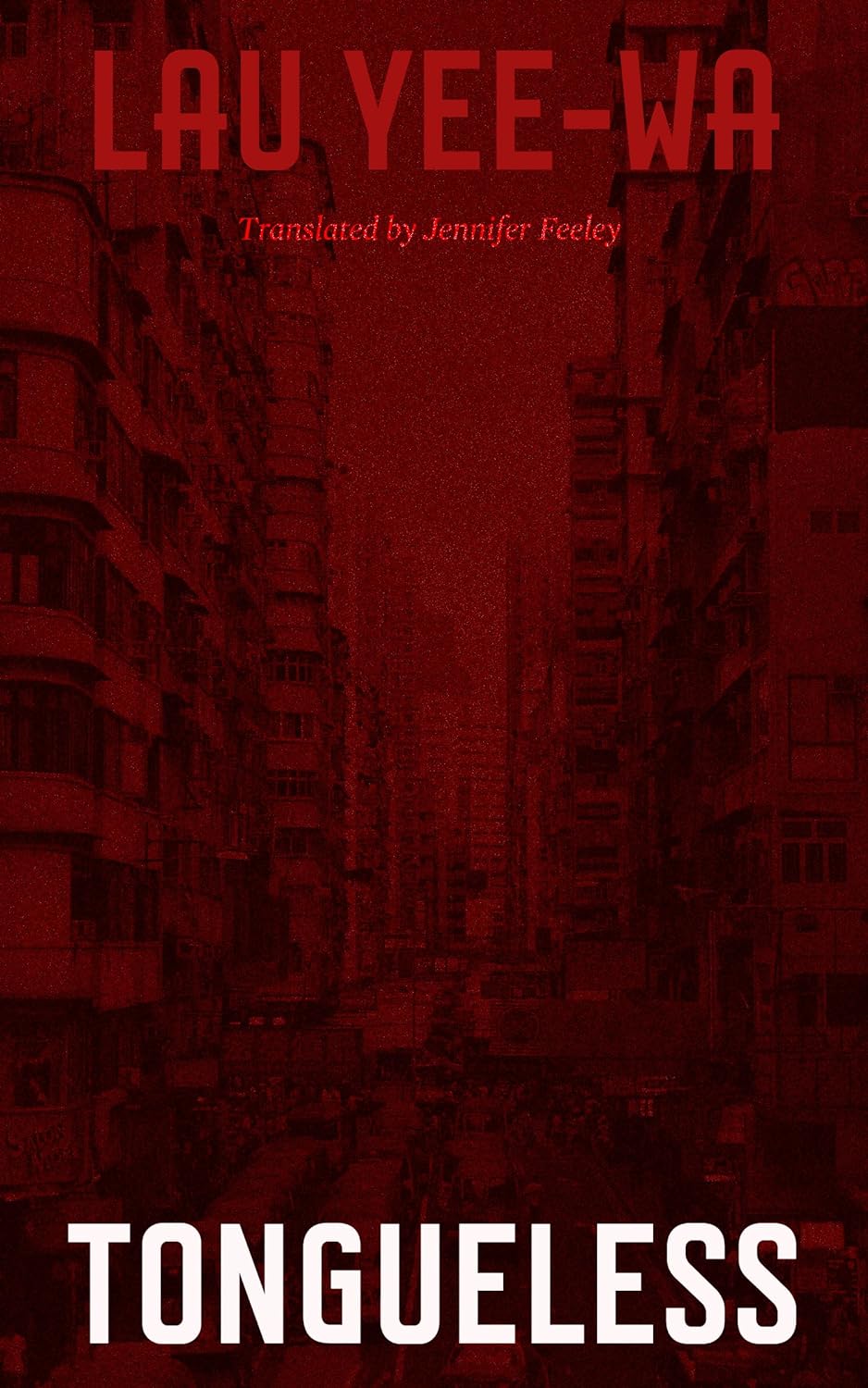
Lau Yee-Wa (author), Jennifer Feeley (translator), Tongueless, The Feminist Press, 2024. 280 pgs.

Wai, the tragic figure at the heart of this rather allegorical novel, and her counterpart, the rather unlikeable Ling, are both equal victims of society and the changes thrust upon them. As school teachers facing the likelihood of teaching Chinese through Mandarin rather than in their native Cantonese, they show their vulnerabilities in different ways.
We are told fairly early on that Wai had taken her own life because of stress, and the story moves backwards and forwards in time, with the focus on Wai in the first part of the novel leading up to her suicide, while the second part focuses on Ling in the second part and the effect Wai’s death had on her. The story is told from Ling’s perspective.
Wai is all surface, eager to master Mandarin, admitting her poor language skills, but trying her best to improve by speaking it at all times, saying to Ling “You can only learn a language well by creating an immersive language environment”, and peppering her workspace with notes in Pinyin to help her pronunciation.
Ling is all hidden, knowing her own Mandarin is poor, but gives the impression that she is adept at it, while emphasising Cantonese as the best Chinese teaching tool, not because it is, or that she really believes it to be so, but because she fears teaching in it.
We see two alternative ways these characters handle the situation through their personalities and how they might deal with change. Wai’s desk is neat to a fault: “What stood out was that the area was extremely neat, the exercise books on the desk arranged by height from tall to short, each angle precisely ninety degrees. Similarly, the pens in the pen holder were categorised by colour: red in front, black and blue in back, resembling a national flag from a distance”. Ling’s, on the other hand was a kind of controlled chaos: “Exercise books were strewn everywhere, the keyboard surrounded by papers, a few red pens tossed on top, the mouse, swallowed up among all the papers, nowhere to be seen.” The desks are a kind of revealing their true ways of handling stress despite outward appearances.
Wai’s is described as a “weirdo” (according to Ling) with a “mushroom head”, a “wide gap between her bangs and eyebrows” and “thick-rimmed glasses”. Unfashionable Wai who wore a “black suit paired with leather shoes similar to the ones worn by schoolgirls” is contrasted with fashion-plate Ling who wears Céline blouses and carries designer handbags.
Ling attempts to help Wai, who sees her as a friend, not realising Ling’s ulterior motive, which is to gain a sense of superiority to make herself feel better. This is also reflected in the transactional relationship between Ling and the other teachers at the school: “Ling got along well with everyone at school. In an office full of women, name brands were a world language.” She sucks up to people by providing information about these brands, fashion advice, and gifts to ingratiate favour with people who might possibly help her.
I used the word “reflected” in the last paragraph intentionally. In rather obvious symbolism, the idea of mirrors metaphorically represents “face” and is a regular motif in the novel. Wai’s desk is also surrounded with all kinds of mirrors all “connected like one mirrored sea” and “even the four sides of the computer screen were besieged by mirrors, leaving only a small rectangular frame. Ling had always wondered: when Wai turned on the computer, what else could she see other than her own image?”—The placement of the mirrors acts as a kind of all-encompassing reminder of her uphill struggle to achieve language fluency.
When Wai fails to get her contract renewed, she is lead down into a depressive spiral. She continues teaching the term out, feeling ostracised by the other teachers through embarrassment and shame; she teaches with her back to the class and speaks to the pupils through a mirror. Wai finally realises that perhaps Ling is not her friend after all, when it finally comes out that Ling had been interviewed by a reporter from the Mango Daily (really!) who had been informed that Ling was a “good friend” of Wai. Her gruesome act of self-harm is livestreamed and is seen to be a result of the stress contract teachers are under due to constant changes in the curriculum, including the medium of instruction. She confronts Ling with a mirror, moving the “mirror in her had to reflect Ling, then swung it back to herself over and over, the mirror continually switching between Ling and Wai. ‘In fact, what’s the difference between me and you?’ Soon, Wai fixed the mirror on Ling. ‘You.’” Although Ling says, “It has nothing to do with me that you can’t renew your contract, nothing to do with me”, she knows it actually does.
Ling takes over Wai’s classes and encounters problem student Tsui Siu-hin, who is threatened with suspension for being disrespectful and unruly in class, and who says to her during an interview with his adoptive parents: “I don’t need you adults to define my future!” You could read this as “adults” being the authorities who tell Hongkongers what they have to do, without having any choice in the matter.
The novel is a critique of forced change, lack of actual choice and a focus on increasing integration with the mainland. I also felt sorry for the mainland woman, a sex worker, and her child who lives in one of Ling’s mother’s sub-divided flats (an ex-hawker, Ling’s mother had pulled herself out of poverty), who has no choice but to accept discrimination by local Hongkongers and exploitation by people like her landlady. Ling’s mother represents embracing change for utilitarian reasons: “There’s no choice. The mainland has money now, and we have to align ourselves them no matter what,” she says. This is also the case with the School Principal’s Association attitude to hiring mainland teachers and to school development schemes through mainland contacts.
Ultimately though, Wai’s dramatic act of self-extermination changes Ling’s life: “She felt as though Wai’s words and actions were enshrouding her like a fog. All she saw was a vast expanse of white, without a starting or ending point.” Ling goes to a face-reading expert to see if she can know the future and how to handle it. Master Chan the face-reader seems to be a realist and says in sermon-style, “If a person understands themselves clearly, then there’s no need to come in for a face reading. Face reading is a process of understanding yourself. However, I can only provide general guidance. Your life is ultimately in your own hands.” But is it, Ling asks herself. We can all ask that too.
Ling contemplates this further as she walks about Mong Kok and hears singing, when the word “freedom” from a song comes into focus. She hasn’t had time to put on her make-up when she goes out and “didn’t want anyone seeing her face”, saying to herself that “some people said that make-up meant you weren’t confident in your own bare face, and one day, when people saw your real face, it would be like exposing the lie of the century”. By the novel, perhaps Ling is starting to realise she has been living a lie and deluding herself.
At the beginning of this review, I called it a “rather allegorical novel” without explanation. To me, as a long-term resident of Hong Kong, this story is clearly allegorical in a rather obvious way to us who live here. Ling and Wai are opposites but similar; Tsui Sin-hin represents what Hong Kong people really want, plainly spoken, which is a choice; and Master Chan is a vehicle to articulate clearly how choices can let us make the best out of a poor situation, or at least how to handle it better. And well, the Mango Daily is really analogous to a certain extinct fruit-named newspaper.
Since this novel is about, I suppose “language hegemony”, let’s talk about how it is handled by the translator. Wai’s poor Mandarin is rendered into stuttering English and mispronounced words. This is the only way that this could be handled by the translator, obviously, although it still sounds a bit odd to me, however.
Ling tells Wai she is not used to speaking in Mandarin. Wai replies, “Then I’ll just speak it and you can speak in Cantonese.” This happens a lot in Hong Kong, and I have witnessed it myself. This is what is called “non-accommodating bilingualism” in which people speak to each other in their own language in a group situation, while understanding what is said in the other. This allows people to avoid the divisive issue of language choice, although languages are not always “balanced” in this situation. But, I wonder, is this is totally a bad thing if communication is still happening?
Ling’s agreement, reluctantly given, being persuaded into being interviewed by the Mango Daily reporter after Wai’s suicide as it will remind readers that Wai’s death “of the absurdity of the educational system”, and this would “at least raise the issue and put pressure on the government”.
All that takes place in the novel is rather obvious to me as a long-term Hongkonger, albeit one with poor Cantonese and somewhat better Mandarin, but would it be to those unfamiliar with Hong Kong’s situation without the translator’s explanatory afterword? Would they “get” Hong Kong’s stressful situation? As a novel in translation, I would be interested to see reactions to it to readers of the original Chinese. In any case, it has the “ring of truth” to it, although at times the message is clearly obvious, and perhaps too “neat” in its symbolism.
How to cite: Eagleton, Jennifer. “A Rather Allegorical Novel: Lau Yee-Wa’s Tongueless.” Cha: An Asian Literary Journal, 1 Jun. 2024, chajournal.blog/2024/06/01/tongueless.


Jennifer Eagleton, a Hong Kong resident since October 1997, is a close observer of Hong Kong society and politics. Jennifer has written for Hong Kong Free Press, Mekong Review, and Education about Asia. Her first book is Discursive Change in Hong Kong (Rowman & Littlefield, 2022) and she is currently writing another book on Hong Kong political discourse for Palgrave MacMillan. Her poetry has appeared in Voice & Verse Poetry Magazine, People, Pandemic & ####### (Verve Poetry Press, 2020), and Making Space: A Collection of Writing and Art (Cart Noodles Press, 2023). A past president of the Hong Kong Women in Publishing Society, Jennifer teaches and researches part-time at a number of universities in Hong Kong. [All contributions by Jennifer Eagleton.]
 Cha
Cha 