
📁 RETURN TO FIRST IMPRESSIONS
📁 RETURN TO CHA REVIEW OF BOOKS AND FILMS
Makoto Shinkai and Naruki Nagakawa (authors), Ginny Tapley Takemori (translator), She and Her Cat, Washington Square Press, 2024. 144 pgs.
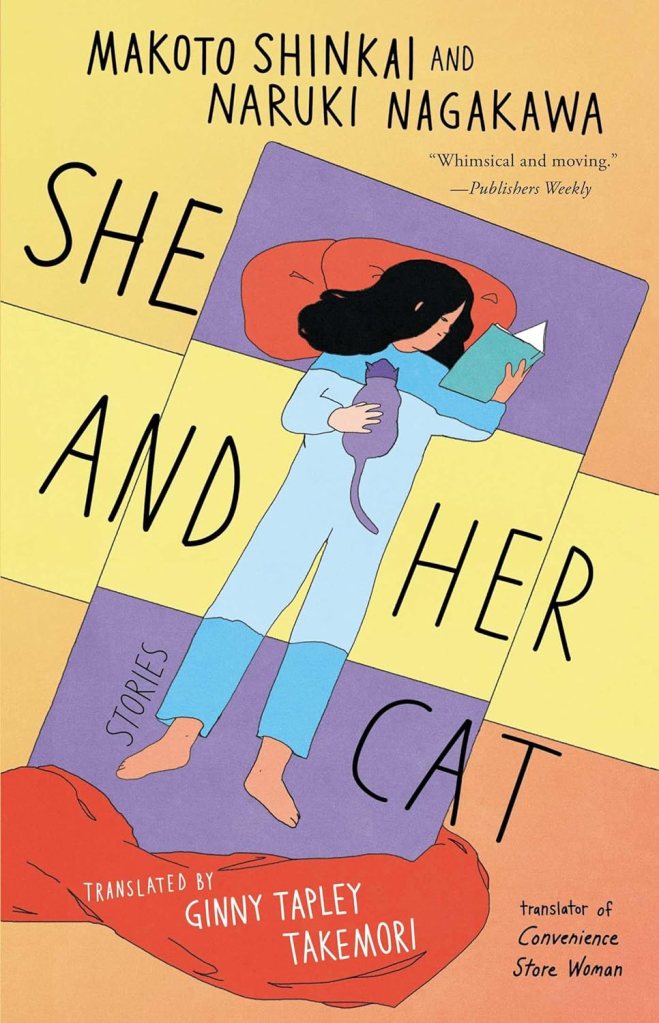
As a reader, I’d never thought that I’d be again so engrossed in a story centred in part on the life of an animal after American author Jack London’s novel White Fang. But Makoto Shinkai and Naruki Nagakawa’s novel in stories, She and Her Cat, translated into English by Ginny Tapley Takemori, enthralled me.
She and Her Cat follows the lives of multiple cats and their owners and carers from different ages and with distinct occupations, living in the same neighbourhoods and interconnected or become interconnected through work, friendships, family relationships, and chance encounters. From a woman who is stranded in a relationship with a man whose nature is unclear to a student in the arts who doesn’t know the right way to find success in her profession, and from a young woman who falls into depression because of guilt over the death of her best friend to an old woman who must find a way to enjoy her life and care for herself after she has spent most of her life caring for others, the different stories of these characters alongside their cats explore the themes of loneliness, mental illness, coming of age and becoming old with thoughtfulness and ingenuity.
The different characters in the novel are gripping. Though they are all almost well-off financially and skilled in what they do, they seem to struggle emotionally with themselves and with the people close to them. That’s where the cats that enter their lives intervene. They seem uniquely possessive of more empathy and understanding of their owners, even if capable of little to uplift them and help them out of their struggles. So, still, Chobi, Kuro, Mimi and Cookie try to help their owners Miyu, Reina, Shino and Aoi to open up, face their fears, live their own lives fully and be happy, and succeed. Indeed, the cats may not be as able as the humans in the novel but have shrewd observation of the world around them and the little grasp they have of it is good. And they seek action when faced with a problem like Cookie, who wanted and sought answers for Aoi’s case “It’s about Aoi. I’m her cat, and I want to know how she can get well again.”
And maybe that’s what humans in real life should be and do too, have more empathy towards each other, and should be more like the cats, to follow their instincts instead of fixating on the problems without pouncing on them to solve them. This idea might not be far-fetched, given that Makoto Shinkai, also a famous and successful filmmaker, came up with the story, which he made into a very short animation video of a cat and her young female owner from the perspective of the animal and released it in 1999, as a way of consoling a girlfriend who happened to be going through some emotional difficulties at the time.
The ingenuity with which the story was told back then, and which was also adapted into an animation series and a manga, was transferred into the novel, as well. She and Her Cat, originally written and published in Japanese in 2013, uses a simple language to tell stories that focus on the inner lives of its characters, a contrast which emphasises the complex nature of life even further, especially since the cats are also given an inner life filled with their own thoughts and feelings. And in using multiple perspectives, the writers also made the human and animal characters equally more relatable.
But though the characters seem to have found a way out of their struggles with the help of their loving cats, the question of why they’d found themselves having them remain. The novel touches on the answer, which is communication or rather, the lack of it, but doesn’t delve deeply into it. Like why did Miyu have this struggle in communicating her true feelings in a romantic relationship? Though she explains that to be a part of her personality traits from the beginning: “Certainly, I felt more comfortable working with documents than with people. I was not a good communicator and would find myself running out of things to say almost immediately”, the reasons behind her being a bad communicator were left unanswered. And they couldn’t be natural as later she finds the power to utter the words held inside her for a long time. The exception being Aoi, who suffers from depression after the death of her best friend, but even her depression, caused by a lack of communication between the two in the first place in spite of their long-time friendship. In contrast, the cats, while limited in the ways they can communicate and understand the world, don’t struggle to communicate with each other, with their owners and even with their canine friend, making their presence in the lives of their owners much needed.
Though Makoto Shinkai had the idea for the original story in the late 90s, the themes explored are ever universally relevant today. Even within a highly and increasingly connected world through tech, feelings of loneliness and mental issues are still common. And while the characters in She and Her Cat found a way out through the companionship of a cat, which may not be what everyone who suffer with these issues may want, it still means there is hope and it’s up to each to find their way of their struggles, and just need some willingness to explore the fitting way or ways.
How to cite: Haddad, Saliha. “Universally Relevant Today: Makoto Shinkai and Naruki Nagakawa’s She and Her Cat.” Cha: An Asian Literary Journal, 23 Apr. 2024, chajournal.blog/2024/04/23/her-cat.



Saliha Haddad is an Algerian writer and an editor. Her work has appeared in The New Arab, The Markaz Review, Newlines Magazine and The Isele Review. She is also a literary interviewer for Africa In Dialogue.
 Cha
Cha 