
📁 RETURN TO FIRST IMPRESSIONS
📁 RETURN TO CHA REVIEW OF BOOKS AND FILMS
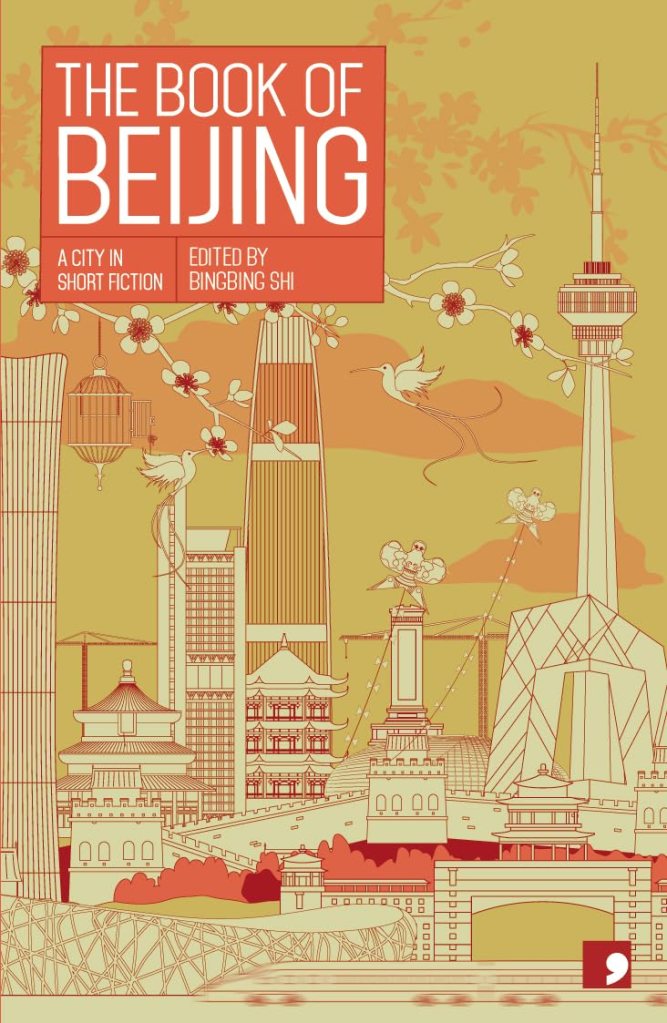
Bingbing Shi (editor), Fu Xiuying (author, tr. Christopher MacDonald), Xu Zechen (author, tr. Eric Abrahamsen), Xu Kun (author, tr. Katherine Tse), Qiu Huadong (author, tr. Paul Harris), Gu Shi (author, tr. Florence Taylor), Wen Zhen (author, tr. Jack Hargreaves), Shi Yifeng (author, tr. Hongyu Jasmine Zhu), Ning Ken (author, tr. Alison Sharpless), Yu Wenling (author, tr. Helen Wang), Han Song (author, tr. Carson Ramsdell), The Book of Beijing, Comma Press, 2023. 208 pgs.
Two years in, he’d grown fond of the city. It was a great fucking place. It had everything you could need; you ran into foreigners on any street; the girls were pretty even without makeup; and your heart beat faster just knowing you lived in the same town as all those TV stars. Their old hometown couldn’t begin to compare. It was the capital, after all.
So thinks the protagonist of Xu Zechen’s 徐则臣 “Secretly” 暗地 (2007), a grifter striving for a foothold in Beijing’s underground economy. He hustles counterfeit licences, diplomas, and passports, and loves Beijing despite his illicit status.
In ten stories, The Book of Beijing visits a jam-packed subway, a football stadium, an after-hours art gallery, hutongs of the Cultural Revolution era, and a levitating train station. We meet a host of characters: a schoolteacher, hawkers of fake IDs, a reformed prostitute, a fast-talking realtor, and a yellow cat. Few of the characters appear comfortable, and their struggles reveal an often-troubled embrace of the city.
The Book of Beijing is one of 28 volumes (and counting) in the “Reading the City” series from Comma Press, a UK publisher of short story anthologies. The volumes “offer diverse and conflicting impressions of the cities”, including Leeds and Liverpool, Rio and Havana, Cairo and Khartoum, Riga and Tbilisi.
The heterogeneous stories range from urban realism to the fantastical and sci-fi. Fu Xiuying’s 付秀莹 “On the Subway” 地铁上 (2021) follows a commuter at rush hour along subway line No. 5, from its densely populated northern terminus to the Lantern Market station in the city centre. Windows figure prominently, both as portals to the outside and mirrors reflecting passengers within.
Two stories feature the centre city’s gritty flats and glitzy skyscrapers. In Yu Wenling’s 于文舲 “Second Ring Road” 二环里 (2023), a young professional searches for a flat in one of Beijing’s tightest real-estate markets. She wants to profit from her residency permit—a benefit of her job at a state enterprise in the central Dongcheng district. Gu Shi’s 顾适 “The MagiMirror Algorithm” 魔镜算法 (2022) brings together tenants of a 300-unit high-rise overlooking the iconic CCTV building and the Lize Financial Business District. The story’s sci-fi dimension highlights technology that allows users to read the thoughts of others.
Several stories address Beijing’s relations to overseas cultures. In “Secretly”, one character has a nest egg they earned as a Chinese expat worker in the United Arab Emirates. In Xu Kun’s 徐坤 “Dogshit Football” 狗日的足球 (1996), a credulous young woman is star-struck by Argentina’s biggest football star. When he comes to Beijing’s Workers’ Stadium to play, her infatuation turns to humiliation as she is surrounded by rabid misogynistic fans. Disillusionment also haunts Wen Zhen’s 文珍 “Date at the Art Gallery” 我们夜里在美术馆谈恋爱 (2012). The story surveys Beijing’s sites, districts, and symbols through the reminiscences of a jaded young woman before she moves to New York. As she reflects on Tiananmen and lost ideals, her disenchantment with Beijing contrasts with her fantasies of New York.
The mind reading devices of “MagiMirror Algorithm” menace an otherwise contemporary setting. Much darker is the dystopian future of Han Song’s 韩松 sci-fi “Reunion”, originally titled 《北京西站醒了,它想去香港》 “Beijing West Station has woken up. It wants to go to Hong Kong” (2018). Han casts the train station as a sentient organism, a voracious AI monster expanding ever outward. The high-tech fantasy only thinly camouflages the story’s implicit critique of China’s pervasive surveillance state.
Fantastical elements also figure in Qiu Huadong’s 邱华栋 ghoulish “Glass River” 里面全是玻璃的河 (2006). The protagonist, fishing outside the city centre, notices what looks like a dead baby discarded in the river. He confirms that it is but, indifferent, keeps fishing. When he returns to his pregnant wife, her revulsion at his callousness sends her to the hospital, nauseated. He’s clueless—“What more could I have done?” Was it a baby, or a phantasm?
Shi Yifeng’s 石一枫 “Is Mr Zhang Home” 张先生在家么 (2006) recalls classic horror movie tropes. A young couple sneaks back into an apartment in an abandoned military compound. Unnerved by the dark shadows and the eerie sounds of the wind, they imagine “headless bodies moving”. Originally perceived as a spectre with no face, a young boy knocks three times to ask after a Mr Zhang. Finally, the narrator walks the boy home, perhaps to become a figment in the boy’s memory.
The volume’s most heart-warming story takes us to the back alleys of Beijing’s hutongs during the Cultural Revolution. In Ning Ken’s 宁肯 “Blue Peony” 蓝牡丹 (2021) ten-year-old Little Yong must fend for himself after his older siblings are sent down to rural labour. When he’s caught shoplifting lamb bones, the butcher deems him a petty thief, but a kindly employee discovers that he’s alone and well-intentioned. He’s just trying to feed his cat Big Yellow.
The volume showcases ten important writers and ten assured translators. The stories’ disparate subjects and styles render a quirky composite portrait of Beijing. Readers seeking unflinching views of this complex megacity will be well rewarded.
How to cite: Knight, Sabina. “A Quirky Composite Portrait: The Book of Beijing.” Cha: An Asian Literary Journal, 10 Apr. 2024, chajournal.blog/2024/04/10/book-of-beijing.


Sabina Knight 桑稟華 is author of Chinese Literature: A Very Short Introduction (2012, translated into three languages) and The Heart of Time: Moral Agency in Twentieth-Century Chinese Fiction (2006). She is Professor of Chinese and World Literatures at Smith College. Her current projects consider the politics of translation, non-Han literatures, and media of dissent. Photo of Sabina Knight by Wilson Chao. [All contributions by Sabina Knight.]
 Cha
Cha 