

📁 RETURN TO FIRST IMPRESSIONS
📁 RETURN TO CHA REVIEW OF BOOKS AND FILMS
Click HERE to read all entries in Cha on Perfect Days.
Wim Wenders (director), Perfect Days, 2023. 123 min.

Wim Wenders is not alone among Western filmmakers in having a fascination with Japan but there are few others who have spun that fascination into a series of films. The first two were documentaries: the 1985 film Tokyo-Ga, ostensibly a tribute to Wenders’s idol Yasujirō Ozu but also an engaging travelogue, and also Notebooks on Cities and Clothes (1989), a portrait of the fashion designer Yohji Yamamoto. The German’s third foray into Japan is his first attempt at fiction, Perfect Days, which has been his most commercially successful film in over two decades and has garnered a nomination for Best International Film at the Academy Awards and a Best Actor award at Cannes for Kōji Yakusho.
The change of scenery seems to have done Wenders the world of good, as Perfect Days is his most accomplished fiction film in decades. Once one of the undisputed masters of Western arthouse cinema, Wenders’s fiction output has been indifferent at best since the early 90s, with his better films in that time almost exclusively documentaries—invariably portraits of artists such as Pina Bausch, Sebastião Salgado and, most recently, Anselm Kiefer. It is not insignificant that the exploration of process that is so evident in those documentaries contributes to making Perfect Days such a winning film.
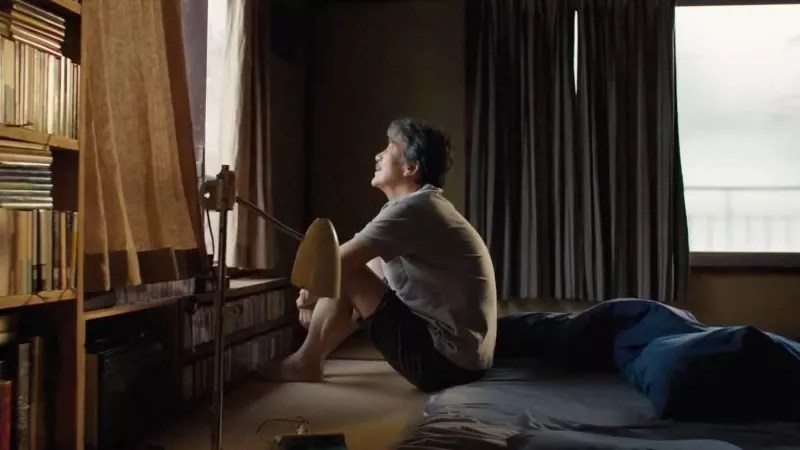
Hirayama, a solitary but seemingly contented cleaner of Tokyo’s public toilets
Yakusho, a veteran actor probably best known outside Japan for his lead roles in Shohei Imamura’s The Eel and Alejandro González Iñarritu’s Babel, plays Hirayama, a solitary but seemingly contented cleaner of Tokyo’s public toilets. The film portrays Hirayama’s daily routine, initially with few deviations. He gets up, showers, and drives from his diminutive suburban home to his various places of work around Shibuya, painstakingly cleaning toilets in silence, stopping to eat a 7-Eleven sandwich at lunchtime, before clocking off for the evening and cycling to his local ramen bar for dinner. At bedtime, lying on his tatami he reads under a small lamp—his taste in American fiction suspiciously similar to Wenders’s own (William Faulkner, Patricia Highsmith), and also the essays of Aya Kōda. On his travels, Hirayama listens to cassettes of favourite rock songs from his youth (again, similar to Wenders’s own—The Kinks, Patti Smith, and Lou Reed, whence the film’s title).
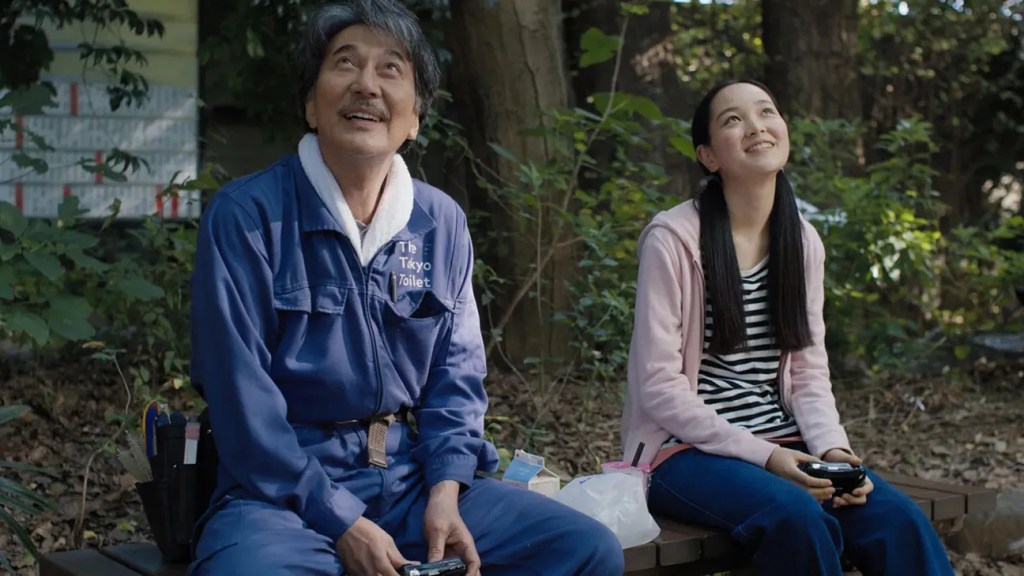
The routine is disturbed by the arrival of his teenage niece
The routine is disturbed by the arrival of his teenage niece Niko (Arisa Nakano), whom he has not seen in years, and who appears to have run away from home. He reluctantly humours her for a couple of days before realising that it is not a situation that can endure for long.
The quiet portrayal of routine and repetition inevitably draws comparison with Ozu but also with Wenders’s own great early films, such as The Goalkeeper’s Fear of the Penalty (1972), Alice in the Cities (1974),and Kings of the Road (1976), works whose wistful lyrical languidness Wenders has struggled badly to reproduce over the past three decades. The scenes where Hirayama drives through Tokyo are reminiscent of the point-of-view travels through the Ruhr Valley in Alice, and also the journey along the Wuppertal Schwebebahn in Pina. It is as if decades later, the hereditary cinematic memory has been reanimated in Wenders’s work.
Setting a film in Japan is, of course, fraught with risk, with the danger of overexoticising the country through Western eyes. But though Wenders relishes portraying the wonders of the Tokyo Toilet project, particularly Shigeru Ban’s transparent toilets, he also commendably avoids orientalising his subject. Hirayama might be a conscientious worker who takes pride in his humble trade but it is never suggested he is representative of Japan in this respect—his garrulous young assistant Takashi (Tokio Emoto) is as lazy and feckless as youths from anywhere else in the world, and Hirayama’s humble job is not shown to be especially esteemed in society. Other directors might have reached for a clumsy essentialism—no doubt illustrated with a mystic Japanese expression that translates to something completely mundane. Wenders’s view of Tokyo is neither wide-eyed nor complacent.
Of course, this view is necessarily mediated for a foreign filmmaker through a lifetime of watching Japanese cinema, as was the case with Abbas Kiarostami’s Like Someone in Love (2012). As with that film, there will be elements in Perfect Days that locals find jarring. For me, one telling sign it was not the work of a Japanese, or even Asian, director was the cursory place afforded food throughout. While eating is shown as part of Hirayama’s routine, there is little curiosity shown about what he is eating. We don’t see the ramen he eats, and there are no scenes of food preparation (the sole occasion we see Hirayama make food at home is when he dredges up an expired cup noodle to eat late night). Perfect Days is very much a Western film in its portrayal of food—American and European films rarely have the same organic integration of cooking and eating, or the same ease with cuisine, that films from across East Asia do. Still, this is a minor blemish, and maybe even a salutary flaw, for what is one of the most successful efforts by a Western director at putting Japan on screen.
How to cite: Farry, Oliver. “Clean Work: Wim Wenders’s Perfect Days.” Cha: An Asian Literary Journal, 21 Mar. 2024, chajournal.blog/2024/03/21/perfect-days.



Oliver Farry is from Sligo, Ireland. He works as a writer, journalist, translator and photographer. His writing has appeared in The Guardian, The New Statesman, The New Republic, The Irish Times, Winter Papers, The Dublin Review, The Stinging Fly and gorse, among other publications. Visit his website for more information. [All texts by Oliver Farry.] [Oliver Farry and chajournal.blog.]
 Cha
Cha 