
📁 RETURN TO FIRST IMPRESSIONS
📁 RETURN TO CHA REVIEW OF BOOKS AND FILMS
Click HERE to read all entries in Cha on People from My Neighbourhood.
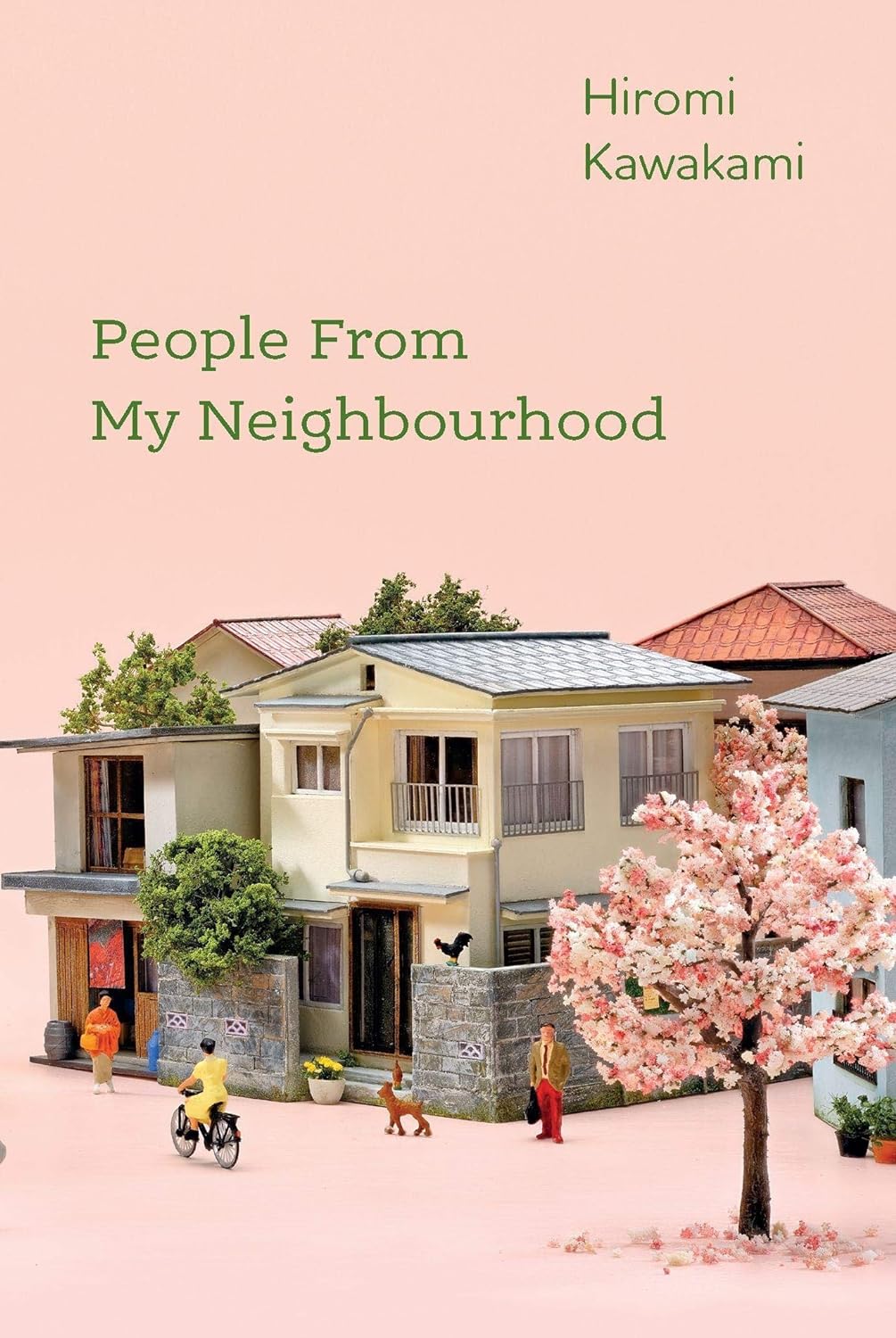
Hiromi Kawakami (author), Ted Goossen (translator), People from My Neighbourhood, Granta Books, 2021. 96 pgs.

The interconnected stories in Hiromi Kawakami’s People From My Neighbourhood have left me with a sense of buoyancy. The neighbourhood in this book is a lovingly reconstructed landscape, where everything seems eerily sentient, even the buildings. It is a small but expansive world, fluid and askew, more than big enough for the book’s narrator, and for a reader like me.
I continue to have the unsettling feeling that the words between the covers of this book float about, visiting other pages to gossip and compare accounts of events they describe. If I suddenly reopened the book, would I glimpse a blur, or hear a slight windy whispering, as those words rushed back to their prescribed places? I honestly wouldn’t be surprised if even the physical book had a mind of its own!
Composed of 36 short tales, People From My Neighbourhood is a compilation that is cross-culturally humorous, darkly magical, and acutely sensitive to the interior lives of ordinary Japanese people. At only 121 pages, it is possible to read it in one sitting or sample and savour it over time. The stories are connected and arranged in the author’s approved order, yet that order inspired me to see alternative ones. These collected stories are more recollective summonses than a sequence, reconstructing a place the way a child memorialises her interpretation of her childhood environment. Kawakami’s stories preserve this kind of mutability of memory, present the holes and silences it contains, and they are comfortable leaving narrative inconsistencies unexplained. I’m glad for the time-travelling twists and turns, the disappearances and resurrections, and the shifts in affliction and affection this book possesses.
There is something powerfully endearing in stories constructed on narrative fault lines. In Kawakami’s neighbourhood, things are perpetually shifting, ghosts come and go, and even the elements have something to say about what is happening above, below, and within them. The stories unfold before us without any self-conscious esotericism, told in the voice and clear language of their Tokyo neighbourhood’s extraordinarily ordinary narrator. Extraordinarily ordinary? Yes, I meant that. Lives overlooked often contain multitudes.
In “Chicken Hell”, an old one-eyed man from a once prominent agricultural family now raises a few goats and chickens in his small suburban backyard. He scares a young female neighbour with a well-told Kamakura-era tale of a demon-avenging chicken, all the while displaying oddly selfish, bullying behaviour toward his birds. He too vanishes, his house and animals replaced by a bland white building, but the narrator reanimates him for us, still a colourfully important legacy from her childhood.
“The Love” is a masterfully drawn story of a place and a woman, both as constant and as fickle, as the neighbourhood bar’s namesake. The Love recurs throughout the book, a kind of touchstone of the familiar, enduring the temblors and tragedies of changing lives, and the inevitable passage of time.
Kanae, the rebellious local teenager at the heart of “The Juvenile Delinquent”, manages to remain the focus of neighbourhood gossip for years. This endurance offers us a glimpse of many Kanaes, as a young girl becomes a young woman. The reader is aware that Kanae’s transformations are mirrored but not reproduced in the innuendoes surrounding her and, perhaps like the narrator’s impressions, just as unreliably imaginative.
The no-gravity alert and occurrence in “Weightlessness”made me recall the earthquake and tsunami alerts I experienced in Japan and the tornado alerts and disasters I experienced as a child. Is weightlessness a parable for our times, full of climatic changes and warnings? The children in this story adapt, as children often try to do, to an environment beyond their control. The elements, in this case, a forest, seem to support them in this.
What is the entity in “The White Dove”? Animal, vegetable, mineral, alien, god, or ectoplasm? I haven’t a clue, and I like it that way. I love how its mysterious appearance, shape-shifting, and eventual disappearance are integrated into the life of a resident of the neighbourhood, known here only as Kanae’s sister.
In the final story of the collection, “The Empress”, the owner of “The Love” reappears, along with a now familiar cast of named and unnamed characters. There are so many wishes and dreams embodied in this story. Yet all are expressed simply, even mundanely. Who doesn’t imagine a life where what they did, how they looked would make meaningful changes in themselves and their world, somehow make them special, important, happy?
Much of the mystery, magic, and humour in this collection respects connections and reveals the extraordinary richness of our association with place and people. There is so much wonder contained in our worlds within worlds, so many desires embodied in the small pieces of history we inhabit and imagine. I wonder how often I may have passed this neighbourhood, or one not unlike it, as I rambled about enclaves in Tokyo.
A final note, with much gratitude, must be given here to Ted Goossen, the translator. It’s Goossen’s years-long sensitive work that has, to me, captured in English the masterful simplicity, subtlety, and ebullience of Kawakami’s writing. He continues to translate Hiromi Kawakami’s stories. I urge readers to discover more of her work, and his translations, as well as other new Japanese writing here.
How to cite: McDonald, Marsha. “Extraordinarily ordinary?: Hiromi Kawakami’s People from My Neighbourhood.” Cha: An Asian Literary Journal, 15 Mar. 2024, chajournal.blog/2024/03/15/neighbourhood-people.


Marsha McDonald lives in Vilar de Andorinho, Portugal. An artist and writer, she works and exhibits between North America, Europe, and Asia. She has received grants from the Pollock-Krasner, Puffin, Mary Nohl (travel), Lynden Sculpture Garden, Gallery 224 Artservancy (artist working within conserved land in Wisconsin USA), and a New York Fellowship. Her writing has appeared in Otoliths (Australia), The Drum and The Cantabrigian (Cambridge MA), Voice & Verse Poetry Magazine, Cha (Hong Kong), and La Piccioleta Barca (Milan). She has collaborated with artists and writers in the UK, France, Spain, Germany, Portugal, North America, and Japan. In 2024, she will be an arts resident at the Tyrone Guthrie Centre in Ireland and Studio Kura in Kyushu, Japan. Visit her website for more information. [All contributions by Marsha McDonald.]
 Cha
Cha 