

茶 FIRST IMPRESSIONS
茶 REVIEW OF BOOKS & FILMS
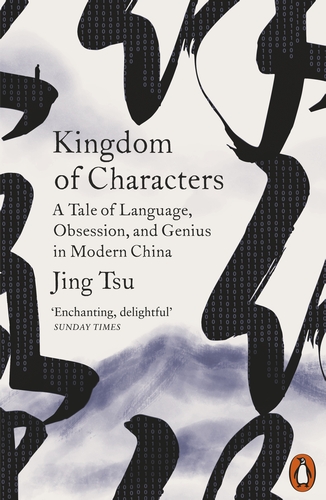
[FIRST IMPRESSIONS] “History As Written by the Successful Underdogs: Jing Tsu’s Kingdom of Characters” by Kevin McGeary
Jing Tsu, Kingdom of Characters, Riverhead Books, 2023. 336 pgs.
The earliest known empire is the Sumerian. It is also the first civilisation known to have written down numbers. Numbers were essential for controlling crops, herds, and people. In other ancient cultures, writing may not have emerged for the same reasons. French linguist Claude Hagège has claimed: “The origin of Chinese writing appears to have been magico-religious and divinatory rather than mercantile.”
A culture’s relationship with language could reflect something about its brain development. Japanese priest of Zen Buddhism Sōiku Shigematsu said that “a word is a finger that points at the moon. The goal of Zen pupils is the moon itself, not the pointing finger”.
In The Master and His Emissary, author and psychiatrist Iain McGilchrist cites a study that found whereas Americans prefer proverbs that are unambiguous, Chinese subjects tend to like proverbs that present an apparent contradiction, e.g., 过分的谦虚就是骄傲 “excessive modesty is a form of arrogance”. Maybe the language is too complex for a world that is addicted to convenience.
Kingdom of Characters: A Tale of Language, Obsession, and Genius in Modern China by Jing Tsu is a history of how China’s official language overcame the odds to enter the modern world. It begins like a mystery novel, describing Wang Zhao, who in 1900 sneaked into China disguised as a monk. Wang Zhao was risking his life by trying to pioneer a romanised writing system for Chinese.
To put this into context, in Chapter 1 “A Mandarin in Revolution”, Jing points out that during the late nineteenth century, ancient civilisations like Persia, Egypt, and India were collapsing under Europe’s rise. Telegraphy was a particularly game-changing technology. In 1866 the first transatlantic telegraph cable was laid, spanning almost 3,000 kilometres from Ireland to Newfoundland. This meant that breaking news, stock prices, and military directives now took just seventeen hours to cross the Atlantic, as opposed to ten days by steamer.
The promoters of telegraphy promised that it would usher in a new era of open exchange and peaceful collaboration. However, this brave new world was facilitated by Morse code, a system that only worked with languages that used the Roman alphabet. The philosopher G.W.F. Hegel had dismissed written Chinese as “a great hindrance for the development of the science”’.
Wang Zhao showed a courage similar to William Tyndale, whose translations of the Bible into English got him burned at the stake. Other key players whose stories Jing Tsu delves into include Wang Jingchun, who, as a technical expert at the Versailles Conference in 1919, had a front-row seat to China’s betrayal when Shandong province was taken from Germany and given to Japan.
The writing is never less than compelling, as it gives overviews of the lives and contributions of such extraordinary figures as inventor, novelist and philosopher Lin Yutang who recognised the Chinese script’s ability to self-organise, and Zhou Youguang, who is credited more than anyone else for inventing pinyin, a romanisation which is now the most commonly used way of typing Chinese.
The book concludes with the argument that every technology that has ever confronted or challenged the Chinese writing system has eventually had to bow before it. Jing Tsu even cites the way dissidents use homonyms to get around censors as an example of how fluid the language is.
As well as being a genuine page-turner like Melvyn Bragg’s The Adventure of English, Jing Tsu’s book shows a profound recognition of the relationship between language and power. At one point she digresses to mention how the Soviet Union introduced writing systems to Central Asia while staying mindful of the possibility of a pan-Islamic uprising.
Since the earliest Chinese characters were pictographs, and an extraordinary amount of the language’s script has survived the millennia, written Chinese is a window into an ancient civilisation. For the same reason, the language wears its etymology on its sleeve, and will no doubt show resilience as it survives into the future.
How to cite: McGeary, Kevin. “History As Written by the Successful Underdogs: Jing Tsu’s Kingdom of Characters.” Cha: An Asian Literary Journal, 2 Mar. 2024, chajournal.com/2024/03/02/characters.


Kevin McGeary is a translator, Mandarin tutor and author. His short story collection The Naked Wedding was published in 2021. He is also a singer-songwriter who has written two albums of Chinese-language songs. [All contributions by Kevin McGeary.]
 Cha
Cha 