

📁 RETURN TO FIRST IMPRESSIONS
📁 RETURN TO CHA REVIEW OF BOOKS AND FILMS
Click HERE to read all entries in Cha on Touring the Land of the Dead.
Maki Kashimada (author), Haydn Trowell (translator), Touring the Land of the Dead (and Ninety-Nine Kisses), Europa Editions, 2021. 144 pgs.
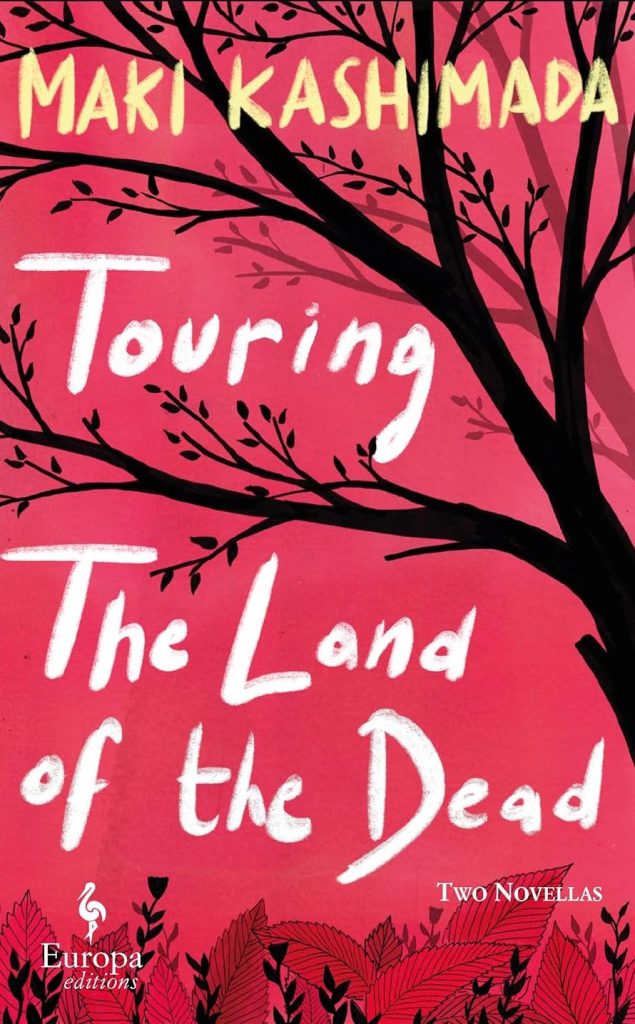
A bitter detachment. That’s the immediate mood you get from reading Maki Kashimada’s Touring the Land of the Dead, first of the two novellas in Touring the Land of the Dead (and Ninety-Nine Kisses). Natsuko wants to go leave things behind, go somewhere else, but she’s stuck. She is part of her family’s life, but everything we see of her interior world makes her seem to be miles apart.
Natsuko has a subtle fascination with death, and with going away in general. As resigned as she is to her life, she also has a deep longing to leave it all behind but knows there’s nowhere else for her to go. No matter where she goes, there is nothing fulfilling.
She had learned several things from the experiences that had visited her in that life. She felt as if she had seen the unseeable, but her memories were vague and cloudy, and she couldn’t quite put them into words. Once, when she had been a child, there had been a news scandal about a debt-ridden household that went on a trip to Disneyland the day before their family suicide. Though still young at the time, Natsuko felt a strange attraction to the incident.
When, without her mother knowing, she took the magazine to her room, she discovered that the young girl had been the same age as her. She imagined again and again how the girl must have felt. Whether it would be fun to go to Disneyland the day before she died.
Disneyland is a bright, vibrant place, completely different from the sleepy spa she takes her husband to. It’s not a place to go before a sudden death. It’s a place where things are drawn out and nothing can end. This spa used to be a hotel, one her mother has childhood memories of. Unlike her, who, despite her detachment, remains aware of reality, Natsuko’s mother is stuck in the past, and can’t accept their family is now poor. So she returns to that hotel over and over in her memories, and forces those memories on Natsuko too. But Natsuko comes to the spa without any nostalgia. It’s just a place to treat her disabled husband, Taichi, who, in contrast to her, seems cheerfully naïve. He has been stuck in a wheelchair for some time, and despite not showing him any overt affection, Natsuko continues to support him, using what little money she has on their time at the spa. She quietly continues with her bleak life.
Europa’s edition of this book comes with a quote from Yōko Ogawa on the cover, claiming, “Only Ms Kashimada can create this kind of world.” And it’s funny she’d say that, because as unique as Kashimada’s fictional world is, the one it most closely resembles is Ogawa’s. The health spa, with its drab discomfort, could easily be the setting of an Ogawa novella. And Natsuko herself could be one of Ogawa’s protagonists. She is quietly unknowable. The first-person narration lets us peek into her thoughts, but no matter how deep it goes, she stays inexplicable.
Touring the Land of the Dead is accompanied by another story, Ninety-Nine Kisses. While the former is cold and distant, the latter is filled with a strange kind of warmth. The prose is just as enigmatic, but joyful too.
All four of us, joining hands in a circle. Our palms getting all hot and sweaty and clingy. Our bodies melting into a thick syrup, becoming one. We were one. Meiko’s pain was Moeko’s suffering. When some burning, fluorescent light pierced my sisters’ hearts, my body too shuddered with pain. This was what I always yearned for.
The narrator Nanako’s love for her three sisters is borderline incestuous. This isn’t uncommon in Japanese literature; Ogawa has touched on it in her fiction too, as have Fumiko Enchi and Murasaki Shikibu. Nanako describes her sisters’ bodies in loving detail, especially Moeko’s. She tells us about the sight of Moeko’s breasts in the bathhouse (“close to perfect circles”), and how good it feels to be naked in her presence or hugged by her from behind. She even tells us Moeko’s masturbation habits, describing a pornographic video her sister watched as giving her a “strange and sacred feeling” as she views it too, as if mirroring Moeko in such an intimate way will make them even closer.
According to Nanako, “Moeko is like the clitoris in our family. She’s erotic, a central, vital figure who can’t be neglected or ignored.” And this shows, despite the pulsing flow of emotion in Ninety-Nine Kisses, a similar sense of detachment as in Touring the Land of the Dead. Nanako is a sideline character, even in her own story. She must put her sisters in the centre.
There’s an innocence to this obsession that keeps these vivid images of her siblings’ bodies from becoming creepy. Nanako is childlike, vulnerable, and androgynous. While accepted fully by her sisters, she has always been set apart from them, claiming, “I’ve been brought like a boy ever since I was little.” She doesn’t explain why her parents did this, or why they left her out of feminine activities. The closest thing to an explanation we get is, “That’s what my family’s like.”
And she never resents her sisters—or at least not openly. All she shows us is a genuine longing to be like them. Or not just like them, but to be them. To be accepted so deeply into their feminine sisterhood that her own sense of self is dissolved. At least, not until the end, when they ask her to decide which of them is the prettiest and she suddenly becomes shaken and uncertain.
Even though this should have been the realization of that sacred dream that I had thought would never come true. My sisters, on some kind of whim, had ended up carrying out this sacred ceremony. My sisters, calculating, forceful, impure, and yet beautiful.
And then, when they offer to do her makeup, Nanako is resistant. This is something she wants, but when it happens it carries a sinister energy, maybe because of its suddenness. “Meiko and Moeko held me down. Yōko started to paint the gloss on my lips. They felt sticky.”
It’s a strange mixture of unsettling and heartwarming. Afterwards, Nanako looks at her reflection, and doesn’t see any difference. But slowly she starts to feel that she will become properly female, like them.
Haydn Trowell’s translation of both stories is impressive, managing to keep the same writerly style in voice, despite their different voices. This is something Trowell has a talent for, as his recent translations of such unique writers as Yasunari Kawabata and Maru Ayase have shown.
How to cite: McBride, Jane. “Enigmatic Prose: Maki Kashimada’s Touring the Land of the Dead.” Cha: An Asian Literary Journal, 28 Jan. 2024, chajournal.blog/2024/01/28/land-of-the-dead.


Jane McBride is a PhD student at the University of Galway in Ireland. Her research is on liminality in urban and digital contexts. Other topics of interest include East Asian literature, electronic and experimental music, digital humanities, comics, and Lewis Carroll. Jane is also a proofreader and artist. Her music and illustrations can be found online under the name Jane Eksie. [All contributions by Jane McBride.]
 Cha
Cha 