
📁 RETURN TO FIRST IMPRESSIONS
📁 RETURN TO CHA REVIEW OF BOOKS AND FILMS
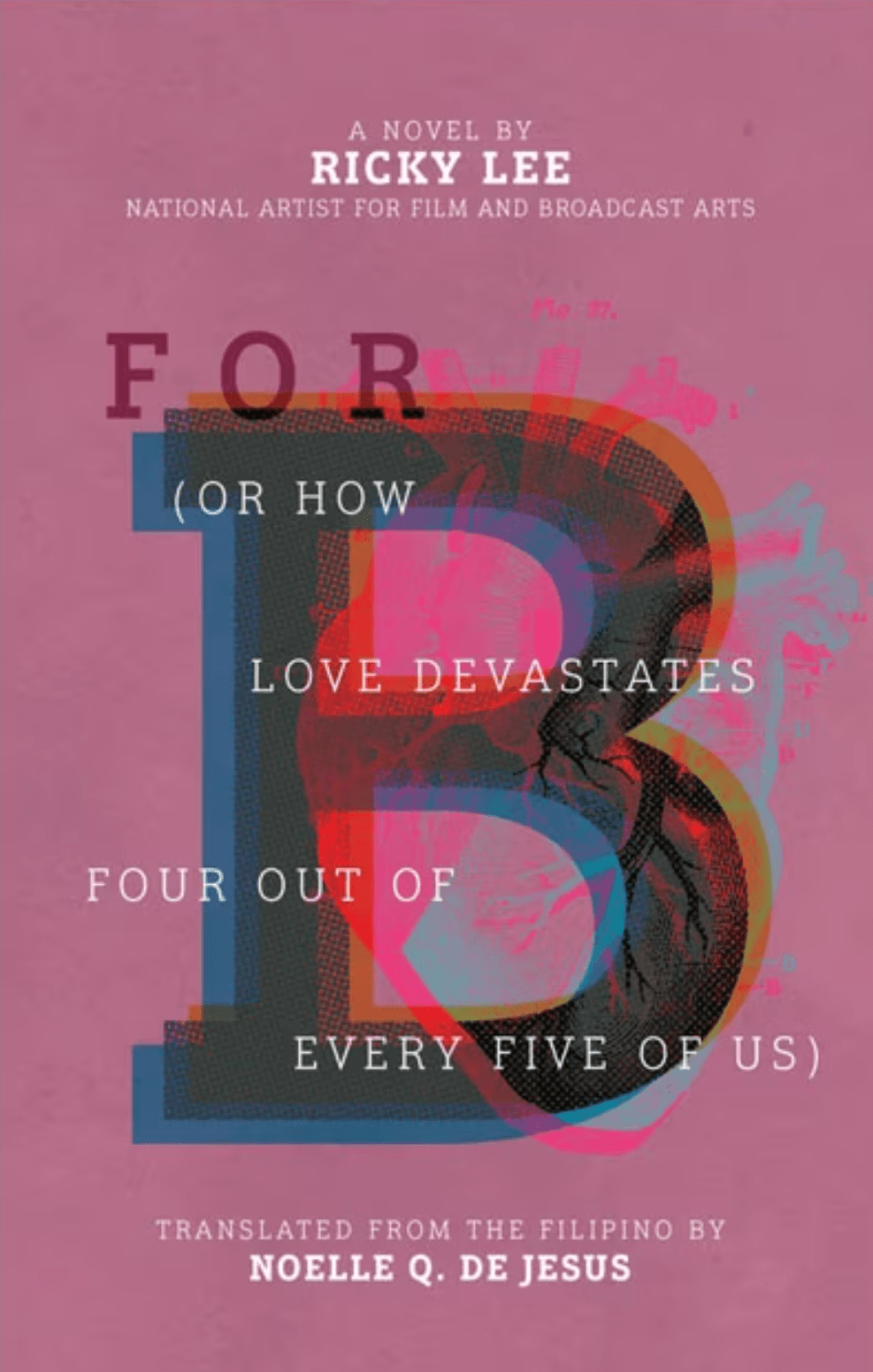
Ricky Lee (author), Noelle Q. De Jesus (translator), For B (or How Love Devastates Four out of Every Five of Us), Ateneo de Manila University Press, 2023. 230 pgs.

This review contains spoilers.
Ricky Lee’s novel For B , translated from the Filipino by Singapore-based Noelle Q. De Jesus, explores the lives of people in five love stories and the writer who weaves them together: Irene (Chapter 1), a woman with a photographic memory who searches for her childhood sweetheart Jordan; Sandra (Chapter 2), a hotel receptionist haunted by an incestuous love for her missing brother Lupe; Erica (Chapter 3), a woman who leaves her loveless fictional hometown of Maldiaga for a parallel world that is obsessed with romance; Ester (Chapter 4), who acknowledges her lesbianism with the help of a gender-nonconforming son AJ; and Bessie (Chapter 5), an attractive and promiscuous woman who subjugates the lacklustre but literary-minded Lucas.
Chapter 6 reveals that Lucas is the writer weaving the five stories as a gift to win Bessie’s heart. The characters confront their writer for projecting the misery of his one-sided love for Bessie onto their stories. Only Sandra and Bessie are people in Lucas’s life while Irene, Erica and Ester are creations of his imagination. Together, the novel frames the human experience of love as the process of reconstituting physiological reactions and details into emotionally charged episodes and hopes. The stories show what happens when that process goes wrong or directs itself towards forbidden places.
Irene’s story shows what happens when the processing of fragments and details into the sensation of love breaks down. The chapter opens with Irene’s friends goading her to show off her photographic memory to a prospective boyfriend. The most notable textual innovation is the insertion of play script formats and dialogue blended into prose description to represent the overwhelming nature of everyday life. Irene’s memorising of fragments (e.g. parts of episodes, doing calculations to calm herself) is her attempt to break down reality into manageable chunks. The gap between fragments and the whole experience they make up is clearest when she asks Jordan to give her a list of words to remember. These words all relate to his mother’s death but they are barely enough to hint at the tragedy that befell his family, not piece together the whole murder. This chapter highlights the despair that occurs when Irene cannot reassemble these fragments into a meaningful sense of love as she drifts from one casual sexual encounter to another.
Sandra’s story highlights the consequences that follow when love directs itself towards her brother Lupe. She vacillates between her proper administrator-self that organises her personal and professional life into mental Excel spreadsheets and incestuous impulses. Like in Irene’s story, Sandra realises her love by piecing together fragmented details into experiences: the hanging guitar, storeroom door and electric fan are enough to ignite her desire. When they reunite after a period of separation, their love-making is remembered as “the monotonous sound of the faulty air-conditioner. The muted images on the TV. The slippers on the floor. The hard pillow. The towel yet unused.” (46) Even as Sandra tries to settle into married life with another man, her and Lupe’s daughter haunts her with the memory of Lupe and the guilt attached to their desire.
My favourite chapter is Erica’s story: as Erica moves from a romantically repressed to supposedly liberated world (referred to in this essay as “anti-Maldiaga” hereafter), both societies’ pathological relationship with romance and sex show the inability for simplistic versions of conservatism and liberalism to foster meaningful love. Erica starts in her hometown Maldiaga, which represents an ultra-conservative world that stigmatises romance and sex (“no one says ‘I love you’, expresses adoration, desire or affection”, 55). This world that claims to “just abhor romance” (55) expresses its obsessive fear of love and spontaneous feeling through farcical trends like “anti-love songs [like]… I Don’t Love You, This Is Not Love. I Don’t Like You. Zero Love in My Heart. I Totally Unlove You. This Is Not a Love Song” (56). After hearing the video testimony of a Maldiaga escapee who discovered love, Erica follows the route out of Maldiaga to find a world obsessed with romance.
Anti-Maldiaga represents a hypersexualised liberal world that claims to free people from prudish tradition, only to trap them within glamorised and self-destructive notions of romance. At first, Erica is dazzled by the residents’ open displays of affection. But anti-Maldiaga’s idea of romance is as shallow and fragmented as Maldiaga’s. The new world’s romance-obsessed world has its own ludicrous trends to match Maldiaga’s anti-love songs: “Sponsored by a major toothpaste brand, the event [Lovapalooza] drew more than five thousand couples to kiss simultaneously… All to prove that their breath stayed kissably fresh” (68). In an attempt to earn the elusive experience of love, Erica transforms herself into a movie-star imitation while leaving her real self behind: “and soon, because she used all the products endorsed by the artists on TV, she started feeling like a product herself” (65).
Similar to Erica’s story, Ester and her son AJ’s dynamic highlights the inability for either reductive conservatism or progressivism to nourish love. However, while Maldiaga and anti-Maldiaga never touch, Ester and AJ’s egalitarian relationship shows how reserved and outgoing parts of the human spirit can co-exist. Ester starts as a character who restrains her feelings, shown in her tendency for incomplete laughter that symbolises the curtailing of happiness: Ester’s “guiding rule [was to] never go overboard or out of bounds” (93). The intimate scene with her housemaid Sara shows the dissolution of interpersonal boundaries as Ester reaches the “highest heights of a most dizzying happiness” (99).
Initially, Ester’s story frames AJ as the liberator of Ester’s homosexual identity. He is socialised into a sexually liberated, queer clique that boasts free promiscuous relations. He makes humorous logical leaps about his promiscuity being the embodiment of Christian virtue because “my body is my most beautiful asset, so I share it with others” (103). However, it becomes clear that, like the people in anti-Maldiaga, AJ cannot assemble these lustful encounters into any meaningful love as he and his peers mock their friend who “still believes in true love” (108). After Sara and Ester’s reunion, AJ is mystified that Ester can emotionally connect with Sara outside of sexual acts.
In fact, while sex features liberally in the novel, it is often followed by punishment or self-destruction. The karmic punishment following sexual misbehaviour is clearest in Bessie’s story. Bessie (a friend in AJ’s queer clique) keeps the writer Lucas as a captive in her apartment where she invites men for one-night stands. Bessie’s story starts with her successfully tempting and having sex with her friend’s boyfriend of five years. Like anti-Maldiaga, which commercialises and decomposes love’s complexity into sellable products, Bessie literally profits from broken hearts by selling items such as engagement rings and gifts from other women’s ex-boyfriends. After a hedonistic whirlwind of partners, a brawl at her place involving Lucas and a casual boyfriend ends in “broken glass, blood and piss” (153).
Potentially the most controversial aspect of the novel is the metafictional insertion of the writer and the way his characters confront him. It is sufficiently foreshadowed, at times entertaining and not resorted to as a cheap resolution to holes in the plot, which can be a temptation when placing the writer in the text as a character. However, there are several ways this metafictional component could have been better exploited to examine society’s shallow ideas of love. For example, at the end of Bessie’s story, the writer breaks the fourth wall and asks an imaginary audience to vote by text message for whether she or another character will be given the happy ending. Following through with this reality TV-style response would have expanded on the performative and commercialised notion of romance.
The relative weakness of Lucas’s character development also diminishes his significance as the five stories’ writer. For example, the trauma underlying his slavish devotion to Bessie could have been better explored. Given the compelling portraits of Lucas’s characters, the fact that he crafts them out of a naive attraction to Bessie was anticlimactic and somewhat disappointing. In contrast, his friendship with Sandra over a shared understanding of each other’s doomed romances would have deepened his character. Nevertheless, For B is a profound exploration of how fragmented details and memories piece themselves into full-blown desire and the tragedy of unrequited and taboo loves.
How to cite: An, Frances. “Processing Love in Ricky Lee’s Novel For B.” Cha: An Asian Literary Journal, 24 Jan. 2024, chajournal.blog/2024/01/24/for-b.



Frances An is a Vietnamese-Australian fiction and non-fiction writer based in Perth. She is interested in the literatures of Communism, moral self-perception, white-collar misconduct and Nhạc Vàng (Yellow/Gold Music). She has performed/published in the Sydney Review Of Books, Seizure Online, Cincinnati Review, Sydney Writers Festival, Star 82, among other venues. She received a Create NSW Early Career Writers Grant 2018, partial scholarship to attend the Disquiet Literary Program 2019, and 2020 Inner City Residency (Perth, Australia). She is completing a PhD in Psychology at the University Of Western Australia on motivations behind “curbstoning” (data falsification in market research). [All contributions by Frances An.]
 Cha
Cha 