

📁 RETURN TO FIRST IMPRESSIONS
📁 RETURN TO CHA REVIEW OF BOOKS AND FILMS
Kim Jee-woon (director), Cobweb, 2023. 135 min.
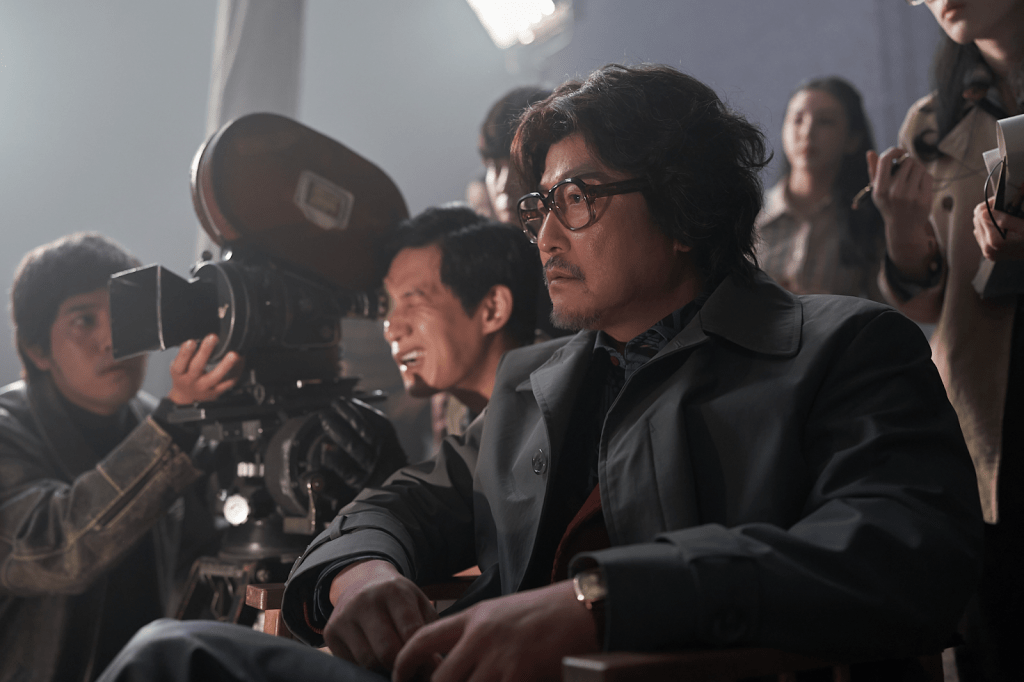
Song Kang-ho (best known for Parasite and A Taxi Driver) in Cobweb
Kim Ki-yeol (Song Kang-ho, best known for Parasite and A Taxi Driver), a studio director under the Park Chung-hee dictatorship in the 1970s, is facing a career crisis, with none of his recent films living up to the success of his debut. And, as if the stinking reviews weren’t bad enough, he has to put up with the taunts of the critics as he tries to eat his lunch.
He has just finished shooting his latest film, a shlockfest by the name of Cobweb, which is unlikely to improve his standing with his lunchtime tormentors, when he has an epiphany: the ending needs to be reshot. As is often the case with films-within-a-film, the Cobweb at the core of this film is a trashy enterprise that may or not be improvable. Nonetheless, Ki-yeol and the ambitious Kafka-reading heir-apparent to the studio Mi-do (Jeon Yeo-been) think it can be elevated with the new ending. The problem is the shooting has wrapped and the studio, currently run by Mi-do’s aunt, is not willing to afford it any more time. So Director Kim (this particular mise en abyme—both directors named Kim making a film called Cobweb—is somewhat obscured by the frequency of Korean family names) gets started on a clandestine shoot, with personnel that are not all happy to be on board.
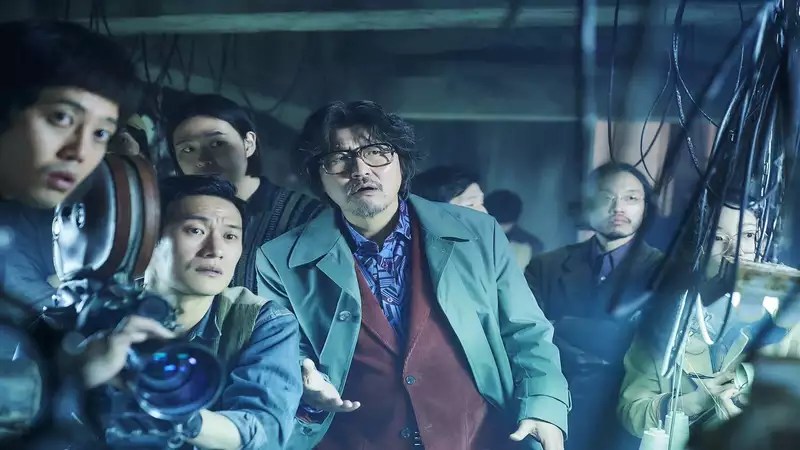
Cobweb falls squarely in the tradition of film-set comedy dramas, Singing in the Rain and Truffaut’s Day for Night being the most obvious, as well as the more recent Babylon. Impediments, slapstick and drunkenness abound, with Director Kim’s efforts to save his career thwarted at every turn by meddling executives, hands-on government censors, not to mention recalcitrant actors and technicians and the fact they don’t have any budget left.
For all its period trappings, Cobweb doesn’t have a great deal to say about the years of the dictatorship, the sole nod to political censorship being the ruse that Kim’s assistant comes up with to get the film made: declare that it is an anticommunist film. This appears to be a bridge too far even for the desperate Kim, but the real meat of the film lies in the secret behind Kim’s big career break.
The constraints and opportunities that shape Kim’s oeuvre put me in mind of the comments of Shin Sang-ok, the South Korean director kidnapped along with his ex-wife, actress Choi Eun-hee, by North Korea in 1978 and forced to work in the DPRK film industry until their escape in 1986. Director Shin later admitted that, despite his ordeal north of the border, he made some of his best work there—he too had experienced a sequence of flops in the South Korean industry in the 1970s.
All in all, Kim Jee-woon’s film is about the universal, sometimes hellish, experience of shooting a movie and its satirical barbs are undoubtedly aimed at contemporary nemeses as much as they are at the various stuffed shirts and petty tyrants of the Park Chung-hee era. In this sense, it is not all that different from the films about filmmaking that have gone before it.
In a further meta-textual twist, the Korean Cobweb is one of two films of that name that came out in 2023, the other being an American horror film that looks like a lot less fun than both Kim Jee-woon’s movie and the beleaguered film maudit at the centre of it, directed by the valiant Ki-yeol.
How to cite: Farry, Oliver. “In the Tradition of Film-set Comedy Dramas: Kim Jee-woon’s Cobweb.” Cha: An Asian Literary Journal, 19 Jan. 2024, chajournal.blog/2024/01/19/cobweb.


Oliver Farry is from Sligo, Ireland. He works as a writer, journalist, translator and photographer. His writing has appeared in The Guardian, The New Statesman, The New Republic, The Irish Times, Winter Papers, The Dublin Review, The Stinging Fly and gorse, among other publications. Visit his website for more information. [All texts by Oliver Farry.] [Oliver Farry and chajournal.blog.]
 Cha
Cha 