
📁 RETURN TO FIRST IMPRESSIONS
📁 RETURN TO CHA REVIEW OF BOOKS AND FILMS
Meena Kandasamy, When I Hit You: Or, A Portrait of the Writer as a Young Wife, Atlantic Books, 2018. 272 pgs.
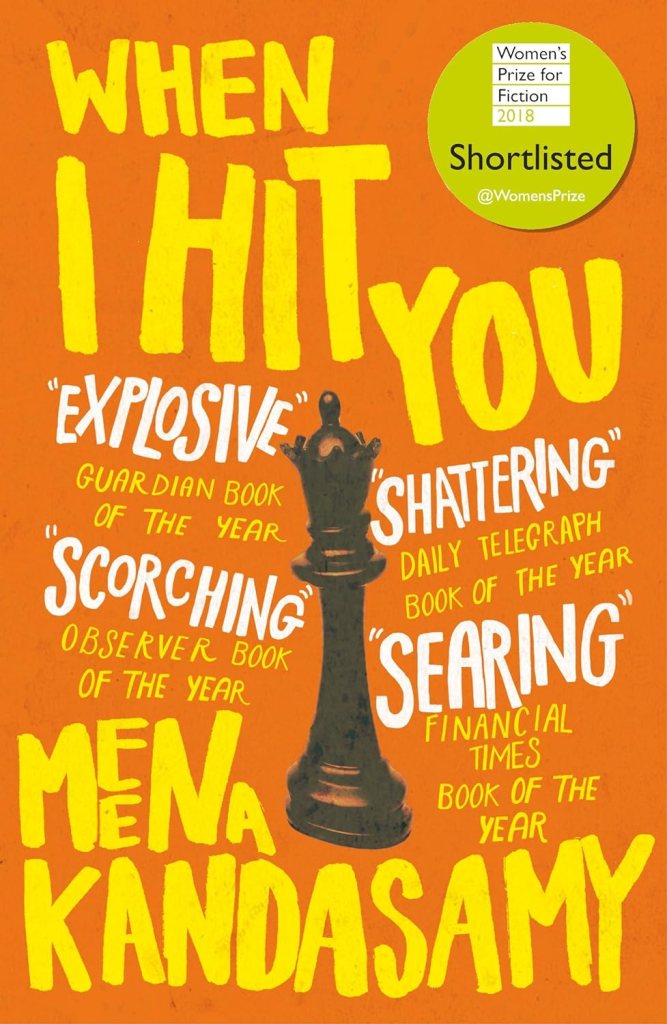
Meena Kandasamy’s When I Hit You, Or Portrait of the Writer as Young Wife, based on her own marriage experience, is a harrowing and powerful account of domestic violence and toxic societal norms that perpetuate injustice against women. The book explores the stigmatisation and discrimination faced by daughters and wives and their subjugation and marginalisation.
The World Health Organization estimated in 2021 that one woman in three experiences violence from her intimate partner in her lifetime and as many as 38% of femicides are committed by an intimate partner. These shocking statistics may help us understand the pervasiveness of gender-based violence and the gravity of Kandasamy’s account. Through a detailed portrayal of the courtship process, various forms of isolation, and the erasure of the protagonist’s sense of self, Kandasamy provides in her memoir a poignant and intimate look at the dynamics of domestic violence.
The reader of When I Hit You is taken through each stage of the abusive cycle, beginning with the tension-building phase characterised by the perpetrator’s imposition of economic, financial, physical, and social isolation upon the protagonist, who responds by appeasing the abuser’s demands. This is followed by the acute battering phase, where the abuse escalates to brutal physical violence, verbal abuse, and marital rape. The battered woman seeks solace in her parents, who, in turn, exacerbate the situation by advising her to be more submissive and accommodating. Finally, the honeymoon phase ensues, wherein the perpetrator manipulates and blackmails the protagonist through the display of amiable behaviour, empty promises, and gifts.
Kandasamy underscores the process of infantilisation often instigated by one’s own parents and illuminates how the institution of marriage takes on a hierarchical dynamic, in which the woman is relegated to a position of subordination and inferiority by her spouse. “Marriage became a Re-education camp. He transformed into a teacher, and I became the wife-student learning from this Communist Crusader” (24). The infantilisation of women by men analysed by the proto-feminist writer Mary Wollstonecraft as far back as 1792, who wrote in A Vindication of the Rights of Woman, “Men, indeed, appear to me to act in a very unphilosophical manner when they try to secure the good conduct of women by attempting to keep them always in a state of childhood” (17). This precisely describes the predicament of Kandasamy’s marriage; her husband and even her parents treat her like a child, denying her agency and reducing her to a powerless dependent. As the subservient “wife-student”, she is completely cut off from the outside world “for her own good” and any indication of her sexuality, femininity, and individuality is erased, while decisions are made for her.
Kandasamy also highlights Asian women’s often misplaced loyalty towards a culture and tradition that prioritises the subjugation of women over their protection and empowerment. She draws attention to the stigmatisation of divorcees as well as society’s systematic support and justification of abuse. When Kandasamy confides in her parents about the ordeal she undergoes in her marriage, she is met with the self-involved disgruntlement of an Indian patriarch. “A father of a daughter—that is a special kind of punishment. We pay the price.” (97) This perhaps speaks to the majority of Indian parents’ reactions to not only their daughters’ decision to leave an abusive relationship but also the birth of a daughter. The “price” could mean dowry or the burden of protecting the daughter’s dignity and honour. In the Indian cultural context, women are subjected to stringent gender norms, and deviating from these norms can result in dishonour or shame for women, particularly in the eyes of male figures in their lives. The list of actions or behaviours that might be perceived as dishonourable or shameful is extensive and includes seemingly mundane activities such as wearing make-up or appearing in public unaccompanied by a man. It is also reflective of a society that puts great emphasis on the opinion of others, with the oft-asked question being Log Kya Kahenge? (What will people say?)
Apart from exposing the societal pressure on women to remain in abusive relationships for the honour of their parents, Kandasamy also drew attention to the normalisation of victim-blaming and the broader social and cultural factors contributing to the propagation of gender-based violence. Leaving a marriage is a complex and difficult process that requires time and opportunity; staying is driven by obedience, fear and self-preservation. When Kandasamy seeks support from her parents in a vulnerable state, they respond by telling her to compromise and to tolerate and endure the abuse, as if she is to blame for what is happening to her due to her lack of patience and femininity. Indeed, in many cultures, the secret to a successful marriage is widely regarded as “to compromise”.
In The Worst Thing I Ever Did: The Contemporary Confessional Memoir, Blake Morrison highlights the importance of creating a nuanced portrayal of suffering that emphasises agency, justice, and responsibility, rather than over-relying on victimhood. Kandasamy’s memoir exemplifies Morrison’s call for a nuanced portrayal; she acknowledges her education and understanding of feminism, and by doing so, she challenges the assumption that domestic abuse only happens to uneducated or rural women. She reveals the sobering truth that no amount of education, empowerment, or privilege can shield one from an abusive relationship or the harm of patriarchy. Rather than simply recounting her experiences as a passive victim, Kandasamy uses her story to shed light on the broader social and cultural factors that sustain domestic violence. She also effectively counters the argument that feminist life-writing conforms to traditional gender roles or portrays women as passive victims. Her narrative offers an intersectional understanding of gender-based oppression and contributes to a more inclusive and diverse body of literature that can inspire social change and empower marginalised communities.
How to cite: Kaur, Bervinder. “Personal Yet Communal Narrative of Meena Kandasamy’s When I Hit You: Or, A Portrait of the Writer as a Young Wife.” Cha: An Asian Literary Journal, 16 Jan. 2024, chajournal.blog/2024/01/16/young-wife.


Kaur Bervinder is a Hong Konger of Indian descent. Her upbringing allows her to immerse herself in South Asian heritage as well as Chinese culture. Driven by her fascination for languages, cultures, and literature, she pursued studies in translation at university. Her inspirations are as diverse as the cultures she encountered, drawing from the art of shayaris, the world of books, and the folklore and history of Asia..
 Cha
Cha 