

📁 RETURN TO FIRST IMPRESSIONS
📁 RETURN TO CHA REVIEW OF BOOKS AND FILMS
Tanizaki Jun’ichirō (author), Anthony H. Chambers & Paul McCarthy (translators), Longing and Other Stories, Columbia University Press, 2022. 145 pgs.
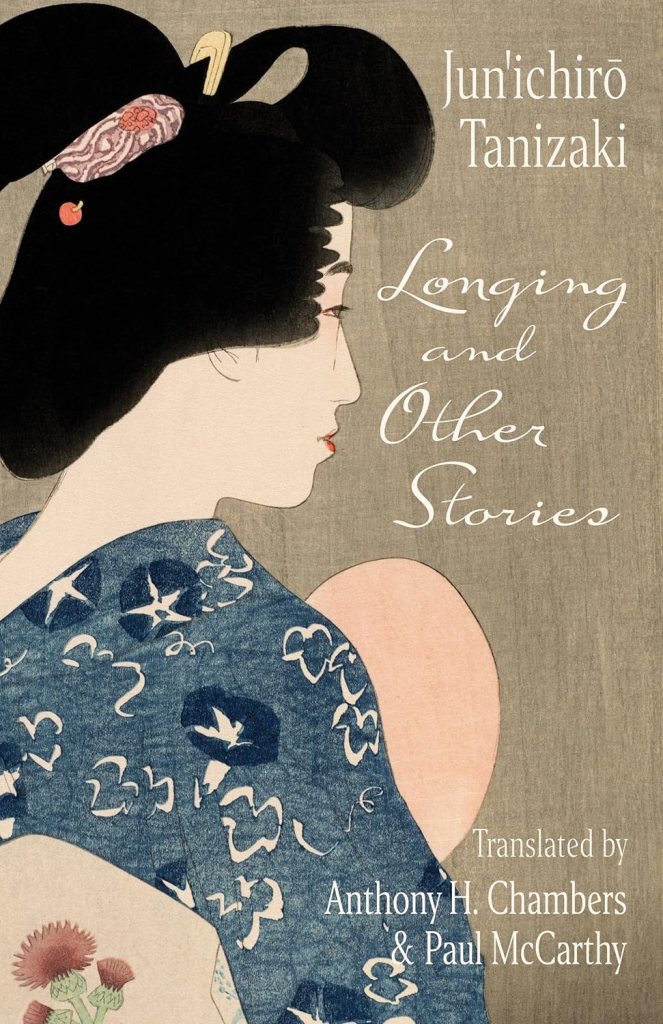
Tanizaki Jun’ichirō’s Longing and Other Stories, translated by Anthony H. Chambers and Paul McCarthy, presents Tanizaki’s three lesser-known short stories to English readers: “Longing” (or Haha o kouru ki「母を恋うる記」1918), “Sorrows of a Heretic” (or Itansha no kanashimi「異端者の悲しみ」1916-17) and “The Story of an Unhappy Mother” (or Fukō na haha no hanashi 「不幸な母の話」1921). In “Longing,” the first-person narrator, Jun’ichi, recounts a dream in which he sees his mother, who passed away two years earlier. The second story, “Sorrows of a Heretic”, introduces the reader to an outsider named Shōzaburō. He carries the burden of a sick younger sister, frequently skips school, turns to alcohol, and borrows money from his schoolmates without ever repaying it. The third story, “The Story of an Unhappy Mother”, shifts back to a first-person narrative. In this tale, a son shares the transformation in his mother’s personality and delves into the reasons behind his elder brother’s tragic suicide. These stories are bound together in the same book due to the exquisite narrative style of each story and their shared theme of family, as the translators explain in their afterword.
Despite the commonalities shared by the three stories, each one exhibits distinct characteristics. “Longing”, for instance, opens with a profoundly poetic portrayal of a heavily overcast night. The motif of pine trees evokes memories of classical Japanese poetry, akin to the Man’yōshu (an eighth-century anthology of Japanese poetry), where the Japanese word of pine, 松“matsu”, carries a dual meaning of waiting and yearning, 待つ “matsu”. In the Noh play Pining Wind (or Matsukaze「松風」) from the Muromachi era, Zeami masterfully employs this same double meaning to convey how the lady Matsukaze yearns for Yukihira and descends into madness. Tanizaki appears to employ this timeless metaphor to convey the yearning of a mother in “Longing”.
Readers who believe in the interconnection between Tanizaki’s biography and “Longing” might take this story literally as Tanizaki’s own confession, judging from both the narrator and author’s fondness for plays, as well as their mothers’ deaths occurring at their early thirties.
In contrast to Jun’ichi in “Longing”, who exemplifies a son with deep filial piety, Shōzaburō in “Sorrows of a Heretic” is a morally corrupt character. He callously neglects his sick sister, radically skips school and remains devoid of friends due to his decadent personality. Despite the title “Itansha” being translated as “a heretic”, it is clear that the Japanese word carries a broader meaning, free from any specific religious connotation. The Nihon kokugo daijiten dictionary provides a second entry, defining it as “someone who stands apart from tradition, authority, conventional norms, and is isolated—an outsider”. Shōzaburō is more an outcast than a heretic. Despite his lack of friends, Shōzaburō never attempts to seek closer friendships, and the “friends” he surrounds himself with are simply drinking companions.
In the last story, “The Story of an Unhappy Mother”, the theme of filial piety comes to the forefront. The narrator skilfully keeps the reader in suspense, hinting at a significant transformation in his mother’s personality. This foreshadowing technique builds tension before he reveals the sudden boating accident that occurs during the trip of his newly wed elder brother and his sister-in-law, and his mother. In a heart-wrenching turn of events, the elder brother chooses to rescue his wife instead of his mother, a decision that haunts him with overwhelming guilt and ultimately leads to his tragic suicide.
These three stories are consistent with the themes found in Tanizaki’s other works, such as Some Prefer Nettles and Naomi. They continually evoke a nostalgic mood for the past, while highlighting the clash of ideas between traditional Japanese values and Western influences. When approached as a national allegory, the mother figure in “Longing” can be seen as a symbol of yearning for the bygone days of Japan. This interpretation is supported by the story’s epigraph taken from the Man’yōshu, as well as the classic symbolism of pine trees and scenes along the shore.
Similarly, Shōzaburō’s character in “Sorrows of a Heretic” embodies the image of an outcast and reflects an over-individualistic behaviour that may stem from his deep knowledge of both classical Japanese and western culture. It is noteworthy, however, that despite his habitual lateness, Shōzaburō manages to arrive home in time to see his sister just before her passing, showcasing a different facet of his character.
The clash of ideas between Japan and the west is elevated to a philosophical level through “The Story of an Unhappy Mother”. The two translators astutely point out in their afterword that the Confucian perspective on family differs significantly from Western views. The elder brother finds himself in a moral dilemma, torn between the clash of these two sets of values. This situation mirrors Japan’s struggle in the early twentieth century when there was an over-absorption of Western values, leading to a sense of nostalgia for the past and introspection about one’s own identity, as argued by David Pollack in Reading Against Culture. Pollack dedicates one chapter to illustrate this idea Tanizaki’s works, particularly Some Prefer Nettles, highlighting the concept of the deviant self.
Anthony H. Chambers and Paul McCarthy have crafted a translation that is linguistically and stylistically accessible to general English readers. In comparison, contemporary Japanese readers who lack knowledge of classical Japanese or familiarity with old Japanese characters may find the original pieces more challenging to comprehend. Nevertheless, it is important to acknowledge that some degree of loss in translation is inevitable.
Despite the translators’ best efforts, as evident in their afterword, certain nuances may elude readers of the English. For instance, readers of the original text immediately grasp the symbolism of the pine and the shore images due to the pronunciation of the words like matsu and mastukaze. Japanese onomatopoeia, with its rich diversity and sometimes use of Katakana script, can pose difficulties when conveying the same vividness in English. Consequently, while the English version captures the essence of the work, it may not fully replicate the depth and intricacies of the original Japanese version.
Another notable difference lies in the use of punctuation. In all three Japanese stories, the author employs quotation marks not only for direct speech but also to indicate characters’ thoughts, such as those of Shōzaburō in “Sorrows of a Heretic”. Given the challenges of replicating this structure in English, both translators opt to italicise the portion representing Shōzaburō’s thinking instead of using quotation marks.
Meanwhile, the original Japanese text employs emphasis marks as a typographic element to denote emphasis. Despite the multiple marks in the original version, both translators choose not use italics or other techniques to convey the same emphases in the translation.
Likewise, multilingualism is a common feature in Japanese writing from the early twentieth century. For instance, the word “masochist” is written in English in the original text, and there is no straightforward way for the translators to replicate the same multilinguistic effect in the English translation. These linguistic and typographic nuances present challenges in maintaining the full depth and texture of the original text in its translated form.
Indeed, despite the inherent challenges of translation, it is heartening to witness the growing recognition and appreciation of works by authors like Tanizaki and other Japanese writers among global readers. What is certain is these works will arouse more interest in modern Japanese literature.
Works Cited
▚ Pollack, David (1992). “The Deviant Self: Jun’ichirō’s Some Prefer Nettles.” In Reading Against Culture. Cornell University Press, 67-86.
▚ Tanizaki Jun’ichirō (1981). Tanizaki Jun’ichirō zenshū 4 『谷崎潤一郎全集第4巻』. Chūō Kōronsha.
▚ — (1981). Tanizaki Jun’ichirō zenshū 6 『谷崎潤一郎全集第6巻』. Chūō Kōronsha.
▚ — (1981). Tanizaki Jun’ichirō zenshū 7 『谷崎潤一郎全集第7巻』. Chūō Kōronsha.
▚ Nihon kokugo daijiten 『日本国語大辞典』. Japan Knowledge Lib. (accessed Oct 7, 2023).
How to cite: Au, James Kin-Pong. “Clash of Ideas: Tanizaki Jun’ichirō’s Longing and Other Stories.” Cha: An Asian Literary Journal, 10 Jan. 2024, chajournal.blog/2024/01/10/longing.


James Kin-Pong Au is a Master’s graduate of both Hong Kong Baptist University and the School of Oriental and African Studies (SOAS) in London. He is currently a PhD candidate at the University of Tokyo, writing his dissertation about the relation between history and literature through close readings of East Asian historical narratives in the 1960s. His research interests include Asian literatures, comparative literature, historical narratives and modern poetry. During his leisure time, he writes poetry and learns Spanish, Korean and Polish. He teaches English at Salesio Polytechnic College and literature in English at Tama Art University. [All contributions by James Kin-Pong Au.]
 Cha
Cha 