
📁 RETURN TO FIRST IMPRESSIONS
📁 RETURN TO CHA REVIEW OF BOOKS AND FILMS
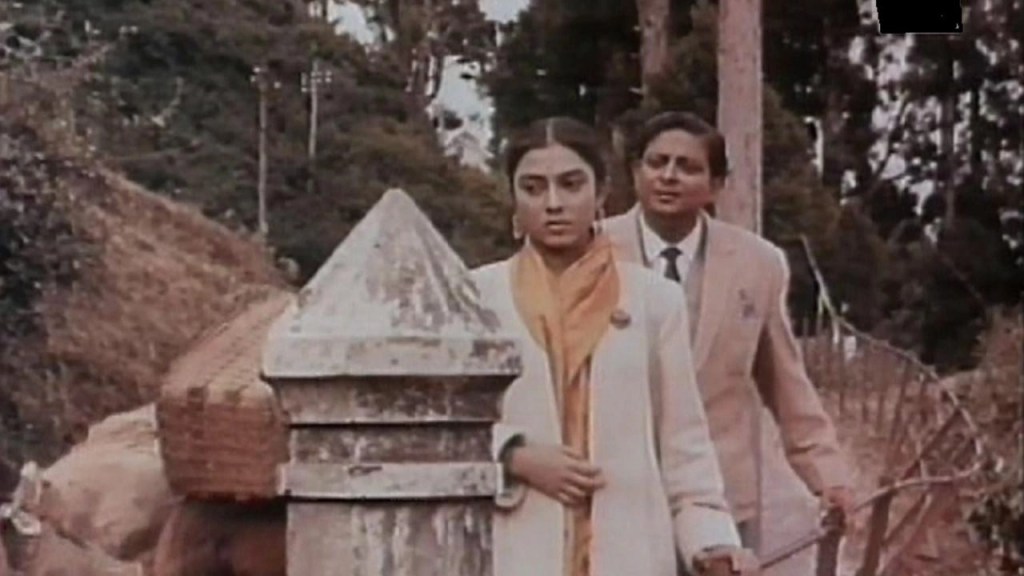
Satyajit Ray (director), Kanchenjungha, 1962. 102 min.

Satyajit Ray hardly needs an introduction—either in the field of arts and culture or cinema itself. He singlehandedly spearheaded the New Wave of Indian Cinema. His first film Pather Panchali is a veritable primer for the art of film-making, showing how a film can be made with a shoe-string budget, and it is also distinguished by the determination it portrays. Pather Panchali is a lyrical human document that teaches us much.
Ray’s 1962 film Kanchenjungha stands apart in his entire oeuvre, being his first in colour, and also because the plot and the storyline were Ray’s own. The action unfolds against the backdrop of the titular mighty peak—the second highest in the Himalayas, and the world’s third highest. The film takes place within a single day in the foothills, in Darjeeling. As the mist envelops from the outside, the inherent contradictory emotions of the characters also converge.
The film had such stalwart actors of yesteryear as Chabi Biswas and Pahari Sanyal. The latter plays the role of maternal uncle to Monisha (played by Alokananda Ray), who is the pivot around whom the story develops. Monisha and her elder sister (whose marriage is in doldrums) visit Darjeeling on holiday with her parents and maternal uncle. Monisha’s father is an industrialist, and has planned for her suitor (played by N. Vishwanathan) to propose marriage on the trip. But Monisha encounters a young lad (played by Arun Mukherjee), to whom she is instantly attracted. The film ends with the vision of the mighty peak emerging from the mist to the lilt of a local tune sung by a small boy, munching on the petals of wild flowers.
Monisha’s mother, played by Karuna Bandopadhay (Sarbojaya in Pather Panchali), sings the Tagore composition, E Porobashe Robey Keye… [Who’ll live in this foreign land…], as she sits alone on a bench overlooking the mighty Himalayas. Monisha’s maternal uncle, played by Pahari Sanyal, is an ornithologist. He is seen busy with his binoculars. But in the film, made six decades ago, he utters a visionary apocalyptical statement: What if these birds do not come anymore?
As the film’s resolution draws in, the peak also becomes visible to the naked eye. This film stands apart in its special treatment, cinematography, and use of location almost as a character in itself. When I saw the film for the first time—many decades ago—I wondered if it was a Ray film at all! Accustomed as I was with his Goopy Gyne Bagha Byne and Charulata movies…!
Darjeeling is still the favourite hill destination among the Bengalis here. But the fact a film could be made with the scenic beauty of the place as the backdrop was itself a novel and innovative concept in those days. For all these reasons and many more, Kanchenjungha is unique in the Ray repertoire.
How to cite: Ray, Haimanti Dutta. “The Mighty Peak: Satyajit Ray’s Kanchenjungha.” Cha: An Asian Literary Journal, 2 Jan. 2024, chajournal.blog/2024/01/02/Kanchenjungha.

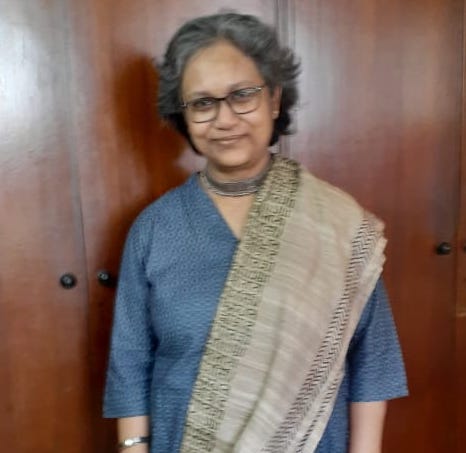

Haimanti Dutta Ray is a regular contributor to The Statesman Kolkata; her short stories have been published in the magazine sections of the paper at regular intervals. In 2020, her story “Pages of Sepia” was awarded the Second Prize in the Annual Wordweavers Short Story competition. Her books are In Loving Memory (Rupali Publications, 2015), a tribute to his father, the painter Shyamal Dutta Ray; The Circle of Life (Locksley Hall Publishing, 2018), Stone Images of Cactus Land (Blue Rose Publishers, 2020), in which she fictionalised the Park Street gang rape incident that occurred in Kolkata in 2012; Private Eye Line (2022), a novella; Yesterday in Tomorrow (Impish Lass Publishing, 2023), her debut collection of poetry with a foreword by the scholar and critic Shoma A Chatterji; and finally, Jump Cut, a combination of short stories and poems, came out from Kitab Writing Publication in November 2023.
 Cha
Cha 