
📁 RETURN TO FIRST IMPRESSIONS
📁 RETURN TO CHA REVIEW OF BOOKS AND FILMS
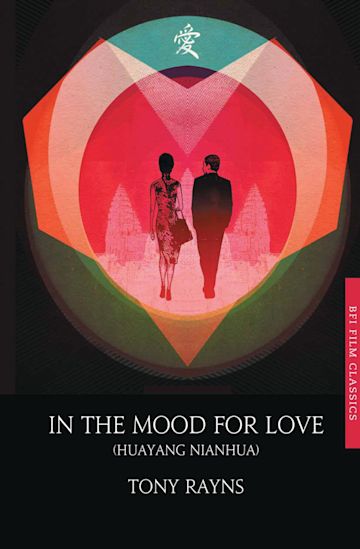
Tony Rayns, In the Mood for Love, Bloomsbury Publishing, 2015. 96 pgs.
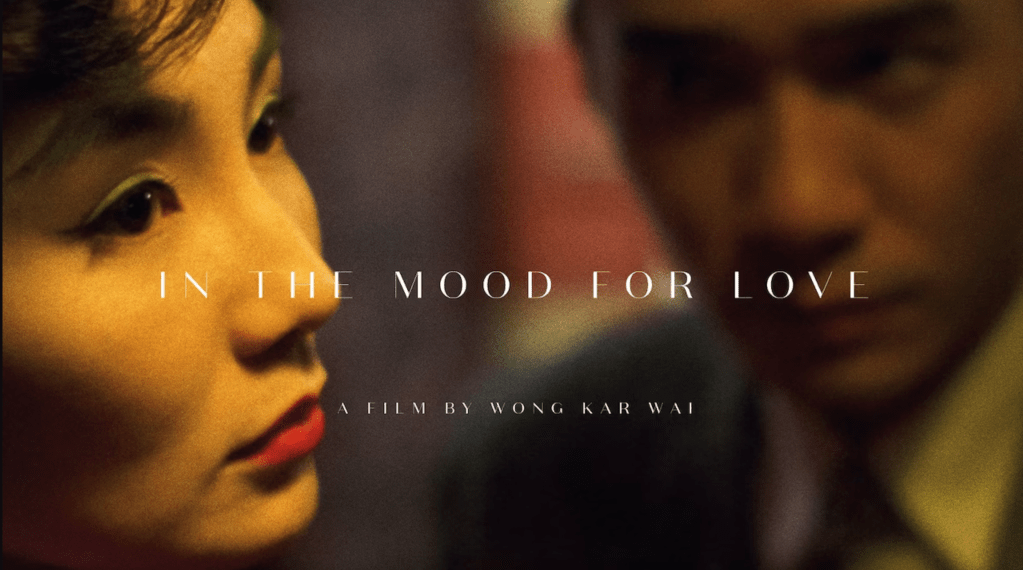
“I didn’t think you’d fall in love with me,” says Mrs Chan.
“I didn’t either,” says Mr Chow. “I was only curious to know how it started. Now I know. Feelings can creep up just like that. I thought I was in control.”
These two unhappy individuals—living in Hong Kong in 1962 and both married, as their surnames indicate, to other people—are characters in a movie: Wong Kar-wai’s now-classic reverie on thwarted romance, In the Mood for Love (2000). Because it’s a Wong Kar-wai movie, and because Mrs Chan (née Su Lizhen) and Chow Mo-wan are played by Maggie Cheung Man-yuk and Tony Leung Chiu-wai, they are not only one of the most glamorous couples in all of cinema, but the film they star in is virtually the last word in voluptuous romantic melancholy—heartache wrapped in a veneer of drop-dead chic—and its mystique has only grown since it first wafted into cinemas worldwide nearly a quarter of a century ago.
Tony Rayns’s monograph In the Mood for Love is a lean-and-mean guide to Wong’s film, not so much a critical exegesis as a straightforward accounting of what happens in it (important, for a movie so reliant on ambiguity and understatement), supplemented by some behind-the-scenes insights into how it got made and why it assumed the final shape it did. Rayns is a veteran British film critic, historian, and programmer who specialises in East Asian cinema; among his many works, he has contributed informed commentary to scores of Criterion Collection discs and on Criterion’s streaming channel.
Why review a book that was published in 2015, about a movie from 2000, so many years later? For one thing, Rayns’s study seemed to get overlooked on its initial release, at least in the United States (where I live). More saliently, Wong’s body of work has been enjoying renewed visibility lately, thanks to a touring retrospective launched in 2021 that brings together digital restorations of seven of the films he made between 1988 and 2004—In the Mood for Love foremost among them. Seeing the movies on the big screen again in the 2020s, I’m routinely aware of how many other people in the audience may be seeing them for the first time; more than a few of those viewers will probably have questions about In the Mood for Love (I know I still do), and Rayns’s book will be an aid to their understanding.
Because Rayns is writing in English about a movie from Hong Kong, some of the information in these pages is rather basic, written with people unfamiliar with Hong Kong in mind. To understand the precise milieu Wong establishes onscreen, for instance, it’s helpful to know which characters speak Shanghainese rather than Cantonese, and what the significance is of the nostalgic pop song sung by Zhou Xuan (a Shanghai film star of the 1930s) that plays on a radio in the background of one scene.
But the heart of Rayns’s text is a literal shot-by-shot breakdown of Wong’s movie, right down to meticulous accountings of what kind of cut joins one scene to the next. (They’re not always cuts—fade-outs, it becomes clear, are an essential element of the WKW repertoire.) I embarked on this section with trepidation, fearing a kind of cinephile obsessiveness run amok, but Rayns’s patient explication revealed nuances in the filmmaking I hadn’t appreciated before, and even led me, somewhat to my chagrin, to rethink my assumptions about a major plot point. The unraveling of the movie’s chronology (increasingly tricky as it goes along) is especially helpful: minute changes in Mrs Chan and Mr Chow’s relationship become more intelligible once you’re clear on whether a given scene is a flashback, a flash-forward, or taking place in the “present”.
The evolution of that relationship is one of the great stealth manoeuvres in the history of movie romance. The two come together when they realise that their respective spouses are carrying on an affair with each other; propriety and a certain sense of shame demand that they disguise their own growing attraction through a complicated and even masochistic kind of play-acting. Rayns nails why these scenes remain so absorbing, even on repeat viewings:
… the “role-play” scenes also add a further level of ambiguity to the plotting. There are at least three scenes in the film… where the viewer is misled into assuming that Chow and Mrs Chan are speaking frankly to each other, only to realise that they are actually role-playing each other’s spouses. The little shock of realisation produces a frisson every time: the film has caught us out, kept us intrigued.
Rayns doesn’t dwell on it, but an equivalent fascination holds later on, when the couple’s interactions go from quiet flirtation and mutual delight to the creeping realisation that they’re in fact making themselves miserable. The latter half of the movie raises the provocative question of whether principled self-denial (“We won’t be like them,” Chow Mo-wan declares righteously) can turn into self-harm, foreclosing possibilities for happiness and growth in ways that will leave at least one character tragically stunted. (Chow morphs into an emotionally curdled cad in 2046, the sort-of sequel Wong made four years later.)
Readers of this book may be surprised to learn how a movie they know by heart came together through a series of spontaneous, frequently last-minute creative decisions. Most Wong superfans are aware that chance, and second-guessing, have always played a major role in the director’s process, and a handful of Mood’s deleted scenes have long been available on various DVD and Blu-ray releases. But Rayns provides an extensive inventory of just how many alternative versions of the movie existed at one point or another, whether in the script or the actual shooting, and it’s startling to see all the different directions the story could have taken: the cumulative effect is of a veritable multiverse in hiding. (Social media has adopted the fragment of a deleted scene that shows Cheung and Leung dancing in close quarters—suggesting an afterlife somewhere in the ether where the characters get to enjoy what they’re denied in the version of their story we know.)
Rayns is by no means an impartial commentator on In the Mood for Love. As he states in this book’s acknowledgments, he helped manage publicity for Wong’s production company, Jet Tone, for more than a decade, and even receives co-credit for Mood’s English subtitles. In the opening pages, he teases the possibility of a tell-all, only to withdraw it in the same sentence: “The sometimes-hair-raising tales of my experiences with Jet Tone will have to wait for another time.” That discretion is admirable, but an even more welcome instance of authorial tact is his decision to forgo laborious interpretive analysis. After hinting at the potential significance of one series of crosscuts, he backs away with a disclaimer: “to go further down that road would be academic, and that is far beyond the scope and ambition of this slim volume.” The critical light touch seems only appropriate for a movie that builds its narrative strategy around leaving things unsaid. That’s especially true of the film’s haunting and enigmatic Cambodian coda, which everyone in the audience should be free to parse for themselves.
Which isn’t to suggest that this volume, not even a hundred pages long, should be the last word on such an elusive, multilayered movie. Other people will write worthwhile books and essays about In the Mood for Love. (The elegant appreciation that the novelist Charles Yu recently wrote for the Criterion Collection offers one such approach—the critical take that becomes a creative work in its own right.) Rayns is relatively circumspect, for instance, about the production design, still another reason why the film stays so watchable even after you’ve seen it multiple times. Patterned wallpaper, printed lampshades, floor and ceiling tiles, and a giant Siemens clock all combine into a hypnotic overall tapestry that splits the difference between cinema and installation art. And when you learn that Wong’s production designer, William Chang Suk-ping, was also the film’s supervising editor and costume designer, it’s clear that his contributions to the WKW canon are every bit as deserving of critical study as those of the more celebrated cinematographers Christopher Doyle and Mark Lee Ping-bing.
Rayns concludes his brisk, useful study by summarising In the Mood for Love as “all about the bittersweet memory of something lost”. True enough, especially if we include in that something lost both Su Lizhen and Chow Mo-wan’s not-quite love affair and the elaborately conjured Hong Kong of Wong’s childhood. But what’s remarkable now is how much the movie itself has come to embody what it’s also about. Whether you choose as your frame of reference the arc of Wong’s subsequent career, the fate of the industry in which that career unfolded, or events in the larger public sphere, the film exists as an artefact from a world that’s irretrievable.
Crafty as he is, the director himself may have seen at least some of this coming. One of his most arresting formal gambits in In the Mood for Love is the set of three inter-titles that appear on screen early and late: stark fragments of text that read like epitaphs for the people and places we’re watching. The inter-titles are unidentified excerpts from “Intersection,” a 1972 short story by the Hong Kong writer Liu Yichang that Wong has acknowledged as a creative inspiration.
The one that stays with me is the second of the three. It comes near the end of the film, when the story has jumped ahead to 1966, but before the cut to Cambodia: “That era has passed. Nothing that belonged to it exists anymore.”
How to cite: Tompkins, Jeff. “Feelings Can Creep Up Just Like That: Wong Kar-wai’s In the Mood for Love Revisted.” Cha: An Asian Literary Journal, 28 Dec. 2023, chajournal.blog/2023/12/28/mood.


Jeff Tompkins is a writer and zine artist in New York City. His articles and reviews have appeared in The Brooklyn Rail and Words Without Borders, among other outlets. [All contributions by Jeff Tompkins.]
 Cha
Cha 