

📁 RETURN TO FIRST IMPRESSIONS
📁 RETURN TO CHA REVIEW OF BOOKS AND FILMS
Bae Myung-hoon (author), Sung Ryu (translator), Tower, Honford Star, 2021. 262 pgs.
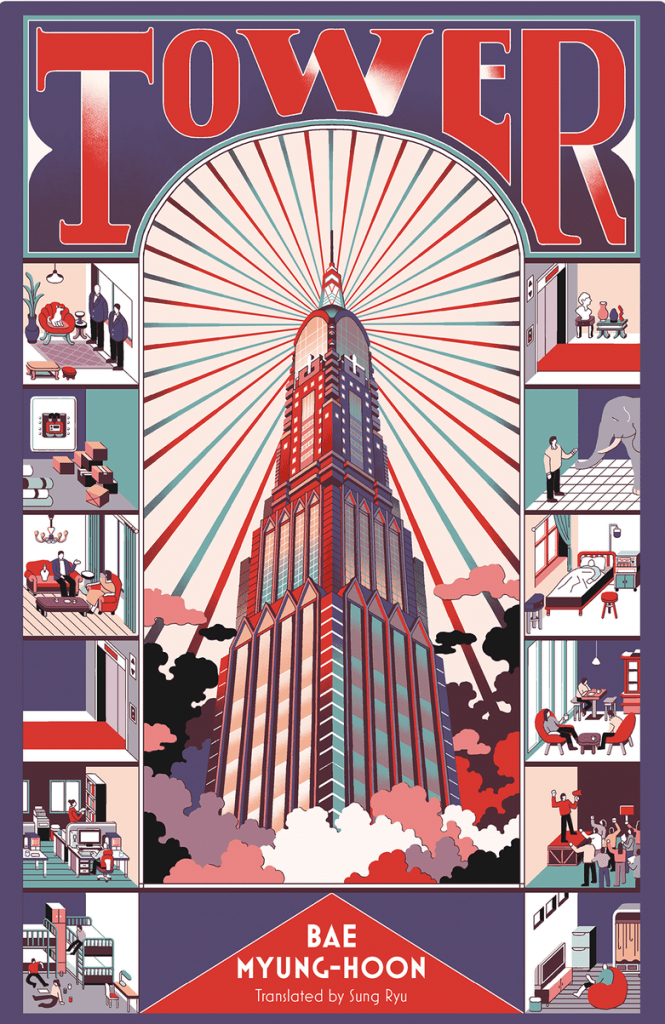
In Tower, Bae Myung-Hoon unveils a kaleidoscope of vignettes anchored around the central pillar of the fictional Beanstalkian society. His vision is Kafkaesque. Whether it’s trying to figure out which elevator leads to which of the 647 floors, arranged like Tetris blocks, or how much to spend when gifting a bottle of liquor without it being considered a bribe, the dilemmas of Bae’s characters are captivating. They are enchanting, not because they take place within the exorbitant tower, but because they are absolutely recognisable.
Illuminating the intricacies of psychosocial and spatial politics, Tower, in both its setting and stories, makes new what is universal. Like all great sci-fi, while Bae’s characters are the product of their environment, they are also peppered with endearing idiosyncrasies that make them endearing, pitiable, tragic, and ultimately relatable. These six stories flit between a powerbroking dog, a downed fighter pilot, to a terrorist ploy, then Beanstalk itself, and yet sustain momentum because they highlight fundamental truths about societies. Bae writes:
After pointing out that the liquor wasn’t any old liquor but the strongest gifting currency in Beanstalk of late, Professor Jung argued that if he put electronic tags on every bottle, entered them into the upper echelons of Beanstalkian society, and closely tracked their circulation, he would eventually get a distribution map of tacit power within the building.
Tagging liquor bottles to trace the “natural flow of the power structure” is not only the absurdist fantasy of an over-earnest professor, but a metaphor for the unspoken laws and peculiarities that govern our own spaces.
And yet, Tower refuses to simplify. Bae steers away from aligning with a single political angle. For example, the dog who bizarrely turns out to be at the centre of this power structure does not necessarily represent any particular leader, just the anomalies thrown up by complex systems. Like the reader, no one in Beanstalk knows who this dog is or why exactly it is at the centre, but when they remove it from the algorithm, the simulations fall apart. Tower itself offers no explanation but instead reveals an underlying structure that eludes the same individuals it governs.
The most memorable of the stories, for me (possibly because it is the story behind the intriguing elephant on the cover), is “The Buddha of the Square”. It is told through an exchange of letters between the protagonist and his sister-in-law, as they discuss both his failing marriage and his new, unconventional occupation. Working as a mounted guard, he is tasked with training an elephant in the art of non-violent crowd control. The protagonist’s account of getting an elephant up to and around Level 321 is as captivating as the premise. We share in his predicament, admiring his initiative of lining the route with flowers, and disagreeing with the sister-in-law who considers his work “clowning around”. Like the protagonist, we take his work seriously, and empathise as he “hang[s] off the elephant, nearly squashed under the low ceiling”.
The sister-in law’s denigration and dismissal of the seriousness of his work taps into a key irony of the story. “The Buddha of the Square” is not at all a farce, but a cutting interrogation of the politics of protest, the ethics of riot control, and the “stamp[ing] out” of anti-war sentiment. As the pacifist elephant, Amitabh, is personified, described as “a nice fellow [with] the kindest eyes” and also a “scaredy-cat”, we pity his exploitation by an increasingly totalitarian government. Emblematic of Tower as a whole, this story also illuminates the danger of naivety in such a system; our protagonist literally riding on his new celebrity, “mesmerised” not by the elephant, but by the status and job security it affords him.
Bae’s elephant brightens up what could easily be a tired political narrative, situating Amitabh at the centre of political, spatial, interpersonal, romantic and even religious crossroads. As the elephant begins to morph into a Buddha-like figure, many citizens take his name, Amitabh, or “Amitabul”, as their new religion. However, while the elephant may be a metaphor for the government’s weaponising of religion, he could equally represent the power of authentic pacifism and righteousness over warmongering. At the end, the sister-in-law asks a key question: “does enlightenment make you immune to pain?” But the power of the narrative is that the reader has to work hard, not to answer, but to understand the question.
“The Elevator Maneuver Exercise” is the first-person narrative of a Government Transportation Official, whose job it is to manage the logistics of both horizontal and vertical transport in Beanstalk. His insight into the divide between “verticalists and horizontalists”, who try to “force one label or other on him”, without “truly understand[ing] what ‘v-winger’ and ‘h-winger’ mean”, begins as a satirical attack on contemporary identity politics. However, when lack of cooperation between the two sides turns sinister in the wake of a terrorist attack, the story becomes a chillingly recognisable dystopia.
In a moment of second person connection with the reader, the narrator doesn’t assume we’ve been to Beanstalk, he knows we have:
You’ve probably felt this when you walk around Beanstalk … loads of places that you have no idea how to get to even though they’re right next to you.
This spatial paradox is a metaphor for our failure to resolve socio-political divides. He asks rhetorically: “we can’t solve the problems of our lives with just one approach or another, can we?” Here, Bae reminds us why we are reading, and in fact why many of us we read sci-fi at all; it abstracts us from our own world in order to make it more visible than it ordinarily is.
In this sense, Bae’s Tower is more social-science than fiction. Tower provides a bizarre backdrop for a series of both personal and national dramas, and in this juxtaposition, I am reminded of the short stories of Leung Ping-kwan. Describing Leung’s unique perspective, Richard Freadman (2008) writes:=
He knows that… the way to politics is through nuanced description of particular lives, and that authentic narrative should begin not with intellectual formulations or political pronouncements, but with basic things like how people “eat, and how they love”.
Tower exemplifies this idea but offers a wider interrogation of the socio-political landscape. Inhabitants of Beanstalk never leave, at least not without navigating the bureaucracy of crossing its national border, making it a microcosm of “nation” and its governing ideologies and mythologies.
None of Tower’s stories showcase this better than “Taklamakan Misdelivery”. While documenting an unlikely rescue mission to recover a downed fighter-pilot, this story provides a historical context for Beanstalk’s conception as a nation. We learn that “Beanstalk was originally just a building instead of a nation” and that “[i]nitially, the Defense Forces’ duty was not to categorise people into nationalities”. However, while initially “Beanstalk’s humility meant that it was not simply another Babel’, things have now changed. Beanstalk now embodies what Benedict Anderson famously called an “imagined community”, in which: “regardless of the actual inequality and exploitation that may prevail in each, the nation is conceived as a deep, horizontal comradeship”–or in Tower’s case vertical.
Its 674 floors, each with its own characters and drama, represent the notion of multiplicity that is fundamental to nation. This realisation strikes the protagonist of “The Elevator Maneuver Exercise”, when he reads a series of stories that take place on level 520. Suddenly realising the multitude of lives that exist parallel to his own, he reflects, “this meant there were over six hundred more worlds in the rest of Beanstalk”. In this moment, the tower metaphor is particularly illuminating. While Bae’s stories open windows onto just a few of these floors, as a microcosm of nation, it is entirely convincing.
But within its governing mythologies, comes prejudice, exceptionalism and internal political division. The nation of Beanstalk is the site of ideological binaries—from the arbitrary (“verticalists and horizontalists”), to the timeless struggle between warmongers and pacifists. But again, Bae resists taking sides. Straddling this demarcation, Tower foregrounds both the value of national borders, as well as their devastating impact on those who find themselves on the outside. When the foreign Navy aviator, Minso, crashes down in the desert outside of Beanstalk, potential rescue forces hesitate, pondering: “Well, it’s not like he’s our citizen.” Here, Bae highlights the cruel reality of nationalist exclusivism. And yet, ultimately, it is the power that nation commands which later allows Minso to be rescued—both in terms of physical Defense Forces and the highly structured international communication it facilitates.
The final story takes Bae’s interrogation of Beanstalk’s politics to its inevitable conclusion. Having sealed itself off to the outside world through borders and ideology, “refus[ing] to even consider threats” from adversaries that it does not consider legitimate nations, Beanstalk makes itself vulnerable. It is in this story that Beanstalk truly embodies its Babelian parallel; ignorant to the truth that the seeds of its demise (quite literally) exist within its own walls.
But it is not only as a metaphor that the tower is striking. Bae’s depiction of space is captivating in its own right. In a beautiful outro, we learn about Terraphobes—the name for many of Beanstalk’s citizens who, living so high above the ground, “believ[e] that the afterlife [is] two-dimensional … a flat plane devoid of a vertical axis”. As his character Choi Sinhak contemplates his impending death, we learn:
He stared down. Just as people living on the ground would gape up at the sky in their final moment, he peered down at the ground with unfocused eyes.
This was how God must feel. Was that what made Beanstalk wicked? The fact that its inhabitants knew how God felt?
It is in these profound moments that the characters’ question their relationship to Beanstalk, to the tower, to each other, and to God. What we do with these insights is not prescriptive, Bae only illuminates them and retreats.
Mulling over enlightened elephants and power-broking dogs, in this final story, we, like the characters, are left questioning. Irresolution is characteristic of Bae’s style, and so as we wait with Beanstalk’s inhabitants for “Judgement Day”, it is unsurprising that “God [hands] down a sentence through His jury: probation”. We are not frustrated by but satisfied with irresolution, because it reflects our own complex reality: a world that does not invite us to think in absolutes.
What Bae’s writing commands is encapsulated in his character Dr Lee’s discussion of a “power field”. He writes:
… a power field is a different story. It is like a gravitational field, where a celestial object warps the space around it due to its mass.
… When power warps the very space around it … even people who believe they are impervious to power begin to show signs of caving in to it and start acting as if they are consciously trying to please it. Whether people intend to cave into power or not, their actions appear more or less the same to an outside observer.
This power field metaphor not only describes Beanstalk, with its grand ideologies of nation, but the book itself. Tower has the same gravitational pull as its physical counterpart. Showcasing both the beauty and corruption of humanity simultaneously, played out on Tower’s parallel storeys, Bae draws in readers of all genres, even those who (like myself) believed themselves largely impervious to sci-fi.
References
Anderson, Benedict. (2006). Imagined Communities. London: Verso.
Freadman, Richard. “Never Quite at Home: Leung Ping-kwan’s Stories of Personal Disjuncture”. Cha: An Asian Literary Journal, vol. 2, February 2008.
How to cite: Hamilton, Lucy. “More Social-science than Fiction: Bae Myung-hoon’s Tower.” Cha: An Asian Literary Journal, 6 Dec. 2023, chajournal.blog/2023/12/06/tower.



Lucy Hamilton is a novelist and academic from Sheffield, UK. Her debut novel, The Widening of Tolo Highway (Penguin Random House SEA, 2022), set in Hong Kong’s New Territories, is now available worldwide. She lectured in Stylistics at the University of Nottingham Ningbo China, and now works at the University of Leeds. [Read all contributions by Lucy Hamilton.]
 Cha
Cha 