
📁 RETURN TO FIRST IMPRESSIONS
📁 RETURN TO CHA REVIEW OF BOOKS AND FILMS
Click HERE to read all entries in Cha on Where Else.
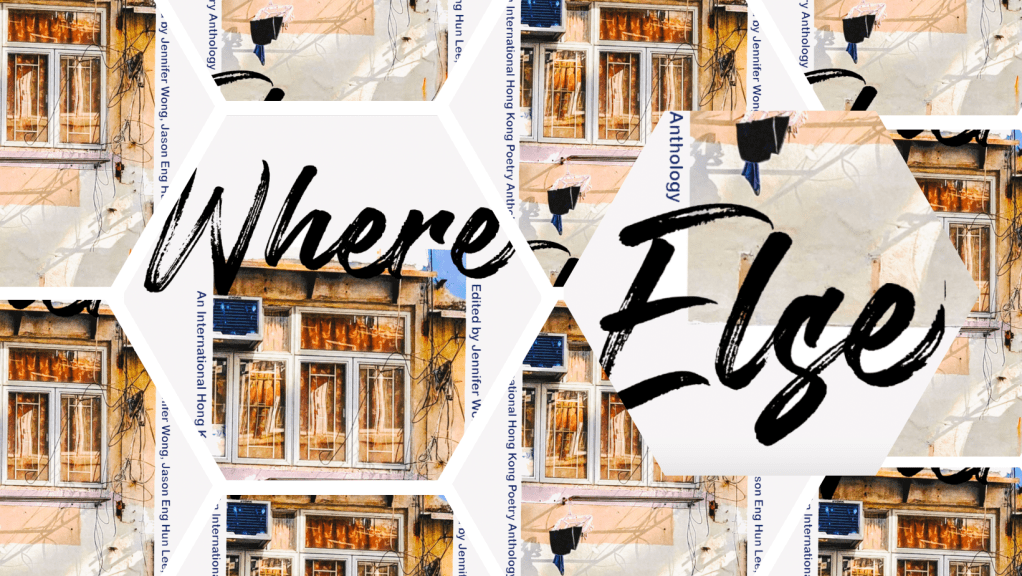
Jennifer Wong, Jason Eng Hun Lee, and Tim Tim Cheng (editors), Where Else: An International Hong Kong Poetry Anthology, Verve Poetry Press, 2023. 219 pgs.

When mapping the development of Hong Kong Literature in English to my students, I often foreground Mike Ingham’s prophecy in the preface to City Voices: Hong Kong Writing in English 1945 to the Present as an uplifting twist,
It will also be one of life’s great and somehow satisfying ironies if post-Handover Hong Kong proves more prolific in producing new writing in English than prior to the ‘Change of Flag’. Nobody would have anticipated such an outcome, but then truth is often stranger than fiction. (15)
Published in 2003, the 400-page anthology, along with its companion book, City Stage: Hong Kong Playwriting in English (2005), was groundbreaking in conferring academic status to the marginal presence of creative English writing in the terrain of Hong Kong literature. Back then, Ingham still observed a tendency among citizens to keep English as a functional language and how drawing it as one’s magical wand remained the choice of a resilient minority. Midway to 2047, Much of the city’s spirit has undergone irreversible changes; hence, it is gratifying to prove the scholar’s vision right after two decades, with the solid evidence of Where Else: An International Hong Kong Poetry Anthology.
The anthology exudes the vibe of an ever-present next-door neighbourhood that bespeaks the flourishing of the Hong Kong English poetry community and welcomes both long-time supporters as well as timid beginners of the genre to read at ease. It collects 106 poems, both previously unpublished and published, from 1997 onwards, by nearly 100 poets. The sheer number of contributors testifies the maturity of the resilient and passionate English literary community in Hong Kong, such as that of Poetry Outloud HK and Peel Street Poetry. Among the chosen poems, there are Louise Ho’s well-known “Home to Hong Kong” and “Island” (which also appear in City Voices), as well as Eric Yip’s recent winning entry “Fricatives” in the UK poetry competition. Doubtless, the publication will claim a significant place among the collective effort of recent years of establishing the field of Hong Kong literature in the global reading community,[1] for its timely renewal of the oeuvre of English poetry. In seven non-chronological sections, it demonstrates how Hong Kong has shed its colonised mentality in the post-1997 period. The cultural space of stock images Yesi resisted has been renovated; what one finds in Where Else is not only the abundance of images but a new Hong Kong, now a versatile sign of personal and collective histories, and still the home commemorated with portraits and snapshots from any possible angles or moments by its many natives and well-intentioned visitors.
The neighbourhood vibe is first conveyed from the white book cover and its photo, which presents the corner of a tong lau common in areas of old districts as yet untouched by urban renewal. In particular, the corner is comprised of a weather-beaten outer wall, heavily curtained aluminium windows, and entangled electric wires. There is no lack of similar vivid sketches in the anthology that capture a fleeting moment, an idiosyncratic occurrence, or routine existence in some inconspicuous corners of the city. For instance, Konstandinos Mahoney’s “Hon Kwong Mansion” depicts the mingling of the sacred and the profane in an aged residential building:
We squeeze into a lift with a bald monk carrying a water bowl with a white flower floating in it, on his way up to the Great Perfection Buddhist Centre, and a buff, tattooed hotty in a tight mesh singlet. He gets off on my floor, disappears into Bobson’s Sauna, a whiff of sex and steam as the door shuts behind him. (194)
John Wall Barger relates the life of a frog freshly bought from the market to the daily melodrama of modern men:
[…] a baseball
of fat, bracing himself
inside the plastic bag
with his weird suction cup hands
like a TV superhero
in deep trouble […] (“At the Market Butcher in Tai Po” 149)
Eddie Tay’s “Office” sympathises with white collars through their repeating gestures and sights:
and you laugh quietly in time for lunchboxes
it’s coffee and brown sugar
and spreadsheets on your screen (160)
The collection’s proximity to working class and bourgeois reality renders the genre, traditionally associated with elite forms, easily relatable.
Addictive attachment to a certain community is foregrounded in the book title, “Where Else”, an interrogative phrase casual in tone for a collection specific to a locale. In its original context, the phrase is embedded in the lines “[‘]Where else / should you be?[’] There. Elsewhere.” (“Hoi Polloi” 200). The Cantonese-speaking persona in Sam Cheuk’s poem decides that, for all his attachment to the city, he can no longer stay due to the shadow of surveillance; his bitterness mirrors the pressure of the migration question faced by many Hongkongers after the anti-extradition bill movement in 2019. In the hands of the three editors of the anthology, the exact sense of the phrase is left ambiguous without the certainty of a punctuation, so that it “…can be a statement, a question, an imperative, a declaration, or a combination of all the above” (“Editors’ Introductions”). The “here or elsewhere” consideration is put forth to everyone in love with the city as the title is forcefully presented in ink brushstrokes.
Where exactly does the neighbourhood called “Hong Kong” lie though? The secondary title, “An International Hong Kong Poetry Anthology”, suggests an answer that is incongruent in nature and yet characteristic of the former colony that has achieved international economic success. In most contexts, it needs little justification that the descriptor “international” is attached to Hong Kong; an explanation of this particular instance is useful in revealing the substantial growth of authorship as well as readership of Hong Kong creative writing in English in these two decades. The long list of contributors, with their diverse ethnic background and places of residence, suggests that the community is not physically bound to the city. For instance, the British poet Viki Holmes, previously active in the local literary circle, now lives in Japan. While the diasporic condition of these poets reflects the migration trend in Hong Kong under Chinese rule, the ongoing appearances of original and exciting poems suggests that the city has attained the significance of what Antony Huen recognizes in “Bauhinia x Blakeana”, a “private sign” that can be activated in numerous subjective and confident associations such as “…you looked like the flower / of my city” and his bedroom on Google Maps (44). “Hong Kong” has become an idea that travels steadily with the poets that claim their allegiance to it. It usually manifests in reality that transcends boundaries such as that of self, time zone, culture, national narrative, and generation, or that it is “an ‘elsewhere’ that is hard to pin down or conceptualise” (“Editors’ Introductions”). Its network, as well as its appeal to overseas readers, is evident in the fact that the current anthology is published by the Birmingham-based Verve Poetry Press. In this light, the persevering poetic community can even be regarded as having successfully refuted the post-Handover process of “An international city becoming national” (“Island” 47).
A good sign of the maturation of Hong Kong English poetry is the unabashed accommodation of Chinese characters and code-mixing in a large number of poems in the anthology. Several of the poems have Chinese titles without annotation. For example, Felix Chow’s “英年早逝” (generically a phrase that describes the death of one in bloom and, in this poetic instance, it is used as a double entendre that refers to the brevity of British colonial years) and Josephine Yip’s “||:碰:||” (A picture and sound imitation of what a mah-jong player with two tiles of the same pattern says to acquire a third one when it is released by another player; the Chinese character is one of the verbal cues in the game). The editorial decision to include a range of styles regarding the integration of Chinese characters or Cantonese slangs (for instance, romanisation, with or without annotation) in the poems underpins open acceptance of the often-hybridised Hong Kong speeches. Actually, it assures the exhilarating capacity for original expressions and perspectives based on the cultural-linguistic politics experienced first-hand by Hong Kong English-writing poets.
To name one mode of poetic mind which can only be raised in the Hong Kong context—when English is subsumed under the brazen and streetwise Cantonese mind. Louise Leung Fung Yee’s “Brew Sky” is one such piece that achieves good fun as well as wit. Noting the mother’s very limited English, like how she would pronounce “blue” as “brew”, the persona then makes creative reflection out of the semantic difference of the “r” sound in Cantonese and English:
Logo is Local, a symbol to claim
Alphabet colonizes places
There is no “r” in 廣東話 [Cantonese]—
except for r 痕 [itch-scratching]:
scratch head when you don’t get
scratch JJ when you horny
scratch away r-less accent to get 5** in DSE oral
With only 25 alphabets to make names,
“r” finds its place in Hong Kong(r). (177; parentheses added)
The confidence with one’s poetic voice manifests in the code-mixing, as well as the carefree shift between formal topics (colonisation, public exam strategy, and the Hong Kong identity) and coarse topics (scratching an itch and grabbing one’s penis). Eventually the persona admits how the coloniser’s tongue, symbolised by the non-existent “r” in Cantonese, is essential in constructing the sense of identity among the locals. As a whole, the anthology should convince bilingual readers (proficient in English and Chinese, including Cantonese) that they are its primary audience, for the poems can touch a large extent of their linguistic consciousness.
Further on the reading experience, Where Else treats readers to constant time travels between different points in Hong Kong history. It can be partially attributed to the greater obligation felt by the poets in recovering histories and herstories from witnesses of the more distant past, such as how the older generation swam to Hong Kong from mainland in River 瑩瑩 Dandelion’s “How We Survived: 爺爺’s Pantoum (II)” and Xiao Yue Shan’s “exodus hong kong”, in which the persona soberly assures that
…the sea—
it is hong kong’s. they will not take
you back from it. it is the first test of the other side’s
forgiveness, to enter admitting you belong nowhere,
that you are no one. (61)
The strong senses of insecurities and disorientation back then can now be stabilizsed in words. Apart from retelling of hardships, there are also the long-gone sceneries in Sarah Howe’s “Calendar” of Beautiful Hong Kong 1983, reinvented from nostalgic gaze.
The imaginary return to the past delivers this refreshing taste when one reads Harry Ricketts’ “Repulse Bay Hotel, Hong Kong (1981)”, a poem that is, as indicated in the brackets, written one year before the closure of the colonial establishment and only first published in the poet’s 2005 poetry collection. Sitting at its famous verandah, the persona starts musing upon the past and future of the place in present tense: “Soon, they say, this elegant façade / will exist only in photos” (43). Readers would be aware that the rumour was right and find themselves enacting the persona’s meditation four decades later:
you find yourself shuddering suddenly
to think of all those, gwai-lo and Chinese,
who have sat, like you, watching
distant flame-trees scarlet out of green.
This foresight from the past begs reconsideration over the continuity between the Hong Kong in memories and the Hong Kong within our current view.
Subject matter aside, it is also the anthology’s non-linear and loosely thematic grouping of the poems that show readers the changes of the socio-cultural landscape of the city. For instance, in the section opening with Louise Ho’s “Home to Hong Kong”, which tautly depicts the cosmopolitan lifestyle of affluent, educated colonial subjects, there is an assortment of more recent poems that celebrate downstairs eateries such as a congee shop and a cha chaan teng. The relish of local flavours, or the thought of the political trouble at home even when dinning in Berlin (“At an East Prussian Restaurant in Berlin”), are representative of the voluntary identification with the city in the post-Handover period. Ho’s idea of “home” across continents receives a bitter renewal, or regression in Hilary Tam’s “想(家)”, literally meaning “miss (home)”, as the persona becomes overwhelmed by the imminent departure from Hong Kong in the airport bathroom.
Lastly, one need not stress how Where Else promises a glimpse into the latest mental outlook of the more self-conscious Hong Kong inhabitants after a critical decade of social movement and pandemic. Postcolonial sentiment gains new interpretation among the post-1997 generation such as Eric Yip. His compact “Fricatives” shows that linguistic imperialism has yet to be extinguished and subjection to it seems to be, ironically, all the more crucial to the young generation’s survival as they would remember well “bruised bodies skinnier than yours” and “the students arrested five years ago” (184, 185). From Shirley Geok-lin Lim, like Ho, another veteran poet, there is the pensive response over the abrupt turn of political development in “Admiralty”: “Five years have passed, / each year in Hong Kong, someone’s last” (118). It harks back to the tear gassing over the society’s appeal for universal suffrage in the election of the Chief Executive in 2014 and notes, in view of the ant-extradition bill movement that took place five years later, the fatalistic blow to its collective sense of belonging. These poems are but two of the many poems that is written in the hope of witnessing the new pages of Hong Kong’s dramatic history. It is only fair to say that the overruling of one system by another is what leads poets more urgently try to deposit personal and collective memories onto the sign called “Hong Kong”.
There are plenty more gems in the anthology than might be included in the current review. I strongly encourage any interested readers to pick up a copy of it and discover their preferred corners of the Hong Kong neighbourhood on their own.
[1] Looking Back at Hong Kong: An Anthology of Writing and Art, edited by Nicolette Wong. Cart Noodle Press, 2021. Penguin Specials:The Hong Kong Series (2017) Hong Kong Literature Series, edited by John Minford. The Chinese University of Hong Kong Press, 2020.
How to cite: Mak, Flora. “Neighbourhood at Heart—Where Else: An International Hong Kong Poetry Anthology.” Cha: An Asian Literary Journal, 22 Nov. 2023, chajournal.blog/2023/11/22/where-else-anthology.


Flora Mak obtained her PhD in English (Literary Studies) at The Chinese University of Hong Kong, with research interest on Romanticism, Modernism, and humanities education. She co-authored The Value of the Humanities in Higher Education: Perspectives from Hong Kong. She is now a happy lecturer of literature and hoping to read more about Hong Kong and Asian literature. She also tries to integrate her support for women’s movement as a daughter, a teacher, and a volunteer. [All contributions by Flora Mak.]
 Cha
Cha 