
[Diary of the Absurd Life in 1997:
All Entries]
TH: Diary of the Absurd Life in 1997, in 28 sections, was written originally in Chinese by Mary Wong and serialised in Ming Pao 明報 in 1997. The pieces, translated into English by Chris Song, are serialised in Cha beginning from Monday 25 September 2023.

.
Melodrama
20/28
.

Bigfeet walked in, wearing a charcoal linen suit, a thick-necked tie with traditional patterns, and black Prada shoes—identical to Ming’s, only three sizes larger. There was an oddness about his attire, an oscillation between trendy and conservative that diverges from his usual sartorial habits. If this ensemble was a love gift from a new girlfriend, it said much about her tastes or, rather, her lack of them. Imagining her reducing fashion to mere conceptual signalling, bereft of any aesthetic or personal considerations, I found myself uninterested in this possibly imagined woman and deeply sympathetic towards Bigfeet.
He shed his jacket and rolled up his sleeves to unblock the toilet. Kwong stood behind him, sporadically breaking into cheerleading poses, infusing the air with a palpable tension. Just then, the doorbell rang—Ming! We’d forgotten that he, too, was supposed to tackle the toilet tonight. Frozen in place, we eventually resigned ourselves to answering the door.
Ming stepped in, immediately spotting the fashionably dressed man exiting the restroom. We could hardly introduce Bigfeet as a mere bathroom visitor. “All clear, shouldn’t be a problem anymore. I’ll take my leave,” Bigfeet muttered before exiting. “This is Bigfeet, a real estate agent, and this is Ming, a phone salesman,” Kwong said, her fingers ceaselessly twirling as if working through an invisible puzzle. I desperately wanted to follow Bigfeet out of this awkwardness.
“See you some other time; I’ll be going now,” Bigfeet left us to mend what he’d unwittingly shattered. “Who was that suit?” Ming asked. He already knew or suspected he did; the interrogation was in the tone. Kwong, already prepared to explain, bristled at his implied accusation. She refused to lay bare the ludicrous chain of events that made up this evening.
At this point, I withdrew to my room, greeting distant friends through the buffer of email.
How to cite: Song, Chris and Mary Wong. “Melodrama.” Cha: An Asian Literary Journal, 14 Oct. 2023, chajournal.blog/2023/10/14/melodrama.


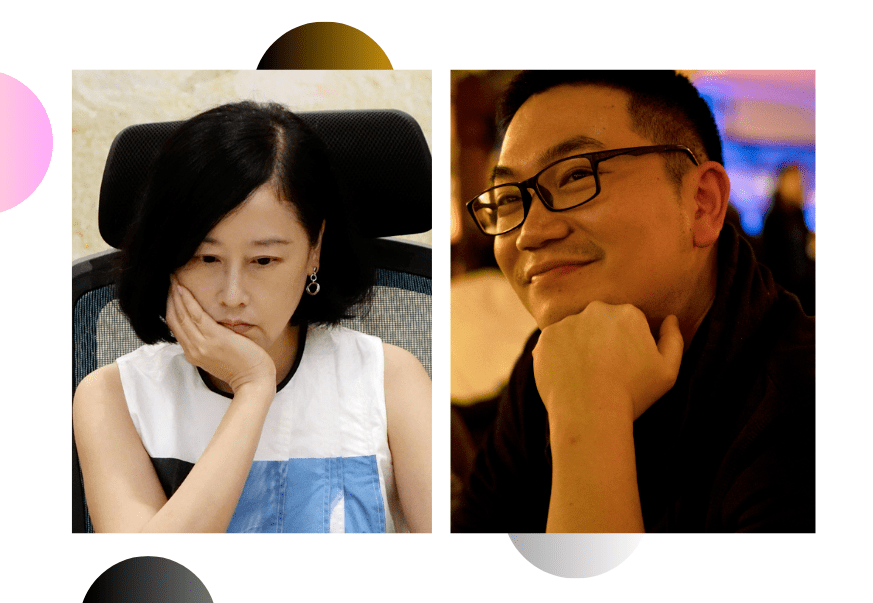
Mary Shuk-Han Wong 黃淑嫻 (author) is a Hong Kong writer. Her short story collection Surviving Central (中環人; 2013) received the “25th Secondary School Students’ Best Ten Books Award.” Her essay collections include How to Live the Sad Days (悲傷的日子如何過; 2021), Against the Grain (亂世破讀; 2017), and From Kafka (理性的遊藝:從卡夫卡談起; 2015). She has also published an online poetry collection, Cave Whispers (絕地抒情; 2022), in collaboration with Hong Kong composer and photographer. She was the co-producer and literary advisor of two literary documentaries: 1918: Liu Yichang (1918:劉以鬯紀錄片; 2015) and Boundary: Leung Ping Kwan (東西:也斯紀錄片; 2015).


Chris Song (translator) is a poet, editor, and translator from Hong Kong, and is an assistant professor in English and Chinese translation at the University of Toronto Scarborough. He won the “Extraordinary Mention” of the 2013 Nosside International Poetry Prize in Italy and the Award for Young Artist (Literary Arts) of the 2017 Hong Kong Arts Development Awards. In 2019, he won the 5th Haizi Poetry Award. He is a founding councilor of the Hong Kong Poetry Festival Foundation, executive director of the International Poetry Nights in Hong Kong, and editor-in-chief of Voice & Verse Poetry Magazine. He also serves as an advisor to various literary organisations.
 Cha
Cha 