
[Diary of the Absurd Life in 1997:
All Entries]
TH: Diary of the Absurd Life in 1997, in 28 sections, was written originally in Chinese by Mary Wong and serialised in Ming Pao 明報 in 1997. The pieces, translated into English by Chris Song, are serialised in Cha beginning from Monday 25 September 2023.

.
Gusts of Bleakness
12/28
.
Ming found himself enveloped in the very scents and shadows he had previously only captured on film; the ambiance floated between the real and the unreal. Having carved out a niche in the mobile phone business, he had some savings but felt out of place among these people, for whom even pyjamas needed to be designer labels. But there was no inferiority in Ming. His award-winning short film and youthful zest gave him a jolt of confidence and ambition. Still, where should that ambition lead? He wasn’t sure. The Italian restaurant on a high floor of a five-star hotel by the Wan Chai waterfront added a layer of exotic surrealism to his unease. His experience of Italian food had been limited to Pizza Hut and diner-style pasta; never had he ventured beyond his mother’s set menu. Unreflective about his dietary restrictions, he’d counter my teasing about his conservative palate with a machismo that dismissed such trifles. That night, he looked tentatively adventurous at an array of colourful, slightly tangy appetizers. But as Kwong and I approached, he took brisk strides back toward the familiar terrain of pasta.
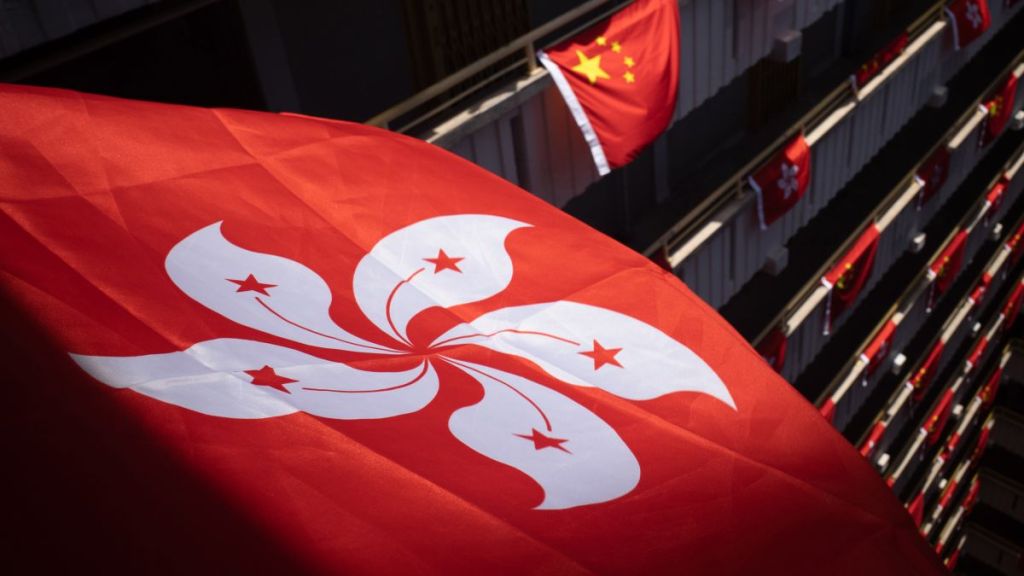
It’s unlikely that her boss would ever agree to meet with Ming. After the cocktail party, as we walked by the Convention and Exhibition Centre, he confessed that his new film proposal had felt exceedingly rough. In the cool breeze of the waterfront, among newly raised flags, he almost believed his pitch to have been drunken nonsense. Though I didn’t dwell on it, his words carried a tinge of guilt. Was it a sense of betraying his social class? Or a lack of courage to reinvent himself?
Night had fallen on Harbour Road, and there were few people around. Despite being old classmates, Ming and I had never had a serious conversation. Waiting for Kwong to wrap things up, we decided to sit in a nearby garden. Here, Ming became unusually reflective, venting his recent workplace frustrations. The flags fluttered in shifting hues, casting their unpredictable lights. I may have had my prejudices against Ming, but in this fluctuating atmosphere, I tried to see him through the compassionate lens of Kwong, to consider the merits this ordinary man might possess.
How to cite: Song, Chris and Mary Wong. “Gusts of Bleakness.” Cha: An Asian Literary Journal, 6 Oct. 2023, chajournal.blog/2023/10/06/bleakness.


Mary Shuk-Han Wong 黃淑嫻 (author) is a Hong Kong writer. Her short story collection Surviving Central (中環人; 2013) received the “25th Secondary School Students’ Best Ten Books Award.” Her essay collections include How to Live the Sad Days (悲傷的日子如何過; 2021), Against the Grain (亂世破讀; 2017), and From Kafka (理性的遊藝:從卡夫卡談起; 2015). She has also published an online poetry collection, Cave Whispers (絕地抒情; 2022), in collaboration with Hong Kong composer and photographer. She was the co-producer and literary advisor of two literary documentaries: 1918: Liu Yichang (1918:劉以鬯紀錄片; 2015) and Boundary: Leung Ping Kwan (東西:也斯紀錄片; 2015).


Chris Song (translator) is a poet, editor, and translator from Hong Kong, and is an assistant professor in English and Chinese translation at the University of Toronto Scarborough. He won the “Extraordinary Mention” of the 2013 Nosside International Poetry Prize in Italy and the Award for Young Artist (Literary Arts) of the 2017 Hong Kong Arts Development Awards. In 2019, he won the 5th Haizi Poetry Award. He is a founding councilor of the Hong Kong Poetry Festival Foundation, executive director of the International Poetry Nights in Hong Kong, and editor-in-chief of Voice & Verse Poetry Magazine. He also serves as an advisor to various literary organisations.
 Cha
Cha 