
📁 RETURN TO FIRST IMPRESSIONS
📁 RETURN TO CHA REVIEW OF BOOKS AND FILMS
Click HERE to read all entries in Cha on The Perils of Interpreting.
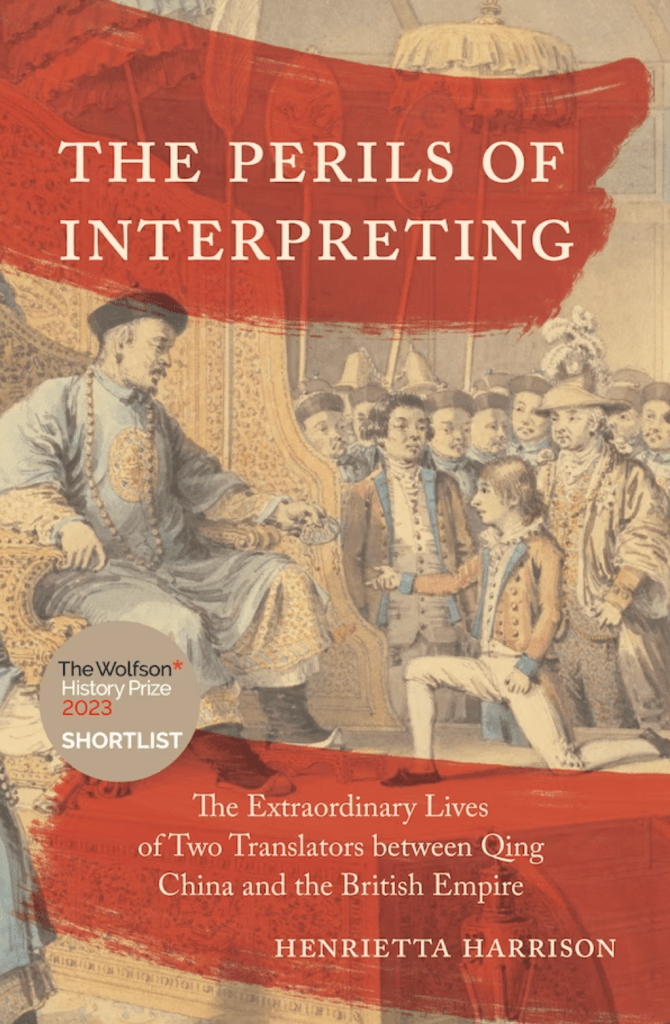
Henrietta Harrison, The Perils of Interpreting: The Extraordinary Lives of Two Translators between Qing China and the British Empire, Princeton University Press, 2021. 312 pgs.
The Manchu-conquest state of Qing China knew all about the power of language. During the 18th century, to facilitate their work at court, missionaries were allowed to study both Manchu and Mandarin. For Westerners looking to trade with the Great Qing, the situation was very different. Under the Canton system, all Westerners were expected to write their correspondence in their own language, to be then translated by Chinese linguists before being forwarded to the relevant Qing officials by Hong merchants. This was considered a practical policy. Not only was it a way to preserve the hierarchical distinction between Qing China and those states seeking to trade with it, but it was also a way of controlling Westerners, who were viewed as neither trustworthy nor peaceful. According to Qing officials, the only binding version of any foreign correspondence was the Chinese version—and this would remain so until the Second Opium War and the Treaty of Tianjin in 1858, when English, as the accepted language of diplomacy and trade, would take its place.
In 1760, the teaching of Chinese to foreigners was made a criminal offence. And, in 1758, the Qianlong Emperor had barred any foreign ships from entering any port except Canton. Unhappy with this situation, the British made several attempts to send their ships north to break this “Canton system”. In 1759, James Flint, an interpreter for the East India Company, sailed north to Ningpo to lodge a complaint against Qing officials. As a boy, he had been left behind in Qing China by an East India Company ship and became the first British man to achieve some fluency in Chinese. He was appointed subsequently as an official translator for the East India Company. But, in the writing of the complaint against the Qing officials, he had sought help from a Sichuan merchant, Liu Yabian. Incensed by this flagrant breach of Qing law, officials sentenced Flint to three years imprisonment in Macau for his trouble. As for Liu Yabian, he was publicly executed as an example to any Chinese who might aid “barbarians”.
Such are the perils of interpreting.
It was not just the command of language but knowledge of the other that was also at issue for Great Britain and Qing China.
All across Europe, during the 18th century, there were competing visions of China and it was the subject of much debate. For some, influenced by the letters, books, and reports written by Jesuits, and often with on eye on their own imperfect societies, China was an ancient civilisation, headed by an enlightened and benevolent ruler, its people administered to by honest and talented officials, and its society regulated not only by Confucian morality but also by laws that were rationmperor of China was nothing but a brutal despot, the country’s officials wholly corrupt and self-serving, the people dishonest and avaricious, and the masses kept in check only by a barbaric and bloody system of laws and punishments.
For Great Britain, always suspicious of anything a Jesuit might have to say, it is probably true that the latter view prevailed. And certainly, as the British empire expanded throughout India and began to consider its economic interests in the Orient as of paramount importance, the reports sent back by British sailors and traders regarding the contacts with Chinese traders and officials—often very critical—were noted, even if it was understood that these reports were self-serving, the British sailors ashore unruly and violent, and the British traders as dishonest and as avaricious as any others. Indeed, British sailors were involved in some notable brushes with the Qing legal system, which affected British public opinion. And then came the Macartney embassy of 1793-94 (of kowtow fame, or perhaps infamy) which confirmed the worst about Qing China for Great Britain, not just because of its failure, but also because of publications written by members of the embassy afterward.
But what of Qing China’s knowledge of Great Britain?
It is probably true that research on Qing China’s impressions of, and engagements with, Great Britain remains inadequate. In recent years, some have argued that the Qing China stereotype of wholesale ignorance of the Western world is incorrect. Certainly, Chinese merchants along the south-eastern coastline had gained a great deal of knowledge of the British—some of it accurate, some much less so—and a few Chinese sailors had actually travelled to Great Britain and returned to report on what they had seen there. But it seems that this deeper knowledge of the aggressive and expanding British maritime empire remained confined to the south-east of Qing China, and the Qing court demonstrated no great interest in learning about European nations—or, more importantly, saw the need for such interest. When informed of the proposed embassy from Great Britain in 1792, it is said that no official in Peking could say exactly what country this was or how far away it lay. And certainly, the Qing court had no real understanding of the embassy’s commercial and diplomatic intentions.
It is within this climate of mutual ignorance and xenophobia that Henrietta Harrison sets her new book The Perils of Interpreting, which focuses on the Macartney embassy and the lives of two very different interpreters who accompanied it: one English, one Chinese.
Let me say first that any new history set about this time that shines a light on the relationship between Great Britain and Qing China and the failure of the Macartney embassy is to be welcomed. Though there have been some good books recently for the general reader on the Opium Wars, there are far too few on the Macartney embassy and Anglo-Chinese relations throughout the 18th and 19th centuries. For what is considered the most informative source for the general reader, we have to travel back to 1989 and the publication of French diplomat Alain Peyrefitte’s L’Empire immobile ou le choc des mondes (published in the UK as The Collision of Two Civilisations in 1993)— a book much criticised in academic quarters for painting too dark a picture of Qing China among other things, as well as being referred to by Frank Dikötter, perhaps unfairly, as “lowbrow”. And then we have Stephen Platt’s outstanding Imperial Twilight (2018), which begins with the Macartney embassy and describes the build-up to the Opium Wars, and finally Eoin McDonnell’s Kowtow (2021), which tells the story of the Macartney embassy with a focus on Lord Macartney himself. There is not much more.
By contrast, for the academic reader there is a host of papers and dissertations, and a couple of very well-respected books, namely Ritual & Diplomacy: The Macartney Mission to China 1792-1794 ed. Robert Bickers (1993); Cherishing Men From Afar: Qing Guest Ritual and the Macartney Embassy of 1793 by James L. Hevia (1995); the almost esoteric The Clash of Civilisations: The Invention of China in Modern World Making by Lydia Liu (2004), where the author introduces her concept of “super-signs”, and is as much a history of translation as it is of British and Chinese interactions; and finally, and this is in no way an exhaustive list, there is Asian Empire and British Knowledge by Ulrike Hilleman (2009) which examines the various routes by which Great Britain gained knowledge of Qing China.
It is hard to say which category of historical writing The Perils of Interpretation fits into, whether for the general or academic reader—a distinction, admittedly, for the best of historical writing is blurry to say the least. The Perils of Interpreting is eminently readable and accessible, with no pages of methodology or past literature reviews to wade through. However, for someone new to the study of the relationship between Great Britain and Qing China confusion at times might prevail. The interactions between the British—diplomats, traders, and sailors of the Royal Navy—and the Chinese—traders, officials local to Canton, and the Qing court in Peking—are complex. This is also true, as we have already seen, for the internal dialogue going on within Great Britain as it expanded its empire, and for the internal conflicts within Qing China, such as the ever-present Manchu-Han dichotomy, as well as the social and economic problems that were beginning to undermine the Qing Dynasty toward the end of the 18th century. Without this “feel” for the history of the time, the importance of some of what is being said within the pages of The Perils of Interpreting might escape the general reader or indeed leave them scratching their heads.
To state the obvious, all historical narratives contain an element of interpretation in themselves. Sifting through a multitude of primary sources, a historian must choose which of these sources should be included within the historical narrative—and, of course, which should not. Then there are the secondary sources: which sources are to be read and reflected on, agreed, or argued with, and which are to be simply ignored. And, for those events for which sources are lacking, the historian must speculate on what might have happened and why.
For the academic reader with specialised or good general knowledge with regard to the events laid out in a historical narrative, the risks of misinterpreting the narrative may not be that great. They may agree or disagree with the written narrative, may well ponder those sources chosen and those ignored, but they will not be led astray. For the general reader, who may not have the luxury of specialist knowledge, they may well accept the narrative as historical truth, and remain unaware of all the choices the author might have made and be wholly dependent on the author’s interpretation of the historical facts. Such are the perils of historical writing and historical interpretation.
But the interpretation of historical events does not stop there. In the telling of any story—historical or otherwise—an author must decide on the limits or framing of that story, as well as for whom that story is being told. The framing of the story is important, for the argument being made must be clear and precise and properly delineated. For instance, in the writing of a novel there can only be one premise. I would argue the same is true for a historical narrative.
And the framing of The Perils of Interpretation is unusual, to say the least. Its subtitle, The Extraordinary Lives of Two Translators Between Qing China and the British Empire, gives us a clue that the book is intended to be a dual biography—of a sort. Dual biographies are comparatively rare and notoriously difficult to write. The subjects of such biographies need to have had some long-standing close relationship—personal or work-related; or their lives to have been on a collision course and to be present together at some significant historical event; or, even if separated by some great geographical distance, to have lived what can only be described as parallel lives, else the framing of the narrative in this way will have little meaning.
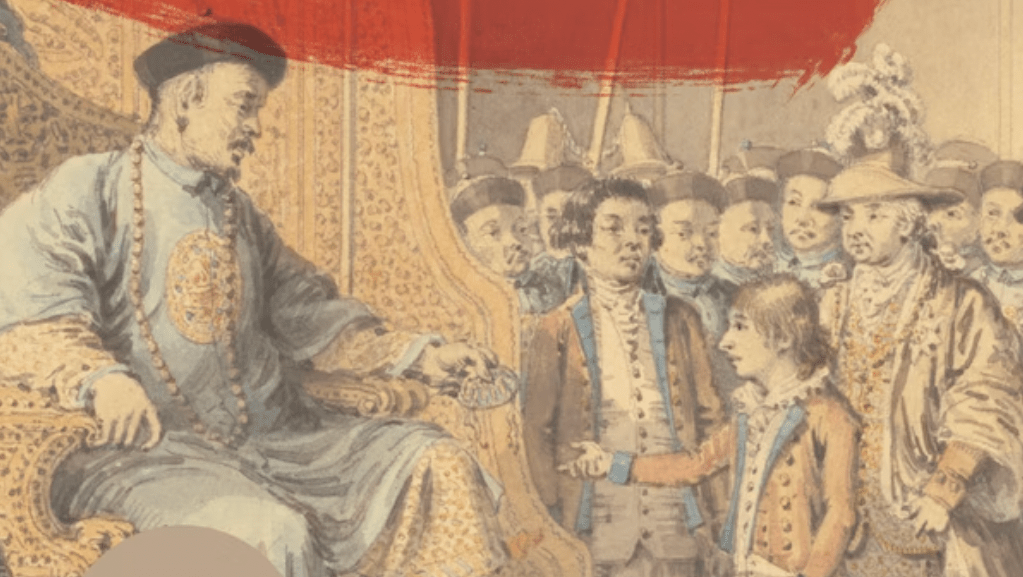
Henrietta Harrison has taken the second option, in that the two subjects of her book—George Thomas Staunton and Li Zibiao—were both present with the Macartney embassy. However, this is still an unusual choice. The Macartney embassy was certainly historically significant, but how personally significant the embassy was for either George Thomas Staunton or Li Zibiao is open to debate. George Thomas Staunton (1781–1859) was but a boy at the time, and even if his kneeling before the Qianlong Emperor and muttering his thanks in Chinese for a gift of a silk purse would prove a useful memory to evoke in future contacts with Qing officials, it was far from the culmination of his life and work, as we shall see below.
As for Li Zibiao (1760—1828), a Catholic and recruited for his language skills from a college in Naples by the Macartney embassy, he was first and foremost a man of faith. The risks he took as an interpreter for the Macartney embassy, though significant, were no more significant than the risks he would take later tending to his religious flock in the village of Zhaojialing, Shanxi, for the remainder of his life. And though he would remember George Thomas Staunton, and though they would exchange letters in the years following the embassy, I wonder if, on his deathbed, he pondered the Macartney embassy, or whether he reflected instead on the Western classical education he had received in Naples and the lifelong friends he had made there, his private audience with Pope Clement XIV—who had given his permission for Li Zibiao to attend the Macartney embassy and return to China—and the work he had done subsequently administering to Catholics in China in an increasing intolerant environment for Christians, and whether he had upheld his faith and done his duty to God as he should.
Herein lies the problem with The Perils of Interpreting: it is neither one thing nor the other. It is neither a straightforward history of the Macartney embassy, nor is it a full and insightful biography of the lives of two fascinating men. That is not to say that the book is not replete with fascinating information on the Macartney embassy and on the lives of George Thomas Staunton and Li Zibiao. But the framing of the narrative in terms of a dual biography, and with the first half of the book focused on the Macartney embassy alone, is its weakness. Moreover, as literary agents will coolly explain to budding memoirists from time to time, very few lives are interesting enough to be worth reading about. Fans of microhistories might object to this view, but there is a reason Li Zibiao usually remains a footnote in histories of the Macartney embassy—if, indeed, mentioned at all. It is true that Li Zibiao did something brave and possibly very reckless (some might say stupid) during his time with the embassy, and was loved by all he came into contact with him. But, from a biographical point of view, despite his unusual classical education, Li Zibiao’s life is rather one-dimensional, and except perhaps to the people of Zhaojialing, somewhat uninteresting.
The same cannot be said of George Thomas Staunton. Not only would he go on to have an important career in Canton as a translator for the East India Company but, in 1810, he would produce his translation/interpretation of the Qing legal code, the Ta Tsing Leu Lee (Da Qing Lü Li), the only translation of its kind for over 180 years. This, the crowning achievement of George Thomas Staunton’s life, is afforded but two pages in The Perils of Interpreting. Which is a great pity, as the choices George Thomas Staunton made, his interpretation of the Ta Tsing Leu Lee, his decision to frame it in the mode of Western law so as to make it comprehensible as a legal code to Western readers, would have very important ramifications in terms of the West’s understanding of Qing law (and therefore Qing society) for both good and ill for a very long time.
The unfortunate and uncomfortable framing of The Perils of Interpreting is necessitated by the choice Henrietta Harrison has made to examine three connected—but distinct—themes throughout the narrative: firstly, that at the time of the Macartney embassy a great many links already existed between Qing China and the rest of the world; secondly, interpreters were vitally important to the commercial and diplomatic interests of both Qing China and Great Britain, despite the all too apparent dangers of the role; and, thirdly, how internal issues and pressures within both Qing China and Great Britain impacted not only the Macartney embassy but also the relations between the two empires in the years thereafter. Each one of these themes is substantive enough to be worthy of a book. But, perhaps, trying to examine all three at once is a recipe for confusion—the arguments made not as clearly put forward and delineated as they should.
Returning to my point about how the general reader, lacking in specialist knowledge, might easily be misled, there are instances in The Perils of Interpreting where the general reader might well reach the wrong conclusion. Much is made of George Thomas Staunton’s father (confusingly George Leonard Staunton) being a slave-owner. George Leonard Staunton accompanied Lord Macartney on the embassy as his secretary, taking, as we have seen, his son, George Thomas Staunton, along with him. Though George Leonard Staunton being a slave-owner adds very little to the narrative of the Macartney embassy, I suppose it is de rigueur these days for slaving connections to be discussed in regard to British aristocracy—and it does add a little to George Thomas Staunton’s biographical detail. And yet within the narrative we learn very little about Qing society at the time of the Macartney embassy except for the Manchu-Han tensions—and even these are not properly examined. The general reader is left with no clue that slavery was endemic in Qing China, even if of a different kind.
To take this point further, and quoting from The Perils of Interpreting:
Macartney […] was struck by Liang’s unpretentious manner and the kindness and courtesy with which he treated his subordinates and servants, an aspect of Chinese life that was significantly different from the more rigid class hierarchies in Britain at the time.
Chapter 8, p. 104
I am quite sure it was not Henrietta Harrison’s intention to mislead the general reader into assuming there was no social stratification in Qing China, or even (most amusingly) that all Qing officials treated their staff with kindness and courtesy and that Qing China was some kind of Confucian utopia—even if the text suggests as such. It is not that I am asking for the inclusion of examples of Qing officials who abused their maids or beat their servants to death—which some surely did—but that further, more detailed, context be put before the general reader. This lack of detail in regard to Qing society—how the people lived, how the people were administered to—is a serious weakness to the narrative. As for the unintended instances where the general reader might be misled, that has to be due to a lack of editorial rigour.
In fact, many parts The Perils of Interpreting do feel rushed, and lacking in editorial control and attention to detail. Poor Sir Erasmus Gower, captain of HMS Lion, the ship that took the Macartney embassy to China, is referred to, rather confusingly, as Ernest Gower. And, throughout the book, the Royal Navy is referred to as the British navy—which, though technically correct, is a little jarring to my ears, and would probably impress Sir Erasmus Gower even less.
These last points are minor, and though they do not undermine the greater part of the text, or cause me to distrust any of the vast array of sources that Henrietta Harrison has used in the writing of her narrative, they are perhaps indicative that her book could have been better than it is.
But the greatest weakness of the narrative is its framing: is it the story of the Macartney embassy? Is it a dual biography? Is it about the perils of interpreting and the many problems inherent in the translation of Chinese into English and vice versa?
The modern interpretation of the Macartney embassy is that it was but the natural consequence of increasing global connections rather than the “clash of civilisations”—a view that Henrietta Harrison adheres to. And yet, in considering the studied ignorance of the Qing court, and the shock and awe—to use modern parlance—soon to be wrought upon Qing China by the Royal Navy, I would say that both historical theories have merit. It is one thing to note the many interactions between Chinese and British traders, that Chinese sailors actually reached the shores of Great Britain and that men of faith like Li Zibiao actually travelled to Italy for a classical education, but quite another to say that any useful information from these interactions reached the Qing court. This point is well made in The Perils of Interpreting, if not the necessary strategic implications.
As for the vital roles played by interpreters and the dangers inherent in that role, this theme is examined in great detail through the experiences of Li Zibiao during the Macartney embassy, but less so in terms of George Thomas Staunton. How much danger was he ever actually in? What is lacking in the narrative is an insight as to why the Qing court took the decisions it did in prohibiting the teaching of the Chinese language and the forbidding of selling Chinese books, its need to control the language of diplomacy and trade, and the history and psychology of the politics behind this. It is possible that Henrietta Harrison feels these are self-evident, but to the general reader perhaps they are not.
Less successful, I feel, is the discussion of the internal pressures faced by both Great Britain and Qing China. The general reader might not have the background to fully appreciate the workings of the British empire in India and elsewhere—not least of the machinations of the East India Company—and how these were discussed, debated, and argued about at length within Great Britain at that time. As for Qing China, as I have already mentioned, not enough is written in The Perils of Interpretation about the state of Qing society and internal politics, and certainly not enough about the social and economic stresses that were later to tear the Qing Empire apart—and arguably do more lasting damage that anything the Royal Navy would ever achieve.
Putting aside the unfortunate framing of the narrative and its inherent weaknesses, this is one of those instances where more rather than less would have been better. Because, given the many primary sources consulted and the historical importance of what happened between Great Britain and Qing China, the subject matter is deserving of a much longer, much more detailed treatment—and would have proved much more satisfying to both the general and academic reader. To reiterate, there is a strange feeling the book was rushed, both in its writing and in its editing.
All in all, despite its weaknesses, The Perils of Interpreting remains a welcome and fascinating addition to the literature of the Macartney embassy. If the questions posed by the narrative, and the matters left unexplained or unexplored within it, spark an interest in the general reader to explore further the relationship between Great Britain and Qing China, or inspire the academic reader into areas of future study, then so much the better.
Alas, for myself, I feel The Perils of Interpreting is a missed opportunity. It was good to learn about Li Zibiao, brave, decent, and kind man that he was. But—and, admittedly, speaking as an Englishman—what the world still needs is a large and comprehensive biography of George Thomas Staunton, whose translation/interpretation of the Ta Tsing Leu Lee would do so much to influence Western legal historians’ understanding of Qing China for so many years after. And maybe in that biography much more could be written of his great friend, Sir John Barrow, who attended the Macartney embassy as his mathematics tutor, and whose book on his experiences in Qing China with the embassy—Travels in China (1804)—would do more to fuel a negative opinion of China in Great Britain and across Europe than perhaps any other. And what about Robert Morrison, George Thomas Staunton’s other friend, whose approach to interpreting and translations would prove so different and who would heavily influence—not necessarily for the best—the commercial and diplomatic work to come? Both these friends of George Thomas Staunton get their mention within the pages of The Perils of Interpreting but, like George Thomas Staunton, they deserve so much more consideration.
How to cite: Westwood, Laurence. “A Recipe for Confusion: Henrietta Harrison’s The Perils of Interpreting.” Cha: An Asian Literary Journal, 5 Oct. 2023, chajournal.blog/2023/10/05/perils.


Laurence Westwood is a retired criminal investigator and security consultant with a long-standing fascination with the history of China—with a special focus on Chinese legal and military history. He currently writes the Philip Ye crime novels set in contemporary Chengdu, Sichuan, and the Magistrate Zhu mysteries set during the Song Dynasty. He can be found on twitter/X at @LWestwoodAuthor and his website. [All contributions by Laurence Westwood.]
 Cha
Cha 