
[Diary of the Absurd Life in 1997:
All Entries]
TH: Diary of the Absurd Life in 1997, in 28 sections, was written originally in Chinese by Mary Wong and serialised in Ming Pao 明報 in 1997. The pieces, translated into English by Chris Song, are serialised in Cha beginning from Monday 25 September 2023.

.
Roles
10/28
.
After the housewarming, Ming made it a habit to visit us every Saturday afternoon. Each time, he would bring snacks that Kwong liked, along with rented videos. They would while away the afternoon eating and chatting. On regular days, Ming dressed casually, opting for a cotton T-shirt, jeans, and leather shoes. However, his attire would completely transform when he had to meet clients or attend important events, making him seem like an entirely different person with no apparent connection to his everyday self. Ming was clearly conscious of the roles he portrayed.
Kwong told me she sensed the duality in Ming, and it wasn’t just about how he was dressed. She felt more at ease when they were alone; however, when they were in a group, he seemed to assume the role of a nonchalant artist, creating a subtle distance between them. This saddened her, but she also wondered if perhaps she was being overly sensitive. Over time, she too unconsciously developed two different attitudes in response to him, and it felt somewhat theatrical when she acted them out. Yet, she approached it all kind-heartedly.
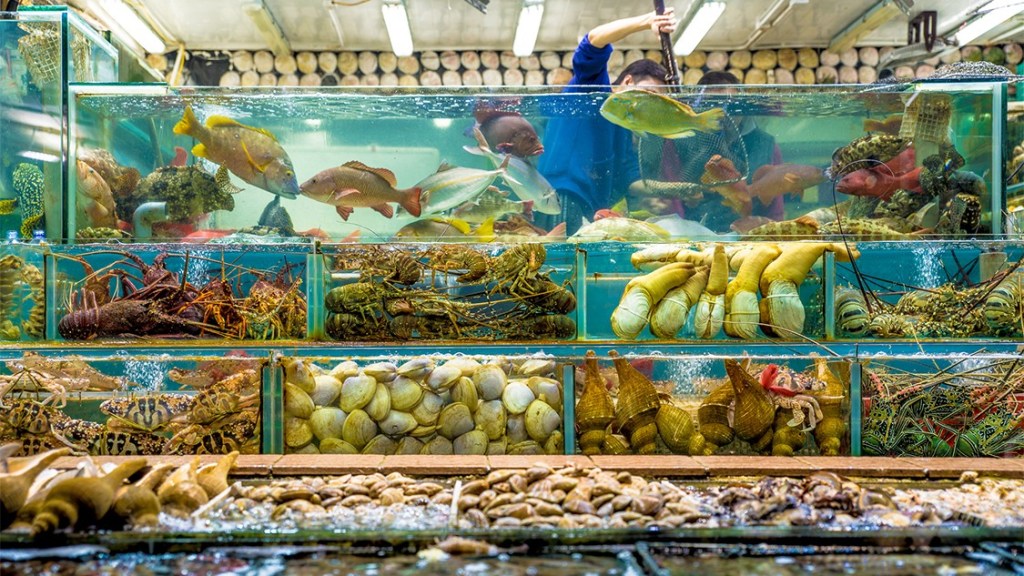
The three of us had some joyful times together. Many Saturdays, after Kwong finished work, she and Ming would head to Sai Kung to buy fresh seafood and then cook delicious dishes. Sometimes when I was home, we would eat, chat, and discuss all sorts of things, including films we’d seen. Occasionally, reminiscing about our college days studying film, Ming and I would burst into uncontrollable laughter at just the mention of a word or phrase. Kwong would chime in, insistently asking us to tell her what was so funny. Doubled over in laughter, we’d tease each other back and forth, much to the delight of an animated Kwong.
Sometimes, she would privately share with me her thoughts about Bigfeet, whom she had completely lost contact with. She wasn’t being nostalgic; she pointed out the two of them were different, as different as large and small feet. She had come to appreciate smaller feet too. Like Manzhen, she found that the more she looked at what she had, the more she valued it. Her only concern was: why do I sometimes become aware of the roles he is playing? What role am I playing?
How to cite: Song, Chris and Mary Wong. “Roles.” Cha: An Asian Literary Journal, 4 Oct. 2023, chajournal.blog/2023/10/04/roles.


Mary Shuk-Han Wong 黃淑嫻 (author) is a Hong Kong writer. Her short story collection Surviving Central (中環人; 2013) received the “25th Secondary School Students’ Best Ten Books Award.” Her essay collections include How to Live the Sad Days (悲傷的日子如何過; 2021), Against the Grain (亂世破讀; 2017), and From Kafka (理性的遊藝:從卡夫卡談起; 2015). She has also published an online poetry collection, Cave Whispers (絕地抒情; 2022), in collaboration with Hong Kong composer and photographer. She was the co-producer and literary advisor of two literary documentaries: 1918: Liu Yichang (1918:劉以鬯紀錄片; 2015) and Boundary: Leung Ping Kwan (東西:也斯紀錄片; 2015).


Chris Song (translator) is a poet, editor, and translator from Hong Kong, and is an assistant professor in English and Chinese translation at the University of Toronto Scarborough. He won the “Extraordinary Mention” of the 2013 Nosside International Poetry Prize in Italy and the Award for Young Artist (Literary Arts) of the 2017 Hong Kong Arts Development Awards. In 2019, he won the 5th Haizi Poetry Award. He is a founding councilor of the Hong Kong Poetry Festival Foundation, executive director of the International Poetry Nights in Hong Kong, and editor-in-chief of Voice & Verse Poetry Magazine. He also serves as an advisor to various literary organisations.
 Cha
Cha 