“I had no regrets till I met you. Now my regrets could kill me.”
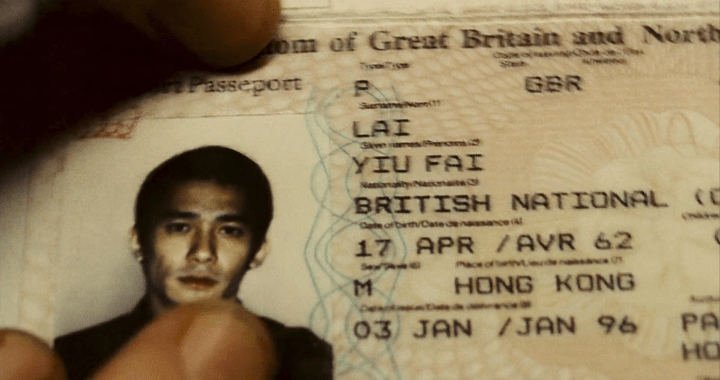
And then Lai Yiu-Fai (Tony Leung) runs away into the night, away from Ho Po-Wing (Leslie Cheung).
It’s a moment of breaking, of a heart shattering, of a relationship ending again but for the first time on screen. The ending doesn’t last and we watch these two orbit one another, hurt each other and themselves.
Claustrophobic, even when the scenery expands. We’re in Argentina for this one, leaving China and Hong Kong behind. But, even leaving behind Hong Kong’s cramped streets and the neo-noir escapades, we get perhaps his most claustrophobic movie to date.
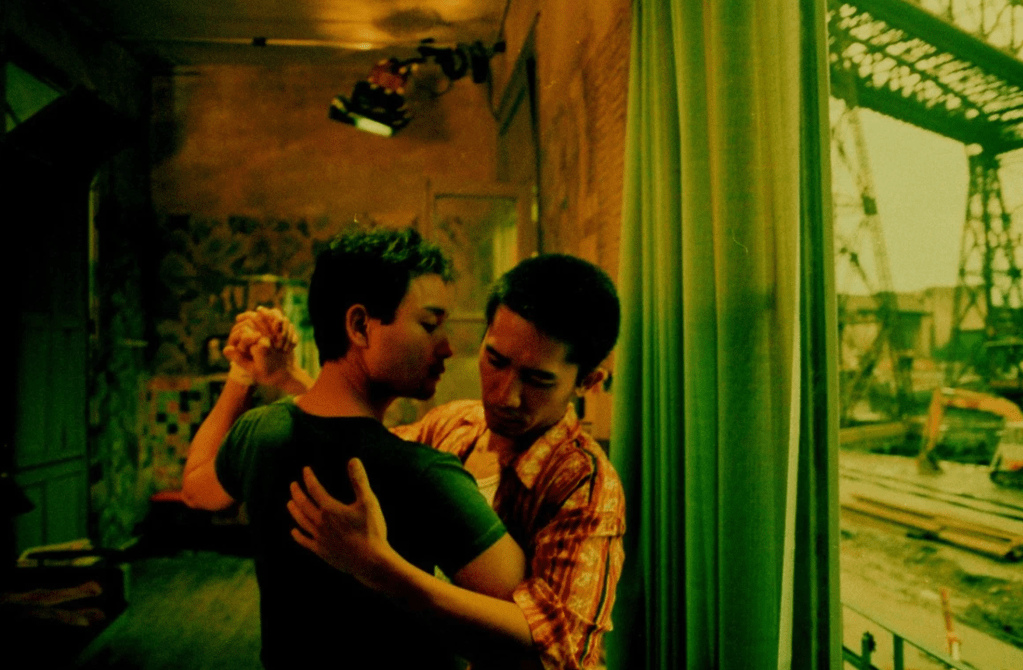
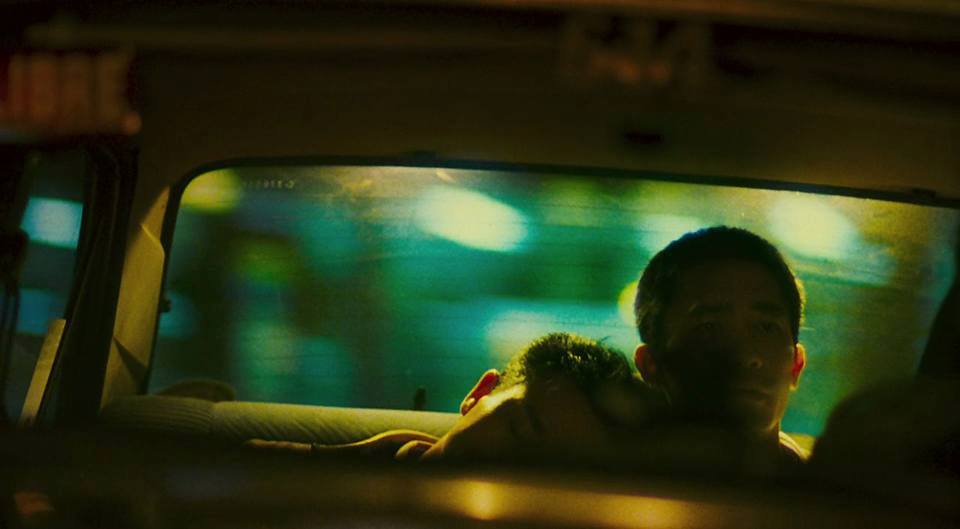
This whole movie is Fai and Po-Wing. There’s another character who pokes his head into the movie periodically, but this is all about these two men and their disastrous relationship that they want to break free of but also cannot live without.
Along with that, they are literally trapped in Argentina. They don’t have the money to buy a ticket home, and so Fai works menial jobs as a doorman and then a dishwasher/cook. Po-Wing lives perilously, bouncing between lovers, refusing to get a job or to even really take care of himself.
Watching this movie so closely focused on these two reminded me of so many relationships, both my own and those of others. A fountain spewing memories to rain down upon me, soak me through, and leave me as broken as Fai and Po-Wing.
A great wailing. A mourning.
A mourning for what we had. For the people we were. And we end with someone left behind. Someone forever caught in the tail of the other’s comet.
Fai and Po-Wing share a bed and then trade beds. They long to plumb each other’s secrets, but they cannot trust the heart of the other any longer. So many times have they hurt. So many times have they been hurt.
While the other is gone, so is their trust. They rummage through one another’s belongings trying to find the other person.
They cannot be happy together. They cannot be happy apart.
And amid this story of ruined love, of broken hearts, we have the political backdrop and the uncertainty, unspeakable hope or fear, instability. Great Britain hands Hong Kong to China during the events of the movie and so even though Fai longs for home, his home becomes other than the one he left.
Terror and violence and yet that flicker of light. We see it at the Iguazu Falls, that vast openness, the showering water, the infinite hope.
Happy Together is considered one of the best LGBT movies of all time. Furthermore, it remains one of the most important and most acclaimed gay Asian films.
The legacy is vast, owing to the style, the story, and the acting. Tony Leung and Leslie Cheung were already among the finest actors of the 90s. Putting them together to play off one another for 100 minutes became a peak in both of their careers.
The kind of acting is rarely seen and certainly never to be replicated.
This movie isn’t about coming out or dealing with societal expectations. In fact, it seems clear that Fai at least is not out.
The characters don’t question their sexuality or their masculinity or anything like that.
It’s about two humans in love, who happen to be both men. The movie never draws attention to its queerness, nor does it ever shy away from it.
It is confidently gay.
Confidently a love story.
It gave Wong Kar-wai his first and only win at Cannes, paving the way for his greatest artistic triumph.
And Christopher Doyle’s cinematography is so lush and gorgeous, but also experimenting with high contrast, with black and white, and letting all this experimentation, this playfulness, heighten the drama between Fai and Po-Wing.
I remember watching this fifteen years ago on my tiny laptop screen in a small dark room while I was having the worst summer of my life—this time, not due to heartbreak but the back-breaking and soul-crushing life of commercial painting—and though I longed to see it on a screen large and capable of showing me this beauty, I find it, now, appropriate to the close claustrophobia of this relationship.
And I remember Fai holding a tape recorder to his mouth, sobbing.
And I remember Po-Wing holding Fei’s abandoned bedding and clothes, sobbing.
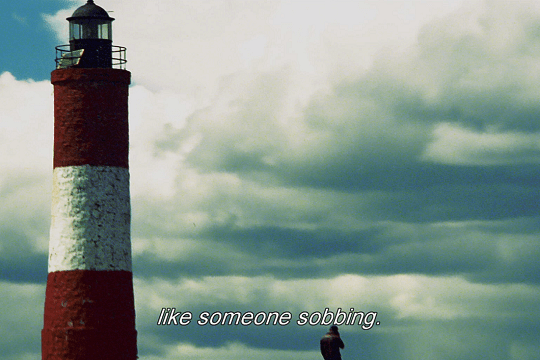
And I remember a lighthouse at the end of the world where the discordant, indistinct sobbing was released, freeing Fai, finally, from love’s terrorism.
And I remember wanting to die while I cried relentlessly, hopelessly, in a place where no one knew me, where none would ever remember me.
But there, at the edge of despair, is hope, is healing. Wong Kar-wai’s Happy Together attempts to explain how two hearts unhappily together can become separate and whole, can become a single heart happy together with its older, broken one.
How the versions of self can stitch themselves happily together.
How to cite: rathke, e. “They Cannot Be Happy Together, They Cannot Be Happy Apart: Wong Kar-wai’s Happy Together.” Cha: An Asian Literary Journal, 25 Sept. 2023, chajournal.blog/2023/09/25/happy-together/.




 Cha
Cha 