
📁 RETURN TO FIRST IMPRESSIONS
📁 RETURN TO CHA REVIEW OF BOOKS AND FILMS
Dina Nayeri, Refuge, Riverhead Books, 2017. 336 pgs.
Home does not always represent comfort or safety. Often, it becomes a place from where you need to flee.
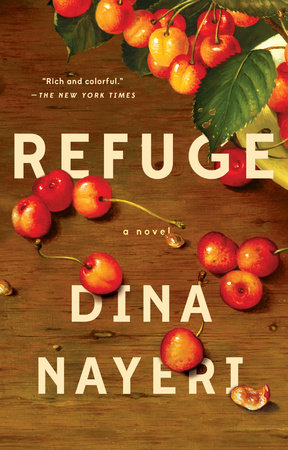
I am a big fan of book covers and believe that a book cover is its soul. I was drawn to the beautiful, cherry-laden cover of Dina Nayeri’s Refuge (2017), a title that can be misread easily as “refugee” but won’t fail to intrigue either way. In the book, the world is seen through the eyes of a refugee who goes on to become an American as well a European citizen and yet “homeless”. Once you have felt like a refugee, you will always be one.
Niloofar, or Niloo, the protagonist, fled Iran at a young age. The trauma of living as a refugee haunts her and changes how she sees the world. Her years as a refugee in Europe and America dictate her life, even after marrying a privileged French man, Guillaume. She is always holding her backpack tightly, always ready to leave. This perpetual homelessness and the fear of being uprooted again comes from the West’s attitude towards refugees from vulnerable countries. The strict border control and stricter immigration policies make it hard for people from elsewhere to feel at home in America. The adopted home is an arbitrary entity, subject to change, depending on who is in power. This is especially true for people from many Muslim countries, who are portrayed as terrorists by the Western media.
Against this backdrop is a highly volatile Iran, where Niloo’s father still lives. The advent of the Islamic Republic had made it hard for her mother to live in Iran, and Niloo and her brother end up being refugees in America without a father figure. Since then, she has lived at different places. She wanders even when she is at home.
Is it her home, this place she’s headed? For decades she’s tried to make homes for herself, but she is always a foreigner, always a guest—that forever refugee feeling, that constant need for a meter of space, the Perimeter she carries on her back. Over the years, she has learned to adapt, start over in each new place and live as if she belongs there. It feels like lying, even more so now.
Niloo feels at home in the company of asylum seekers in Amsterdam. Even though she now leads a comfortable life, she feels triggered and vulnerable again. This uneasiness makes her question her own life and the first thing she realises is the lack of security she still feels and the fear of losing everything again. Her husband, who always led a sheltered life, can’t empathise with her, and they part ways. The personal and the political become one.
The rising tide of prejudice was exemplified by far-right Dutch leader Geert Wilders, who would regularly demonise refugees in his speeches. These are his exact words from one such speech in 2014.
Islam is eating away at our Judeo-Christian and humanist civilisation and replacing it with intolerance, hatred and violence. And our so-called leaders allow it…our politicians foolishly allowed millions of Islamic immigrants to settle within our borders.
Widespread Islamophobia caused delays in the processing of cases of Muslim asylum seekers, and at times doomed them outright, and the asylum seekers had to endure much while waiting for their life to begin in the Netherlands. Some committed suicide, and this backdrop forms the crux of the novel. The power to make someone wait is the ultimate form of authority and refugees endure this along with the pain of humiliation and the sense of worthlessness. A skilled immigrant contributes to the economy but a refugee can’t work, and hence can’t be useful in an enterprising way.
Where then does a refugee fit into the narrative of usefulness? Refugees are created by tyrannical states, and this tyranny follows them elsewhere, too. All nations are capable of this tyranny, sometimes under the disguise of national security and, at other times, it is in the name of sheer patriotism. A nation-state can be an oppressive construct, loaded with power and teeming with lies. Nobody flees because they like doing it. They do it for survival.
For all its self-proclaimed altruism, Western countries want everyone who come to their shores to give up their roots and assimilate; they also deny people an identity without a hyphenated disclaimer. Becoming a naturalised American, French or Dutch citizen is different from being one by birth. There is always a vulnerable non-American person inside this person who was once a refugee. Nayeri, in her novel, touches upon this extremely vulnerable side of human existence.
How to cite: M, Fathima. “In Perpetual Transit: Dina Nayeri’s Refuge.” Cha: An Asian Literary Journal, 21 Sept. 2023, chajournal.blog/2023/09/21/refuge.



Fathima M teaches English literature in a women’s college in Bangalore, India. She likes hoarding books and visiting empty parks. [Read all contributions by Fathima M.]
 Cha
Cha 