
📁 RETURN TO FIRST IMPRESSIONS
📁 RETURN TO CHA REVIEW OF BOOKS AND FILMS
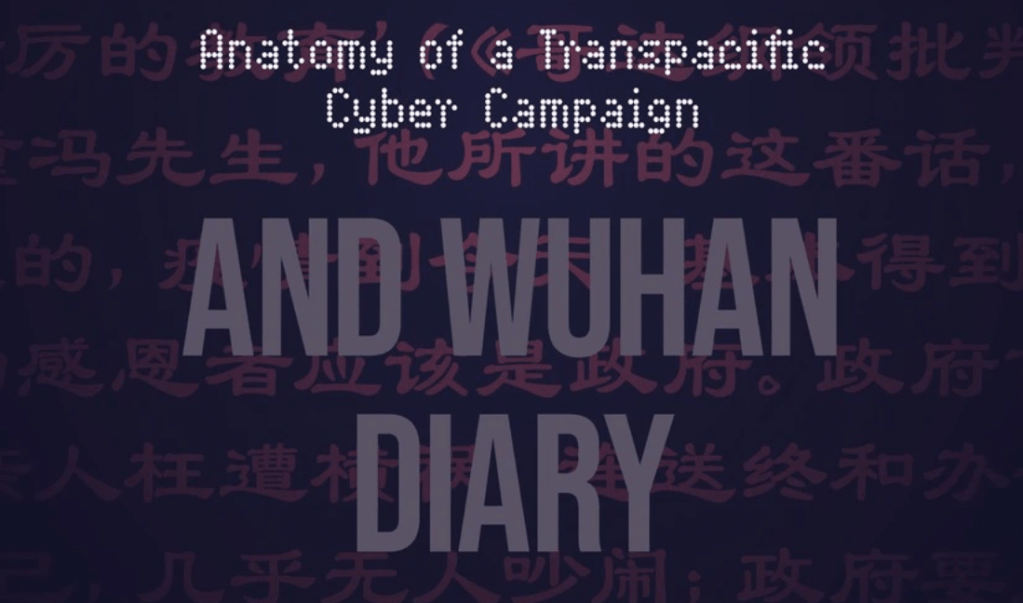
Michael Berry, Translation, Disinformation, and Wuhan Diary: Anatomy of a Transpacific Cyber Campaign, Palgrave Macmillan, 2022. 247 pgs.

When Michael Berry took on the project of translating Fang Fang’s Wuhan Diary: Dispatches from a Quarantined City in 2020, he did not anticipate that his translation would unleash a tsunami of online attacks. “Your family will live in hell forever and never get peace,” one attacker claimed; “Your son will die in three days,” said another (74). Unlike Berry’s previous works, in which he has maintained objective critical distance, his new book Translation, Disinformation, and Wuhan Diary: Anatomy of a Transpacific Cyber Campaign (2022) is much more personal, immediate, and emotional. The trauma and pain of being unwittingly swept into the centre of a massive cyber-denouncement campaign is palpable. “[J]ust as readers can create meaning from texts that the author never intended, so too the act of translation itself can carry meaning never before intended by a translator,” he laments (199).
Berry is a UCLA professor of contemporary Chinese cultural studies and a prolific translator of contemporary Chinese literature. He has numerous scholarly publications on Chinese literature and film, including A History of Pain: Trauma in Modern Chinese Fiction and Film (2008)and Jia Zhangke’s Hometown Trilogy (2009). His translation introduced the works of many accomplished contemporary Chinese writers to an English-speaking audience, among them Yu Hua, Wang Anyi, Ye Zhaoyan, and Zhang Dachun. His new book explores a very different ground.
Berry took on the task of translating Wuhan Diary in 2020 because he knew that Fang Fang’s diary, as one of the earliest lockdown diaries of the COVID-19 pandemic was a significant record with global relevance. Berry was already acquainted with Fang Fang, having translated her novel Soft Burial. Fang Fang is a highly esteemed author who had served as the Chairperson of the Hubei Writers Association before her retirement. On Jan 25, 2020, two days after the lockdown began, she began documenting her experience of the Wuhan quarantine. Her diary was published as nightly entries on Weibo, China’s most popular social media platform, and she soon amassed more than 50 million followers (16). Berry helped Fang Fang’s voice to reach a global audience as the virus spread around the world and one city after another experienced varying degrees of lockdown measures.
Berry’s translation of Fang Fang’s 60 diary entries was published on May 15, 2020. However, the news of the diary’s translation and publication in English changed its reception overnight. Both Fang Fang and Berry became targets of vicious online attacks. “Fang Fang’s stench will last for 10,000 years and you will be the rag in which her corpse is wrapped,” a reader denounced (198-199). Berry was clearly alarmed by both the massive number and the pronounced aggression of these cyber-bullies. He recounts the murder of the Japanese translator of Salman Rushdie’s The Satanic Verses, and observes that “[f]or The Satanic Verses, these attacks were inspired by extremist religious views, but in the case of Wuhan Diary, it was extremist nationalistic views fuelling the fire. What was truly unique about the attacks against Wuhan Diary, however, was the way in which online discourse had been manipulated, pivoting overnight from widespread support to mass denunciation” (11).
Though disturbed by the incessant online attacks, Berry wisely refrained from engaging with the internet trolls. His book is an effort to document and understand the brutal online campaign waged against Fang Fang and him. In the book’s twelve chapters, Berry recounts his decision to translate the diary in minute detail. He explains Fang Fang’s initial reluctance in accepting the translation, the careful selection of the book’s title, and the long and relentless online denunciations that followed the publication of Wuhan Diary in English and German.
Berry’s new book is an ode to the profession of translation in an age where interracial, intercultural dialogue and understanding is increasingly assailed by racist and xenophobic responses, amplifying the rapid spread of disinformation on social media. Berry uses his scholarly skills to meticulously recount the online posts, the news reports, the scholarly receptions, and the legal debates about Wuhan Diary, providing a valuable first-hand account of the controversy. Echoing Slavoj Žižek, Berry notes that two kinds of viruses ravaged our world in the past three years: the virus of the pandemic and the virus of disinformation. Between the two, the contagion of disinformation is, to some degree, more alarming, as it distorts reality and creates unbridgeable ideological divides. Despite the trauma of public denouncements triggered by his translation, Berry reaffirms the role of the translators in their work of performing “transmission and transformation”, making the incomprehensible understood and building bridges between seemingly unbridgeable cognitive gaps (199).
The most important contribution of Translation, Disinformation, and Wuhan Diary is that it offers a case study of social media functioning as an instrument contributing to the rise of authoritarianism, rather than as a vehicle for promoting democracy and enhancing human connections. Written texts on social media are very different from written texts in print; they are ephemeral, fluid, and reactionary, subjected to constant updates and erasure, and shaped by the ever-changing social environment. The algorithms of social media sites tend to circulate posts that trigger strong emotional reactions, and the anonymity of these sites makes online interactions more hostile than face-to-face conversations. When a nation is facing a crisis like COVID-19, social media can be easily manipulated by a few opinion leaders and extremist views can spread like a virus. Berry attributes disinformation as a major cause of both the controversy about Wuhan Diary (which ended with internet trolls defaming and silencing Fang Fang), and the rise of far-right populism and anti-Asian racism in America. He alerts his readers that disinformation in cyberspace can lead to polarisation and radicalisation, and the consequences can threaten the very order of democracy in the real world.
There were real-world consequences for Berry as well. His own students at UCLA began questioning his motives and integrity. “I saw an online article about Fangfang’s Wuhan Diary and surprisingly I saw you translated it. And I’m a little curious about why you did it” (166). Another consequence was that he was uninvited to talks and events both in and outside China because of the harassment of internet trolls. “Between April and June 2020, I was uninvited or asked to revise my topic on five separate occasions, including one university in the United States” (140). In 2022, Berry was removed from the jury of an independent Chinese film festival shortly before its opening ceremony (156). Hostile comments not only swamped Berry’s Weibo account, but also flooded his Amazon book reviews. Ultra-leftists posted YouTube videos and published articles on newspapers to condemn Wuhan Diary. In the hyperconnected world of social media, devoid of national boundaries, the chilling effect of anti-Fang Fang trolls spread far beyond Chinese borders.
In Chapter 9, “The Strange”, Berry recounts a personally distressing encounter. A professor whose work Berry had translated into English two decades before unleashed a series of online attacks against him. After Berry spoke about Wuhan Diary at Hong Kong Baptist University in Sept. 2020, the professor published a Weibo post claiming, “[Michael Berry] was yet again enthusiastically promoting Fang Fang’s diary in a manner completely outside the framework of normal academic discussion; instead, he viciously attacked Wuhan and China” (144). Berry respectfully wrote of this professor’s influence on his own academic trajectory and expressed his understanding of the professor’s circumstances. “It is difficult to fathom someone like him spending so much time attacking a diary, unless of course, it was somehow part of his political mission” (143). Like many intellectuals who turned zealously against their own colleagues, friends, and even family members in public denunciation meetings during the Cultural Revolution, Berry suspects this professor was likely condemning him for self-preservation and opportunist pragmatism.
A truly moving aspect of Berry’s book is that despite the aggressive attacks, the cancelled invitations, the loss of students’ trust, the broken friendships, and the death threats he experienced for translating Fang Fang’s Wuhan Diary, he continues to support Fang Fang, paying tribute to her integrity, dignity, and courage. “The strength and resilience that Fang Fang demonstrated as she wrote Wuhan Diary and faced an unprecedented onslaught of online threats and attacks was one of the great acts of courage I have witnessed in my life” (193). Michael Berry too, in writing this book, demonstrates unfailing friendship and unyielding courage.
True to his mission as a transformative translator, Berry ended his book with a chapter titled “The Light”, in which he shared many of the supportive messages he received in private that give him hope. In one example, a supporter wrote, “I felt terribly sorry when I saw the internet violence you were subjected to for translating Fang Fang’s Wuhan Diary. Please don’t pay any attention to all of these rumours and malicious comments. Nationalist sentiments are currently extremely high in China today and it has already gotten to the point where diverse voices are barely tolerated. One day, future generations will look back upon these curses and attacks and laugh at them” (206). Berry captures many dimensions of the cyber-nationalist backlash against Wuhan Diary in his book and manages to transform the ephemeral online texts of social media into a more enduring medium of print. Let’s hope that one day future generations will be able to laugh. Until then, sadness seems to be the more appropriate response.
How to cite: Zhang, Emma. “An Ode to Translation: Michael Berry’s Translation, Disinformation, and Wuhan Diary.” Cha: An Asian Literary Journal, 17 Sept. 2023, chajournal.blog/2023/09/17/wuhan-diary.


Emma Zhang teaches in the Language Centre at Hong Kong Baptist University. Her research interests include comparative literature and comparative mythology. Her doctoral dissertation Domination, Alienation and Freedom in Ha Jin’s Novels (2015) analyses Ha Jin’s novels in connection with contemporary Chinese society. Her other works include “Father’s Journey into Night” (2013), “No End in Sight—the myth of Nezha and the ultra-stable authoritarian political order in China” (2018), and “The Taming of the White Snake—The oppression of female sexuality in the Legend of the White Snake”. She is currently working on translating ancient Chinese legends Nezha and The Legend of the White Snake. [All contributions by Emma Zhang.]
 Cha
Cha 