
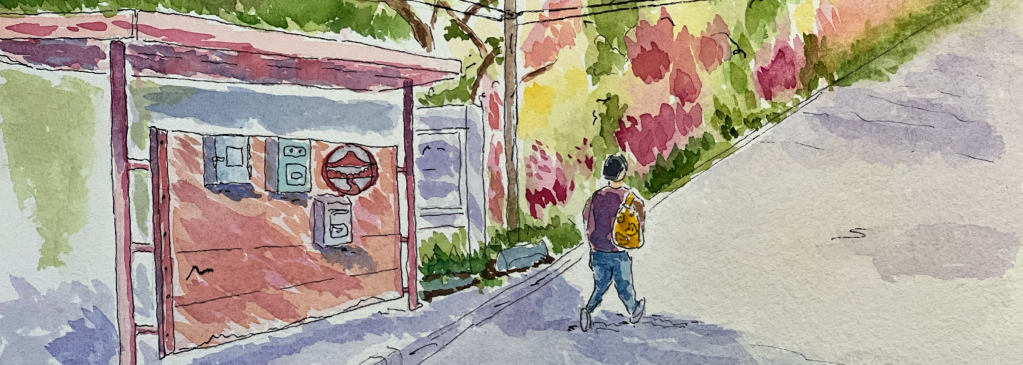
Translated from the Chinese original, also available below, by the author. Drawing by the author. The English translation is edited with help from David Morgan. George Lo, a watercolour teacher, provided the author advice on her painting.

“Huh! So you think that much suffering is going to kill you? Don’t worry, there’s plenty more suffering and trouble waiting for you in this life, young lady.” This was the first time the cleaning lady had said anything to me other than hello. At the time, I had just joined the Translation Department at Lingnan University, naively aiming to apply what I had learned, in accordance with the promise I had made to myself: to pass on the knowledge taught to me by my teachers. But the reality I faced was an overwhelming workload, often of 15 hours a day, seven days a week, and being a weak-willed person, my spirits were at a low ebb. So, when I bumped into our cleaning lady Ping Jie (or Big Sister Ping, as we address her in Chinese) in the corridor of the Translation Department, I suddenly took it into my head to ask her if I would drop dead with such a heavy workload to bear. Back then, Ping Jie was wearing the green T-shirt that was her working uniform and was holding a mop. Her short black hair was tucked neatly behind her ears. She glared at me, at the same time angry and amused at my words, and delivered the above statement in a loud voice. Of course I wouldn’t drop dead but I would “suffer” for almost another twenty years. And for all of those twenty years, Ping Jie would be like family.
Every morning, Ping Jie would go with a smile from office to office and say to the lecturers: “Good morning, teacher! Sorry to interrupt you. Am I bothering you? Do you want me to vacuum or not?” Whenever you met Ping Jie in the corridor or pantry, she would always have a brief chat with you, beginning with the traditional Chinese greeting: “Teacher, have you eaten yet?”, followed by “Busy teaching today?” When the lecturers have the so-called “Earth-Sky lessons” (Meaning a very early class at 8:30am and a very late class, at 6:30pm the same day), knowing that she wouldn’t take too much of your time, because you have to spend a long day in the school anyway, Ping Jie would chat with you.
Ping Jie hopes that I will become strong, so she uses her “life story” to encourage me every time she has the chance to chat with me. Ping Jie’s hometown is a small town called Pingdi near Shenzhen, across the border in Guangdong. I’m not sure that Pingdi still exists, though, as it may have been swamped by the astronomical growth of the Shenzhen Development Zone. She told me that her father passed away when she was about fifteen and ever since she had been the oldest in her family apart from her mother. She had a brother five years younger than her and a sister ten years younger. When she was a child, she loved running around in the mountains, playing basketball like a little boy, and studying at school. At that time, her family had no money, so she had to take care of her siblings and her mother from a young age. Whenever she had spare time from working on the land, she would often stand at the door of the school classroom listening in to the classes while carrying her little sister on her back and holding her younger brother’s hand. Her siblings would cry like all children do and then she would have to go away and calm them down before coming back to resume her listening in to the class. Ping Jie said that she was very “fierce” at that time because she had to protect her family and survive. She had fights with boys and also stole crops from other people’s fields. “Strength comes from having to fight back,” Ping Jie told me. In the face of difficulties, running away was never an option for Ping Jie. She always had to face the music. Afterwards, Ping Jie worked in a factory to support her mother and younger siblings, and later she started a family of her own, had two boys, and even took on the migration to Hong Kong.
Ping Jie came to Hong Kong to join her husband in the late 1990s and, being of such a “strong” disposition she at first wanted to find a well-paid but heavy job as a porter. But because she hadn’t fulfilled the seven-year residency necessary for a permanent Hong Kong ID, she couldn’t get the job. So she had to take second best, and went to Lingnan University as a cleaner. And for nearly 30 years she’s been in the same job. When she first started there, Ping Jie was in her early forties. In order to support her two children in Guangzhou to study and live, as well as her mother and younger siblings, and her ne’er-do-well husband, she had to bite the bullet again and regularly work two continuous shifts in the cleaning job. In other words, to work fifteen or sixteen hours a day. Year after year, month after month, while both her children finally graduated from university in Guangzhou, got married, and joined her in Hong Kong. Now her grandchildren are about to go to university.
But no matter how strong a person is, there are always some difficulties you can’t just fight off.
In 2018, Ping Jie became ill. She got cancer, the disease that terrifies people of her generation. The wrinkles that had accumulated on Ping Jie’s face due to smiling and exposure to the sun, were now deepened by her sad and worried expression. Her biggest concern was her children and grandchildren. She worried that taking care of her would become a heavy burden to them.
The news of Ping Jie’s illness spread throughout the Faculty of Arts at Lingnan, until almost all the teachers knew about it. Then, without any organisation, people began to act, each in their own way. Some would send food, some would send money, with their blessing, some introduced doctors, and the one thing everyone said was not to delay, to go and see a private doctor, and not to worry about money. Ping Jie was moved to tears by everyone’s concern. Later, she always told others that her life was saved by the teachers. On September 21, 2019, a team meeting of doctors from Tuen Mun Hospital was to be held with Ping Jie. After a whole year of various treatments including surgery, Ping Jie’s mood had gradually calmed down. But now she couldn’t help feeling anxious, fearing that the hopes she had slowly accumulated through the year would be dashed again. She tossed and turned the whole night before the meeting, and went anxiously to the early morning team meeting. But it turned out to be good news! Ping Jie’s disease had been cured because of early detection (following the recommended examination by a private doctor) and timely treatment by the doctors’ team from the government hospital at Tuen Mun. Tough old Big Sister Ping had even conquered cancer.
One day, I went to Ping Jie’s house. We walked along the path outside the south gate of Lingnan University to a wooded mountain crossroads. At the crossroads, there was a red display board erected by the Tuen Mun Home Affairs Bureau, with the mailboxes of each villager attached to it. The small stone house that Ping Jie had bought after years of saving is up there on the mountain. Her house shares a courtyard with several other small stone houses with a very simple iron mesh door as their main gate. The furnishings in the house are simple but very clean. The kitchen is outside the house, and some cured meat and dried vegetables are hung under the eaves, giving the house a rich, lived-in smell. Standing outside as she cooks, Ping Jie will have a clear view of Lingnan University.
Ping Jie loves her family very much, and helped her two sons to settle in Hong Kong by offering them places to live. Some people think that Ping Jie took care of her children and grandchildren too much. But Ping Jie doesn’t try to explain anything, she just says, “It all comes naturally. When you become a mother, you will understand.”
As she bade me farewell, Ping Jie was still reminding me not to accidentally step in a hidden hole and not to trip over the rough stones in the track, and kept telling me to be careful, as I was not used to walking along that track. She also went on about me needing to be stronger and to always put my family first, as if she was trying to instil her whole philosophy of life into me all in one go.
I was walking behind Big Sister Ping, and looking at her as she approached the age of 70, the age at which Chinese people think that you can do whatever you want, it was as if I could see in her that teenage girl once again running around in the mountains.

萍姐
「邊有咁容易捱死!後生女,有排你捱啦!」這句話是萍姐第一次除了打招呼外對我說的話。當年的我剛剛本著「學以致用」的理想加入嶺南大學翻譯系,記得當年對自己許下的承諾就是:把老師教给我的知識傳承下去。可是,現實是排山倒海的工作量,意志力薄弱的我在一週七天、每天十五小時的工作下,在翻譯系辦公室的長廊撞見清潔姐姐萍姐時,竟突發奇想地問萍姐,自己會不會做著做著就累死了。當年的萍姐,身穿綠色T恤工作服,手持拖把,一頭黑色的短髪整整齊齊地別在耳後,她瞪了我一眼,又好氣又好笑似的,聲大如洪鐘,贈了我這句話。的確,我沒有「捱死」之餘,還「捱」多了差不多二十年。二十年來,萍姐親如家人。
每天早上,笑容滿面的萍姐都會挨個房間地問老師:「老師,早!吸唔吸塵?阻唔阻你?」每每在走廊或者茶水間遇到萍姐,她也總會問:「老師,食咗飯未?」「老師,課多唔多?」遇上「天地堂」,即早上八點半和傍晚六點半有課,中間沒課,她也會跟你拉一拉家常。
萍姐很寄望我變得堅強,於是不下一次用她的「生命故事」來鼓勵我。萍姐的家鄉在廣東深圳附近一個叫「坪地」的小鎮,但因為深圳的發展,現在也不知道還有沒有這個地方了。她說她十五歲左右父親已經過身,母親之外,她就是最大的,她下面還有一個小她五年的弟弟和小十年的妹妹。小時候的她最愛在山𥚃跑,愛打籃球,像個小男生,也愛讀書。那時家𥚃沒錢,她小小年紀要擔起照顧弟妹和母親的職責,常常是種田餘暇,背著妹妹、拖著弟弟,站在學校課室的門口「聽」課,弟妹一哭閙,她就得走開,哄好了,又回來「聽」課。萍姐說那時侯的自己是很「惡」的,要保護家人,要生存,她曾經跟男生打架,也有偷過別人田𥚃的作物。「堅強,係逼出來的。」萍姐告訴我。面對艱難,退縮從來不是萍姐可以有的選項,只有硬起頭皮。之後萍姐在工廠做工供養母親和弟妹,再之後她自己也成立了家庭,有了兩個男孩,還來了香港。
九十年代末來到香港與丈夫團聚的萍姐本著一慣的「堅強」個性,本想找薪水高一些的搬運貨物的工作,但因為居留日期不足七年,不是香港永久居民,就只能「退而求其次」,去了嶺南大學做清潔,這一做就一直沒轉工,到現在仍未停下,將近三十年。當年萍姐才四十出頭,為了供養廣州的兩個孩子讀書、生活,還有母親、弟妹要接濟,丈夫又好吃喝懶工作,她又硬起頭皮,就一個人做兩個時段的工作,一天往往工作十五六個小時。年年月月,終於兩個孩子都在廣州大學畢業了,也都成家立室,都來了香港團聚,現在孫子孫女也快上大學了。
不過再堅強的人,「捱」幾十年也會累。
2018年,萍姐病了。是上一輩的人聞風色變的癌症。萍姐臉上因日積月累的日曬和笑容而堆積的皺紋,此刻反加劇了愁苦和憂慮的表情。她最放心不下的還是兒孫,她怕自己成為他們生活的負擔。萍姐生病的事在整個文學院傳開了,幾乎所有老師都知道了,然後,也沒有任何人組織,反正大家就開始默默行動了,有的會送一些物資,有的送上金錢,表達祝福,有的介紹醫生,大家都叮囑萍姐,不要拖,去看私家醫生,不要擔心錢。萍姐哭了,因為大家的愛,她說,她的命是各位老師救的。2019年的9月21日,由屯門醫院幾位醫生組成的團隊要面見萍姐了,本來經過了一整年各式各樣的治療和手術,萍姐的心境也漸趨平靜,這時又不由忐忑,怕不經意累積的希望又失落,她前一晚整晚輾轉,這天一早神情緊張地去了見那幾位醫生,結果,是好消息!萍姐的病因爲及時的發現(去私家醫生處檢查)和治療(屯門醫院醫生團隊)得以治癒了,堅強的萍姐連癌病也「捱」過了。
這天,我去了萍姐家,就沿著嶺南大學南門外的小路,走到一片青蔥的山路口,路口有一個屯門民政事務局立的紅色棚架,掛著各戶村民的信箱,萍姐當年耗費多年積蓄買下來的小石屋就在前面山上。小石屋和其他幾間石屋依山而立,共用一扇簡單的鐵網門作為大閘,屋裏陳設簡單但十分乾淨,廚房在屋外,屋檐下掛著些臘肉和菜乾,透著生活的味道,站在屋外煮飯就能遠眺嶺南大學。萍姐很珍惜自己的這個家,之後又再幫兩個兒子也安頓好住處,才安下心來。有人會覺得萍姐太顧念兒孫,萍姐也不解釋,她說「都是自自然然的, 到你做人啊媽,你就會明白。」
送我離開時,萍姐仍舊不是怕我踩空石梯,就是怕我给山石絆倒,不停地要我小心點,說我走不慣這路。又絮絮叨叨要我堅強,好好愛家人,似乎要把她的人生智慧一股腦兒灌輸給我。看著走在我前頭,已快進入從心之年的萍姐,不知怎的,我依稀看到了那個十幾歲在山野奔跑的女孩。
How to cite: Tong, Jasmine. “Big Sister Ping.” Cha: An Asian Literary Journal, 16 Sept. 2023, chajournal.blog/2023/09/16/sister-ping.


Jasmine Tong migrated to Hong Kong with her family from Shanghai in the 1980s. She loves painting and telling stories. After spending almost 20 years teaching translation at university level, she is now exploring a different way of celebrating life. While continuing to translate Hong Kong writers’ works into English, she also wants to use her paintbrush and her bilingual skills to capture the beautiful moments of Hong Kong. PHOTO of Jasmine Tong © Heidi Huang. [All contributions by Jasmine Tong.]
 Cha
Cha 