

📁 RETURN TO FIRST IMPRESSIONS
📁 RETURN TO CHA REVIEW OF BOOKS AND FILMS
R.F. Kuang, Yellowface, William Morrow, 2023. 336 pgs.
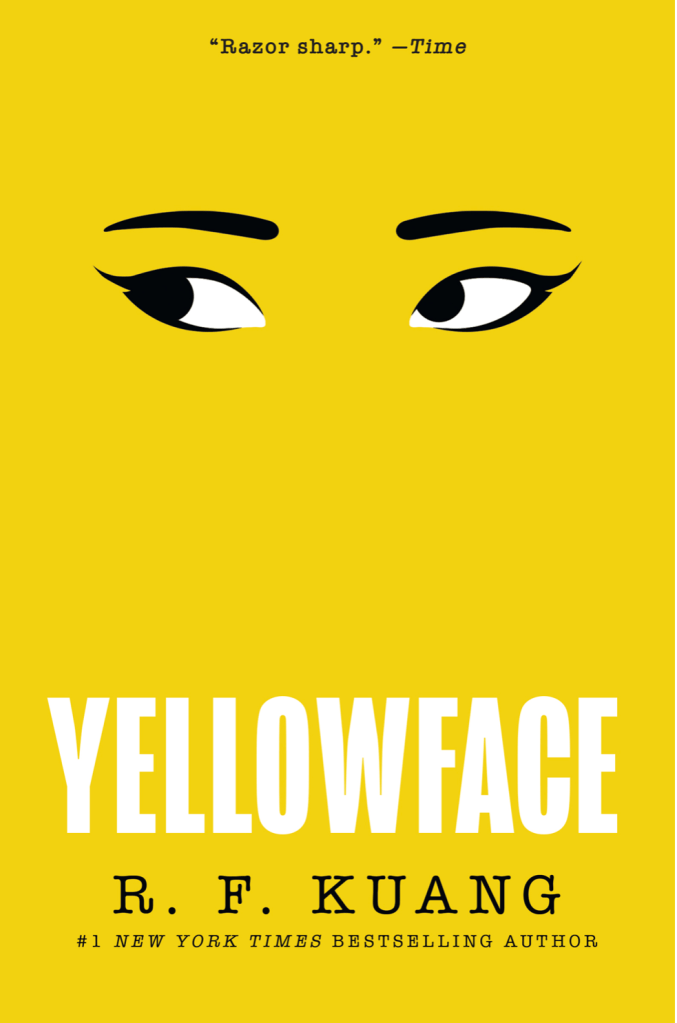
The title of the novel and its bright yellow cover suggests that the subject matter might having something to do with cultural appropriation. Indeed, it does. The work also deals with criticism of the mores of the publishing industry and death by social media.
Yellowface is about a young white author who steals the manuscript of her dead Asian friend, Athena, an already successful writer, finishes it, and publishes it as her own. Throughout the novel, Juniper “June” Hayward, under the ethnically Chinese-sounding name Juniper Song, works hard to maintain the lie that her first bestseller The Last Front, a story about Chinese workers in the British Army during the First World War, is all her own work.
June justifies herself by saying what she is doing is not merely plagiarising, but rather “completing an unfinished work” and the fact Athena had once “stolen” a traumatic personal experience from her is reason enough for what she herself is now doing. Eventually, she is called out for “appropriating” both Athena’s work and Chineseness. June finds herself increasingly harassed online experiencing death threats and calling her to be “cancelled”.
June is challenged by a Chinese American reader on why she thinks it’s okay to write and profit from painful Chinese history. She responds, “I think it’s dangerous to start censoring what authors should and shouldn’t write… I mean, turn what you’re saying around and see how it sounds. Can a Black writer not write a novel with a white protagonist?”
Can an author write about anything? These days there are “sensitivity” readers if one is writing about characters or situations outside their immediate experience; but wouldn’t it just be enough to have empathy for one’s characters? And do a bit of research? I don’t think that the novel answers this question. I doubt this question will ever be resolved to everyone’s satisfaction. The novel considers cultural appropriation as an ethical issue rather than a deliberate action done for profit. The novel also raises the issue of racial tokenism—how non-white writers are often categorised into certain genres or narratives, and how the identity of the writer is often part of the book’s selling point.
Kuang’s novel is a commentary on the exploitation and rigours writers face under the pressure to be successful. It’s “publishing [that] picks a winner,” June says, “someone attractive enough, someone cool and young and, oh, we’re all thinking it, let’s just say it, ‘diverse’ enough—and lavishes all its money and resources on them”. As the protagonist says: “It all boils down to self-interest.” June also says “publishing is rigged, you might as well make sure it’s rigged in your favour”.
The book was an easy and quick read and raises a lot of valid points, about who can write what and the vagaries of the publishing world, but it has flaws. June seems to be the archetypical casual racist and is rather overdone—like when she becomes ultra-paranoid and imagines seeing Athena’s ghost everywhere, her identity as a writer being above everything else. But maybe its excessiveness proves the point.
Ironically, the author R.F. Kuang is herself an Asian American writer telling this story through the eyes of a white one. It’s not hard to think that Kuang is writing herself, for Athena, the successful author, is young, vibrant, and from a privileged background, as is the author of Yellowface.
How to cite: Eagleton, Jennifer. “Can An Author Write About Anything? Reading R.F. Kuang’s Yellowface.” Cha: An Asian Literary Journal, 11 Sept. 2023, chajournal.blog/2023/09/11/yellowface.

Jennifer Eagleton, a Hong Kong resident since October 1997, is a close observer of Hong Kong society and politics. Jennifer has written for Hong Kong Free Press, Mekong Review, and Education about Asia. Her first book is Discursive Change in Hong Kong (Rowman & Littlefield, 2022) and she is currently writing another book on Hong Kong political discourse for Palgrave MacMillan. Her poetry has appeared in Voice & Verse Poetry Magazine, People, Pandemic & ####### (Verve Poetry Press, 2020), and Making Space: A Collection of Writing and Art (Cart Noodles Press, 2023). A past president of the Hong Kong Women in Publishing Society, Jennifer teaches and researches part-time at a number of universities in Hong Kong. [All contributions by Jennifer Eagleton.]
 Cha
Cha 