

📁 RETURN TO FIRST IMPRESSIONS
📁 RETURN TO CHA REVIEW OF BOOKS AND FILMS
Davy Chou (director), Return to Seoul, 2022. 119 min.
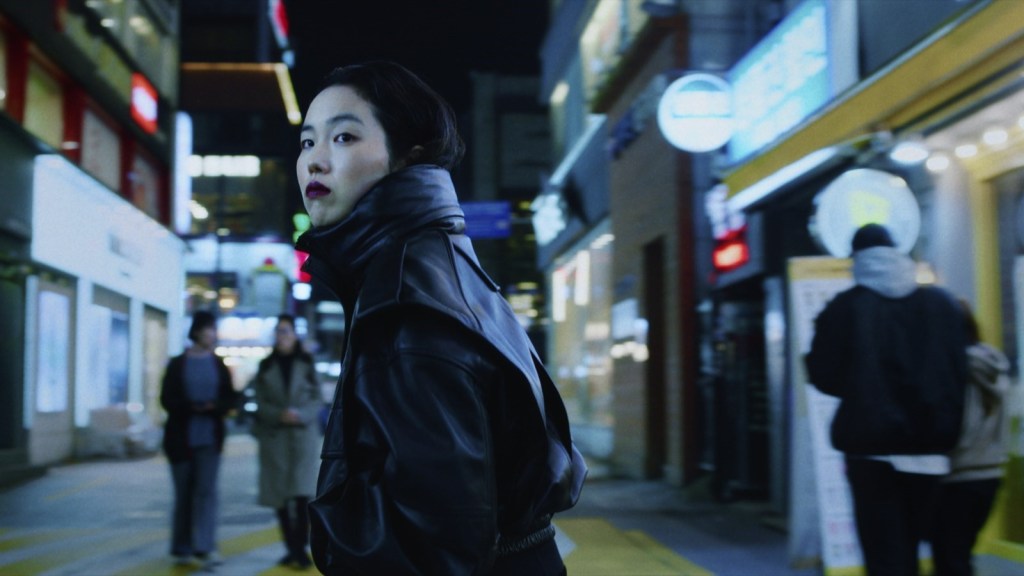
There’s an ambiguity inherent in the title of Davy Chou’s film Return to Seoul. At first sight, it seems to straightforwardly relate to the protagonist Freddie’s (Ji-min Park) first visit to Korea since she was adopted as an infant by French parents. But there’s more than one return, even if it is not exactly clear how many (the film is split into four sections, though the first and second may be part of the same continuum). In any case, Freddie comes back to Seoul at regular intervals over the course of several years. You get the impression these returns might well extend beyond the scope of the film, forming a mere slice of a long succession of eternal returns. There is also an abiding sense that each return, each time a search for something, is an ultimately unsatisfactory one.
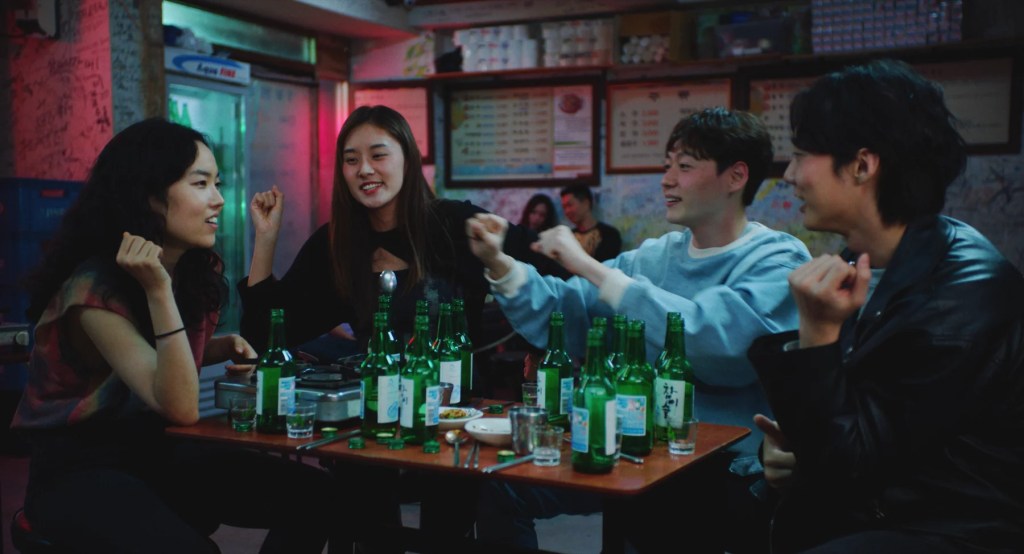
Having just arrived in the Korean capital at the start of the film, Freddie strikes up a friendship with Tena, the receptionist at her hostel, and drunkenly regales strangers at a chimaek restaurant. It is instantly apparent there is a gap between Freddie and the contemporaries who might otherwise have been her compatriots: not only does she not speak Korean, she acts with the entitled forwardness characteristic of many Western expats in Asia. A greater social cleavage is evident when she contacts her biological father through the adoption agency and goes to visit him. She is unprepared for his solicitude and enthusiasm at seeing her (her birth mother, by contrast, declines to meet her), and retreats into sullenness, treating him with petty disdain.
The later returns revisit some of these situations while accumulating more. Freddie begins to work for an older Frenchman, André (Louis-Do de Lencquesaing) she previously had a fling with and who is an arms dealer (the sort of only-slightly-probable lurches into genre fiction that French filmmakers and novelists are so fond of). Like many an expat/emigrant before her, she starts monetising her partial expertise; André says the clients “love her” and think she’s some type of “Bond girl”, in spite of the fact she speaks fairly rudimentary Korean.
Chou, a Frenchman of Cambodian ancestry, previously made the excellent documentary Golden Slumbers, about the lost generation of Cambodian rock, most of whom were murdered by the Khmer Rouge. It was a haunting yet beautiful work, one marked by a frustrating distance, where the music, preserved and still beloved by many Cambodians, is yet doubly intangible, existing as the ghostly leavings of a lost tribe, few of whom are around to perform it or talk about it.
A similar air of cultural orphanage hangs over Return to Seoul. Freddie is played by Ji-min Park, a Franco-Korean artist, who came to France with her parents at the age of eight. Park has the benefit of dual insight Freddie so cruelly lacks and her performance amply captures the self-consciousness that accompanies the culturally ambiguous existence. The disconnect is exemplified further by the casting of Freddie’s Korean family: her biological father is played by Oh Kwang-rok, a Park Chan-wook regular, and her aunt by Kim Sun-young. Neither of them massive stars in Korea but rather character actors who would be familiar to many cinema-goers, a familiarity that the adoptee Freddie, and much of the film’s audience, cannot partake of.
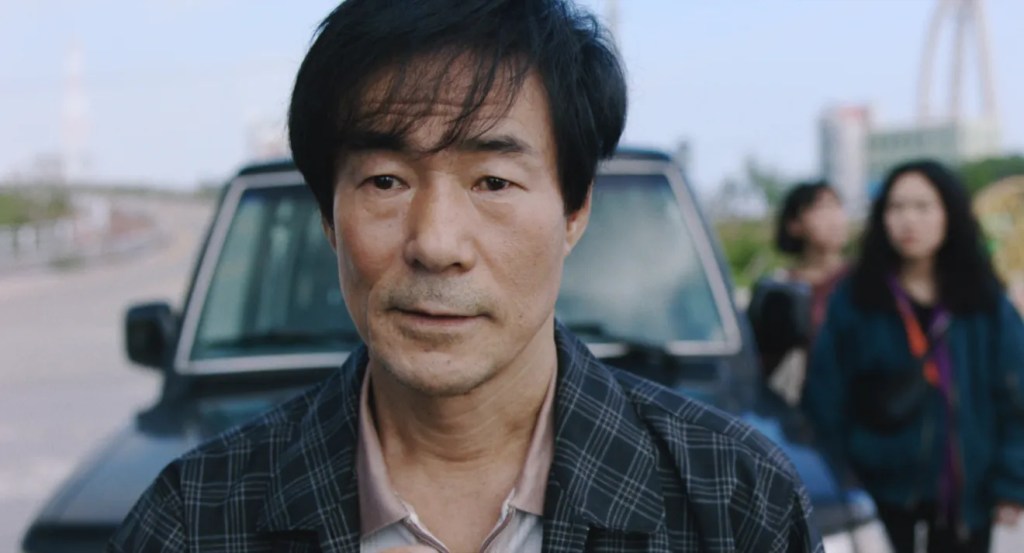
Oh Kwang-Rok as Freddie’s Korean father
How to cite: Farry, Oliver. “Cultural Orphanage: Davy Chou’s Return to Seoul.” Cha: An Asian Literary Journal, 11 Sept. 2023, chajournal.blog/2023/09/11/seoul.


Oliver Farry is from Sligo, Ireland. He works as a writer, journalist, translator and photographer. His writing has appeared in The Guardian, The New Statesman, The New Republic, The Irish Times, Winter Papers, The Dublin Review, The Stinging Fly and gorse, among other publications. Visit his website for more information. [All texts by Oliver Farry.] [Oliver Farry and chajournal.blog.]
 Cha
Cha 