
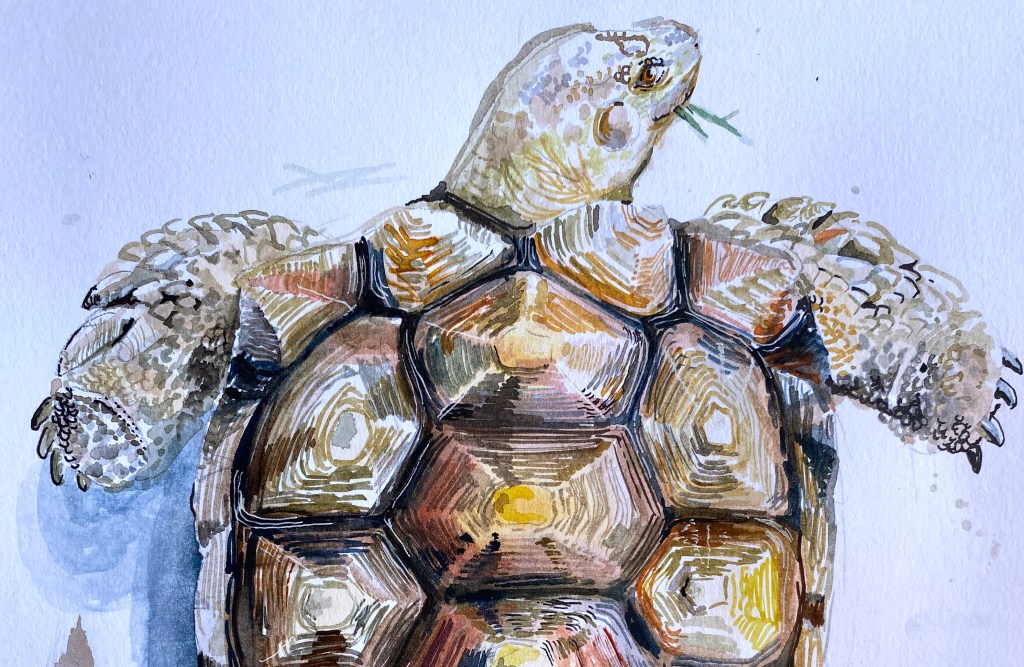
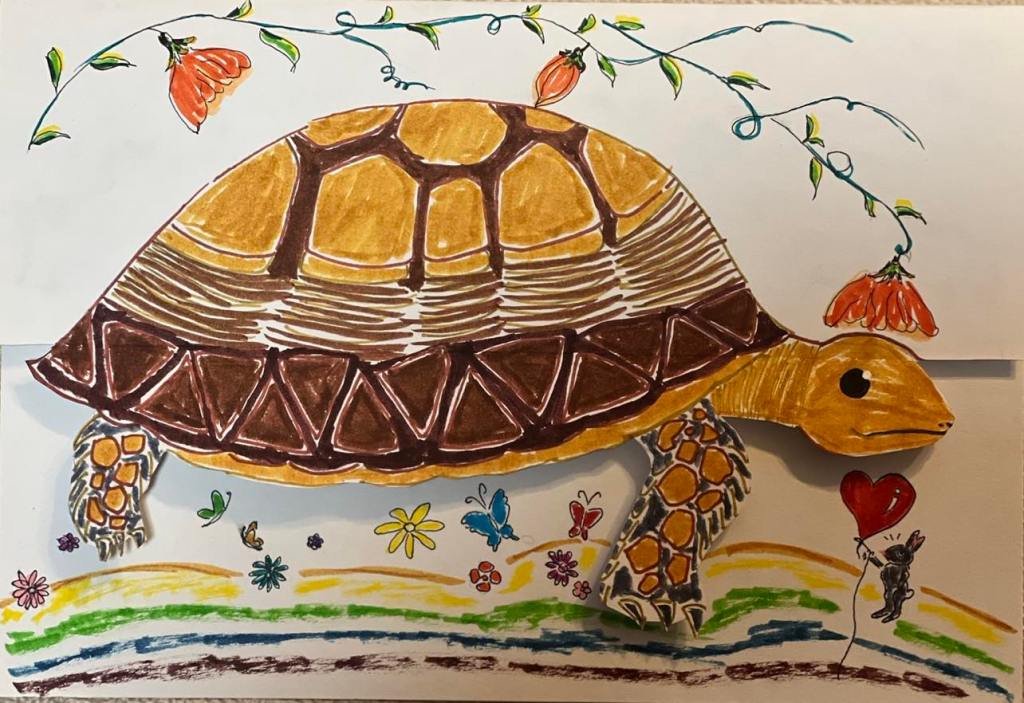
Translated from the Chinese original, also available below, by the author. Drawing of Buji by Tang Yiu Lun 鄧耀麟. The English translation is edited with help from David Morgan.
We got to know “Orange” first.
“Mummy, Big Brother Orange says he is a Martian and can speak Martian dialect!” my daughter Yuyu said to me one day after her painting class. Her trusting little face had a serious “no kidding” expression. “Orange” is the adopted English name of one of the staff in the “Birdintree Creative Studio”, so Yuyu knew him as Big Brother Orange. The studio is a children’s art centre founded by a professor from the School of Design of the Hong Kong Polytechnic University and jointly run by some of the graduates. It’s a tiny place located in the densely populated Flower Market area of Mong Kok in Hong Kong. The “leader birds”, as the staff are known, are able to lead the children to fly in their imaginations to explore the highest and most varied artistic spaces.
Orange is a sunny young man with big smiling eyes, who has the unusual habit of wearing the same hats as Japanese cartoon characters such as Mario. Yuyu especially likes to have her painting class with Big Brother Orange, because Orange is full of tales about small animals, such as the goldfish raised in the studio which is called the red-tailed black shark. You might think the name “shark” sounds very fierce, but as used in the Centre it comes out as a very mild and harmless title. Then there’s the unicorn beetle, also raised in the studio, which likes to hide in sawdust, paper scraps, and moss, but needs to be ventilated, and has to be fed fruit jelly prepared specially for insects. Big Brother Orange has raised many small animals in his time, from chickens to rabbits, fishes, frogs, and even turtles. Because of this wealth of experience, his capacity for observation, and his enormous love of animals, he is by now a real walking encyclopaedia of little animals. This capacity to relate to animals makes it easy for both adults and children to feel close and comfortable with him.
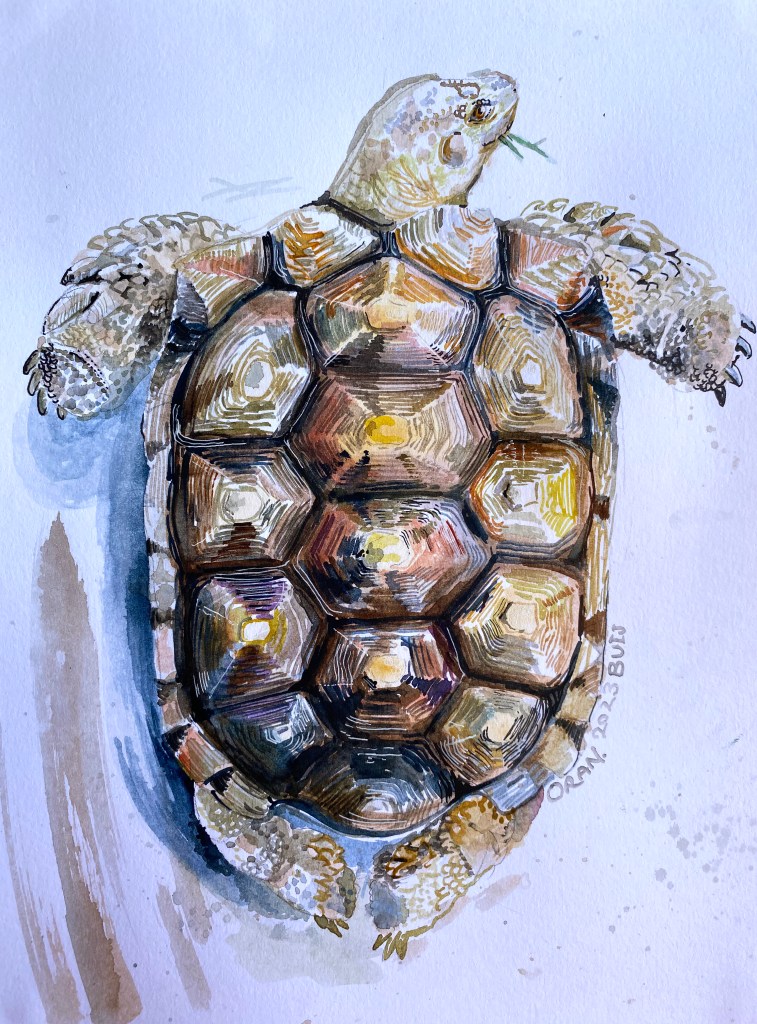
Buji is the name of a tortoise raised by Orange. Technically, Buji is an African Spurred Tortoise, or a Centrochelys Sulcata. Orange told me that it was only by chance that he found himself looking after Buji. A distant friend of his was planning to move to another country and was looking for someone to take care of his tortoise. Orange, with his enormous love of animals, jumped at the chance. Buji is a very intelligent creature, and the very first time he saw Orange he walked straight to him. However, when Buji first came into Orange’s care it was clear that he had been sadly neglected by his previous owner, and at seven years of age he was only as big as a human palm, and all four paws were very small. Luckily, with Orange and his partner looking after him, Buji grew bigger and bigger every day. When Buji was fully restored to health, Orange sometimes took him to the studio to play with the children, and that’s where Yuyu and I got to know him.
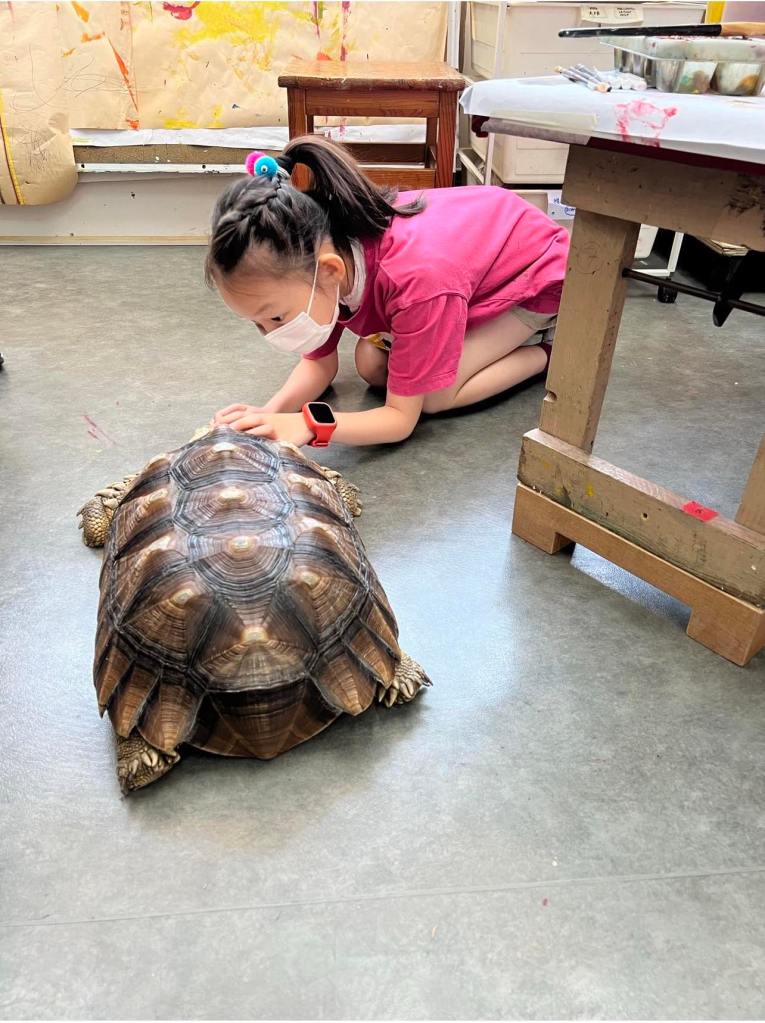
When Yuyu was nine years old, she picked up Buji for the first time. With her little hands and feet, she picked up Buji, who weighed 8kg. Buji’s shell almost covered her entire body, which made a very amusing picture.
Later, Buji became a model for the children’s paintings, and it was under the gaze of many pairs of small eyes that he stretched out his wrinkled neck, opened his big hard beak to bite off the leaves of vegetables, and used his thick tongue to push the vegetables into his mouth and chew them. His crawling path forward was either opened up or else hindered by many pairs of little hands and feet, and with gentle touches on the top of his head, his shell, or even an occasional secret touch of his paws. This is what Orange thinks is important, that by allowing children to have close contact with animals, so that they can understand animals better, and in this way, animals can guide children to explore and understand the world.
But all good things come to an end, and…
And then Orange was moving to Canada, and we were all very sad. I asked him why he was leaving Hong Kong. He said that no one wants to leave their home. He had no relatives and friends in Canada. It’s just that when a home no longer gives you the warmth of a home, or even sometimes makes you feel sad and scared, and at the same time, you are unable to change the way you are, the only way out is to leave. But leaving is not abandoning, it is taking the warmest and most beautiful things on the road together, raising and spreading that warmth and beauty in the new land, so that then, you can be a window on your home town opening to the world.
Buji is a member of Orange’s family, so of course they have to stick together, and Orange started the tedious procedure of arranging to transport the tortoise to Canada: first he had to go to the Hong Kong Agriculture, Fisheriers and Conservation Department to obtain a certificate proving that he was the owner of Buji the tortoise; then various tests are required to prove that Buji was in good health; next, he needed to design a protected container for Buji to take the plane, ensuring enough space, air circulation, drinking water and food. Orange fulfilled all those procedures by himself, without relying on anyone else. And so it was that at the end of last summer vacation, Orange and Buji arrived in Vancouver.
Now, after one year’s autumn, winter, spring and summer, Buji has grown a lot, and he weighs a full 12 kilograms. In autumn and winter, Buji usually hides at home, and loves to sleep under the covers with Orange and his partner. The three enjoy family life together; in spring and summer, Buji goes out for a walk. The vast Canadian prairie is his paradise, and he always attracts a lot of adults and children wherever he goes. If Buji is there, there will always be a crowd and of course a rich topic of conversation. Buji has become Orange’s bridge to integrating into the new environment and making new friends.
After one year’s autumn, winter, spring and summer have gone by, Orange has also matured a lot. In the work and life of a foreign country, he has a better understanding of his abilities, preferences, and ideals, and he knows how to appreciate the simple beauty in life, and he also cherishes his partner, friends and the tortoise who are always by his side. May the warmth and beauty of Hong Kong remain in the hearts of Orange and Buji, and may the beauty of Orange and Buji continue to make vigorous new growth in the new land.

阿橙和Buji
我們是先認識阿橙的。
「媽媽,橙哥哥說他是火星人,會說火星話呢!」女兒小語有天一臉認真地跟我說。那時候,阿橙是「雀仔塗鴉創意間」的其中一個「雀仔老師」,小朋友都叫他「橙哥哥」。「雀仔塗鴉創意間」是由一位香港理工大學設計學院的教授創立,並由幾位畢業生共同經營的兒童藝術中心。中心位於人煙稠密的旺角花墟,那些「雀仔老師」就在香港的這個彈丸之地,領著一群群孩子,飛向可以容納萬千天馬行空的藝術想像空間。
阿橙是個陽光大男孩,有一雙愛笑的大眼晴,也總愛戴各種各樣的日本卡通公仔的帽子。小語特別喜歡跟「橙哥哥」畫畫,因為「橙哥哥」總有說不完的小動物話題,像是畫室養的金魚叫紅尾黑鯊,儘管名字很威猛,其實很溫和;又像是甲蟲獨角仙,喜歡躲在木屑、紙碎、水苔,但又要通風,喜歡吃昆蟲果凍。「橙哥哥」養過好多小動物,小雞、小兔、小魚、小青蛙、小龜都有,養得多,觀察得多,又喜歡,便慢慢變成了一本「行動的小動物百科全書」。大人孩子也因著他這份「動物」性,更喜歡跟他親近。
Buji是阿橙養的陸龜,正確的學名叫非洲盾臂龜,或者蘇卡達象龜。阿橙說,養Buji也是一個緣份。當年有朋友的朋友要移民,需要有心人接手照顧陸龜,愛動物的阿橙便一口答應了,而Buji也很有靈性,第一次見阿橙就很親。不過開初接到Buji時因為前主人照顧不善,七歲的Buji只有巴掌那麼大,手腳也很幼細。之後阿橙和同伴悉心照顧,Buji也就一天天長大。後來阿橙有時會把Buji帶去畫室,跟孩子們一起玩,我們就也認識了Buji。小語9歲那年第一次抱起Buji,小手小腳抱起當年重8公斤的Buji,Buji的殼幾乎遮蓋了小語整個身體,畫面相當趣致。後來Buji更成了小朋友畫畫的「模特兒」,給一雙雙小眼睛定睛看著如何伸長滿是皺褶的脖子、張開硬硬的大喙、一口咬下菜葉子、厚厚的舌頭再推動咀嚼;又給一對對小手小腳開拓或阻礙爬行的前路、輕輕摸頭頂、摸殼、悄悄摸爪子。阿橙就是如此讓孩子們近距離接觸他鍾愛的動物,讓孩子更懂動物,讓動物引領孩子探索、瞭解世界。
然後……
然後阿橙要去加拿大了,我們都很不捨。我問他,為什麼要離開香港?他回答,誰願意離開自己的家?在加拿大也是舉目無親。只是,當家變得不再讓你有家的溫暖,甚至讓你絕望、害怕,但又無力改變,唯一的出路是離開。但離開不是拋棄,是帶著最暖的、最美的那些東西一齊再上路,把這份溫暖、美麗揚起、灑落在新的土地上,而自己也成了以往的家通向世界的一扇窗。
Buji是阿橙的家人,當然要「齊上齊落」,於是阿橙展開了運陸龜往加拿大的繁瑣程序:先要去漁農自然保護署拿到證明,證明自己是陸龜Buji的主人;然後要做各項檢測,證明Buji身體健康;接著要設計給Buji乘搭飛機的專屬空間,保證足夠寛敞、空氣流通、足夠飲用水和食物;再有要訂可以同行的班機。所有步驟阿橙都親力親為,一點也不假手於人。就這樣,阿橙和Buji在去年暑假尾扺達了溫哥華。
這一年的秋冬春夏𥚃,Buji又長大了不少,現在已經有12公斤了,秋冬天的Buji會躲在家中,也愛跟阿橙和伴侶膩在被窩裡,三個一齊享受天倫之樂;春夏天的Buji會外出散步,廣闊的草地是牠的樂園,所到之處也總是吸引著一堆堆的大人和孩子,有Buji,就有話題,Buji成了阿橙認識新環境、新朋友的橋樑。
這一年的秋冬春夏𥚃,阿橙也成熟了不少,在異國的工作和生活中更清楚自己的能力、喜好、理想,更懂得欣賞生活中樸實的美好,也更珍惜一直陪伴身邊的人和龜。
願香港的那份暖和美一直留在阿橙和Buji心𥚃,也願阿橙和Buji的美好繼續在新的土地「茁壯成長」。
How to cite: Tong, Jasmine. “Orange and Buji.” Cha: An Asian Literary Journal, 1 Sept. 2023, chajournal.blog/2023/09/01/orange.


Jasmine Tong migrated to Hong Kong with her family from Shanghai in the 1980s. She loves painting and telling stories. After spending almost 20 years teaching translation at university level, she is now exploring a different way of celebrating life. While continuing to translate Hong Kong writers’ works into English, she also wants to use her paintbrush and her bilingual skills to capture the beautiful moments of Hong Kong. PHOTO of Jasmine Tong © Heidi Huang. [All contributions by Jasmine Tong.]
 Cha
Cha 