

📁 RETURN TO FIRST IMPRESSIONS
📁 RETURN TO CHA REVIEW OF BOOKS AND FILMS
Click HERE to read all entries in Cha on Bright Fear.
Mary Jean Chan, Bright Fear, Faber & Faber, 2023. 72 pgs.

Mary Jean Chan was born and raised in Hong Kong. They now reside in the UK where they are a Senior Lecturer in Creative Writing (Poetry) at Oxford. Chan’s poetry, essays and reviews have been featured in numerous magazines and publications. My first encounter with Chan’s work was their first book of poetry Flèche (2019). The allusion to fencing is not merely symbolic as Chan is a practitioner of the sport. Chan writes, in the title prose poem “Flèche”: “At the age of thirteen, I wielded a blade because I had a firm grip” (57). Chan follows this with the line, “I was in love with Shakespeare.” Chan next moves into referring to their mother tensely gripping the railing in the spectator area as she watches her child fence: “until her marriage ring was folded into flesh”.
Language is a palpable weapon in Chan’s hands: flashing with swift arrows and rapid shifts of posture. As in their first collection, Chan’s skill in wielding language continues in Bright Fear. Chan’s poetic language expresses in the body and through the body, never a dissociated or decontextualised notion. Language is employed as strategy, a quick move that advances the poet past a reader’s psychological or intellectual defences. Chan’s lines are movements, confronting us with twists and surprises, gesturing to the personal, the historical, the political, sometimes allowing lines to fold, run or even crash into one another, with a refusal to behave according to expectations or conditioned politeness—all this while managing a degree of subversive aplomb.
As Adrienne Rich writes in her poem, “Diving Into The Wreck”, she “came to explore the wreck… the thing itself and not the myth” (Rich, 1973, p. 23). Similarly, Chan’s poetic voice explores internal psychological landscape, as it interfaces with familial, social and political contexts. Chan begins Bright Fear with a poem that serves as preface, an introduction to what is to come:
… of muscle and memory do not
be afraid let us speak ourselves into
splendour that is the joy I’m after
(“Preface”, page 1)
A spirit of interrogation enlivens Bright Fear. The pairing of words “bright” and “fear” is unusual, undermining conventional expectations. “Bright” is commonly associated with either intelligence or possessing visual intensity; here, Chan juxtaposes that quality with fear, which many of us would tend to associate with recoiling or shrinking.
To describe fear as bright is to offer new topographies and meanings. Chan encourages us to name the fear, to foreground its possibilities of intelligence or brilliance. Their work is a voicing of “muscle and memory”, so as to attain “splendour that is the joy” (1).
In “Grief Lessons”, the first section of the book, Chan offers readers two takes on bright fear:“Bright Fear (I)” describes an atmosphere of vulnerability: “beaten for wearing a mask” (5). There is intelligence inherent in one’s fear because it attests to the vulnerability of being targeted for being Asian, especially increased since the beginning of the COVID pandemic. Linking this fear with grief widens the lens on how the loss of safety and its attendant grief informs our fears: “All fear is grief “ (5). A dream sequence in “Bright Fear (II)” spills into the horror of reality where “the bright air felt menacing” (12). Chan imagines a fantasy where reversals of fate, of bodies, even of a reversal of power dynamics between a mother and her child, are possible.
Three poems, titled “EDI for Migrants” name as well as challenge the abstract, neoliberal, and often racist underpinnings of academic programming. In (I) and (II), Chan relies on the data of lived experiences, intersecting the personal with the political, bearing witness to the impact of racist assumptions and behaviours. Some assumptions might seem slight or innocuous to the speaker or viewer, but Chan juxtaposes such seemingly well-meaning or unconscious assumptions with the stinging, disorienting impact on them. In (III), Chan boldly states: “it is the illusion of freedom / until it is withdrawn ever so / softly like a hospital curtain” (20). Chan challenges “the texture of abstract nouns”—the disembodying abstract notions of Equality Diversity Inclusion—through the use of concrete realities.
The middle section of the book “Ars Poetica” alludes to Homer’s long poem of the same name. In that 476-line poem, Homer provides maxims for young poets on how to write poetry. Chan’s use of this term is deliberate; their poems in this section can be read as challenges to the established patriarchal poetic tradition. The poems engage readers with tangible, tender, and powerful arguments presented through the juxtaposition of apparent contradictions. Chan is boundary-crossing, refusing to behave, in the best way.
The poet opened a clean Word document, titled it POETRY, then saved it
in a folder titled NONFICTION, then saved it in a folder titled FICTION. (I, 25)
The sixteen sequences are like musical movements, each with a different theme or subtle shift in atmosphere or tone. Rather than siding with dominant heteropatriarchy, these movements explicate alternative positions and approaches. For Chan, the poem has become refuge in a hostile, queer-phobic environment; through the poem, their voice becomes freed up to occupy space. And yet—here is an apparent contradiction—“I work too well with constraints”(III, 27).
The poem sometimes embodies existential/psychological splits or twin realities as portrayed in IV (28). Or the poem sometimes witnesses the experience of whiteness as “a kind of stopping device” (V, 29). There, the poem is shot through with pauses, non-verbal gestures, the overheard conversation of two white men and the cruelty of their xenophobic aversion to non-English presence and languages. The poem is a response to the world’s rage and grief (VI, 30). Poetry and the practice of it, is an offering, “the way trees do” (VI, 30) and involves listening and response. Chan cites being trained to “plunder my own/thoughts, exploit my deepest resources” (VII, 31), alluding to being entrained by colonising and imperialist values. VII moves the reader from such experience to alternatively respecting the poem as a wandering—in other words, a renunciation of the “hunter” impulse back to attention to “vivid logic of its colours” (VII, 31). In VIII, Chan wonders if poetry is “a struggle to translate/the weight of flesh” (32). The curved shape of this poem resembles a cup or vessel, a concrete allusion to the receptivity inherent in this kind of poetic practice. IX acknowledges that sometimes language fails, that there are limits to metaphor. Yet, if there is love, even in the presence of pain, there may be no reassurances or certainty except “We remain” (33). A powerful distinction is made: between the ineffable companionship of love and a sentimentality that may seek to reassure when no reassurance is possible or even honest.
Chan is generous, encouraging readers and other poets, to “Offer a translation your life can bear / Revisit poems that spark mysterious/doorways in the mind and glistening / eyes. Let ink seep into what you hear.” (XI, 35). One thinks of portals that animate the spirit, of openings that cross from hearing into visible expression.
Poetics must be grounded in the “work of mending or mourning / what remains dear to each of us” (XII, 36); it involves the embrace polyphony, specifically the use of various languages, their “relationship to the world through sounds again / till I was reconciled” (XIII, 37). One is reminded yet again of Rich’s allusion to “the thing itself” when Chan refers to a poem as “a shape-shifting, defiant force in the world” (XIV, 38). Chan expresses that the queer poem can be used to imagine a future; as a tool motivated by desire, the queer poem has potential to create something radical and different. There also has to be a robustness to the poem, tested by its ability perhaps to weather life itself (XV, 39). The last poem in this sequence brings us back into qualities of each moment, “a cup of freshly brewed oolong tea”, or “the scent of something bittersweet” (XVI, 40). Once again, Chan’s language affirms “the thing itself, and not the myth” (Rich, “Diving into the Wreck,” p. 23).
As Sara Ahmed writes in her book Complaint! (2021), “to queer use, to open up spaces to those for whom they were not intended often requires a world-dismantling effort” (p. 137). Ahmed further explicates: “Complaint teaches us that for some to be accommodated requires dismantling an existing structure or modifying an existing set of arrangements” (p. 138).
Mary Jean Chan opens up queer spaces through rupturing familial contexts in the third section of Bright Fear: “Field Notes on a Family”. The notion of field notes conjures up the sense of the poet not only as observer, but also possessing the sufficiently detached perspective of a scientist, someone in the field collecting data. That perspective provides the basis for a necessary spaciousness in relation to one’s family, allowing sufficient capacity to interrogate and even to protest or make complaints. An interrogation of familiar/familial tropes leads to a dismantling of these structures, as voiced in the first poem “Hindsight” where the second of two stanzas consist of a rewriting of the sequence of lines in the first stanza. The dismantling and reconfiguration of lines result in radically altered meanings. Idealised, nostalgic and self-sacrificing tropes are replaced by a tough, truth-telling stance that questions the claustrophobia in the first stanza. Chan subverts with the last two lines in this poem, “I grew up well-fed, years away from / all the ingredients necessary for happiness” (43).
In this third section of Bright Fear, Chan’s searing, passionate truth-telling unpacks the benefits and costs of privilege, silence, and complicity. Sometimes that truth-telling is like an unravelling of complicated, entangled strands as in “Glance” (45); examining family conflict and losses with tender pathos as in “brother (I)” (46), “brother (II)” (49) and “beauty” (47).
Chan speaks to the lack of emotional attunement in painful heteronormative family narratives as in “bout” (50) and “Reunion” (52). As Chan says in the poem “After Twenty-One Days in Hotel Quarantine”: “It is not simple to miss another voice” (53). In recounting the small but significant shifts and gestures of acceptance in their parents, Chan also spares readers any easy sentimental clichés. Instead, readers are challenged to ponder the question: how do queer love and desire create openings and ruptures in painful heteropatriarchal narratives?
In the prose poem, “How It Must Be Said” (55), Chan weaves anecdotes of their mother’s linguistic conundrums as she moves from Shanghai to live in Hong Kong, with the emotional investment and difficult landscape of communicating in various languages. Here, Chan suggests, through a question posed to their father, that language plays a role in either increasing or lessening of pain. Ultimately, to open up spaces, one also needs to occupy the position of translator, as Chan writes in “The Translator”:
I am a translator: one who is
multilingual, refusing soil
and other forms of burial. (57)
Chan’s Bright Fear richly offers readers innumerable rewards. On repeated careful readings, one finds more gems and intricate connections. There is indeed much splendour here.
How to cite: Kwa, Lydia. “The Thing Itself, Not the Myth: Mary Jean Chan’s Bright Fear.” Cha: An Asian Literary Journal, 25 Aug. 2023, chajournal.blog/2023/08/25/bright-fear.

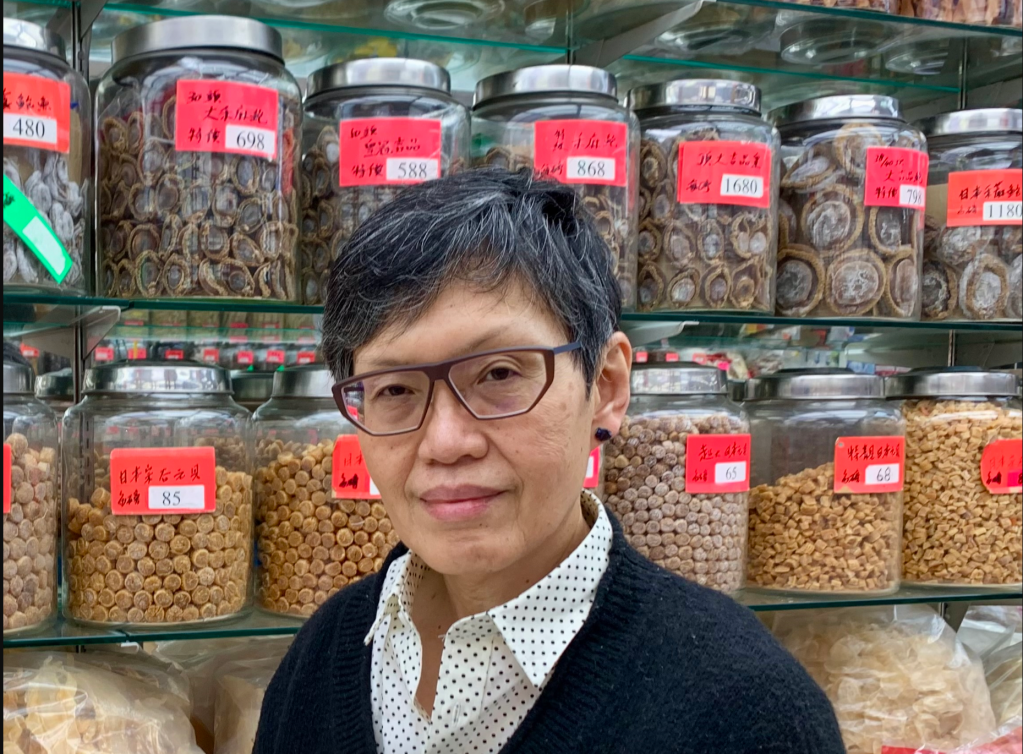
Lydia Kwa has published two books of poetry (The Colours of Heroines, 1992; sinuous, 2013) and four novels (This Place Called Absence, 2000; The Walking Boy, 2005 and 2019; Pulse, 2010 and 2014; Oracle Bone, 2017). Her fifth novel A Dream Wants Waking will be published by Buckrider Books, an imprint of Wolsak & Wynn, in Fall 2023. A third book of poetry, from time to new, will be published by Gordon Hill Press in Fall 2024. She won the Earle Birney Poetry Prize in 2018; and her novels have been nominated for several awards, including the Lambda Literary Award for Fiction. [All contributions by Lydia Kwa.]
 Cha
Cha 