
📁 RETURN TO FIRST IMPRESSIONS
📁 RETURN TO CHA REVIEW OF BOOKS AND FILMS
Click HERE to read all entries in Cha on Indelible City.
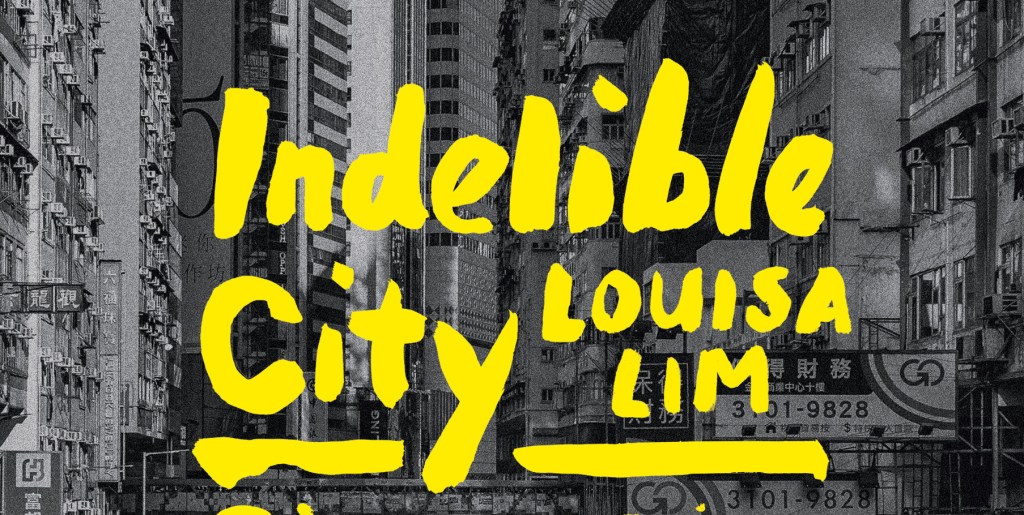
Louisa Lim, Indelible City: Dispossession and Defiance in Hong Kong, Text Publishing Melbourne Australia, 2022. 306 pgs.

“There is no escape from the horror of watching your home be destroyed.”
Louisa Lim’s telling of Hong Kong’s history and descent into authoritarianism celebrates the city’s distinctive spirit and identity, and though the author tries to keep a stiff upper lip, the book is suffused with a sense of despair and burning indignation.
Skilfully mixing political history, journalism and personal anecdotes into a highly readable narrative, Lim presents Hong Kong as “a borrowed place on borrowed time” whose popular aspirations were suppressed by both colonial British and communist Chinese masters. The book aims to place recent events in a longer narrative of dispossession and defiance and “put Hongkongers front and centre of their own narrative” through Lim’s interviews with politicians, artists and activists. Key historical episodes from Chinese antiquity to the present are recounted at dizzying speed, with a focus on events leading to the 1997 Handover and the 2019 protests. Like an approaching typhoon, the book’s foreshadowing of Hong Kong’s current situation engenders a sense of impending gloom. By the time Lim’s account arrives at its inevitable conclusion—the National Security Law and its early aftermath—the reader may feel emotionally drained by this tragic narrative framing.
Yet Indelible City has beautiful, sometimes even funny, moments of sunny respite amid the distressing downpour. These mostly come from glimpses of Lim’s life story that scatter the narrative, such as her learning Chinese calligraphy in Beijing in the 1990s or being dragged out by her mother to “local celebrations to watch ear-splitting operas on rickety bamboo stages and eat gloopy, unidentifiable food” during her early childhood. Lim later describes taking her own children to museums and sending her son home to avoid the tear gas while she herself goes to cover the protests as a journalist. These personal touches are outstanding. By bringing the focus to the level of human individuals and families, readers with limited personal ties to Hong Kong may better understand the city’s current state. Indeed, Hong Kong’s tragedy isn’t just the collective subjugation of a once proud city, but also the countless sorrows of millions of individual Hongkongers whose home no longer exists as it once did. Lim’s emphasis on the personal and the intergenerational reminds us that Hong Kong’s predicament isn’t just a series of events that can be quickly published and forgotten as ephemeral news headlines. The National Security Law will affect Hongkongers for generations to come, but Hongkongers will continue to shape their city’s future despite Beijing’s totalitarian fantasies.
Writing is a central theme of Indelible City. As the book’s title hopefully suggests, Hong Kong’s true identity will persist like ink on a page, or at least not be forgotten. Lim points out that, in traditional Chinese culture, calligraphy is a tool of power. She posits that Hong Kong’s distinct identity was formed at least in part by its “gloriously irregular” Cantonese language. Giant protest banners “turned the territory itself into a canvas” and Hongkongers wrote their political aspirations on Post-it notes at Lennon Walls across the city during the anti-extradition bill protests. As a journalist, Lim felt that news of Beijing’s authoritarian crackdown happened “so fast that we could hardly even write them down before they were superseded by even worse”. Fearing Beijing’s Orwellian internet surveillance apparatus, Hongkongers have deleted their online posts in what Lim describes as a kind of mass self-cancellation. Lim suggests that writing is a form of self, and Hong Kong’s identity and self-determination is inconceivable without the written word.
Themes of writing and identity are further explored in Lim’s description of Tsang Tsou-choi, the so-called King of Kowloon. Tsang, a “toothless, often shirtless, disabled trash collector with mental health issues”, believed that Hong Kong had once belonged to his family but that the territory had been stolen from them by the British in the nineteenth century. Convinced that he had been robbed of his true emperorship, he embarked on a “furious graffiti campaign” in the 1950s to publicise his imperial claims in distinctively misshapen characters scribbled across the city. By the time he died of a heart attack in 2007, he had produced an estimated 55,845 works during his war of words against first the British and then the Chinese authorities.
For Lim, Tsang Tsou-choi’s street life and art is “a prism through which Hong Kong’s story could be viewed” and she romanticises the King as “a shaman, a truth-teller, a holy fool” and “an exemplar of a distinct Hong Kong identity”. However, while the King’s “regents” and “courtiers”—art curators, advertising executives and others—may have wilfully entertained Tsang’s delusions of grandeur so as to produce exhibitions and TV commercials, it’s unclear whether this mentally challenged man really understood what he was doing or how his works and persona were being used. His art sometimes sold for tens of thousands of US dollars, but Tsang lived in a “squalid, fetid” apartment on a public housing estate. Tellingly, media coverage of the King’s death was “fawning”, yet Tsang’s family held his real funeral in private and even his closest artistic collaborators were not invited.
Lim’s personal obsession with this “mentally and physically challenged pensioner” overstates his relevance to the city’s epic political struggle against totalitarianism. While no doubt a fascinating figure, the King takes up far too many pages and is mentioned in nearly every one of the book’s chapters. (The only picture inside the book is a portrait of Tsang.) As a result, Indelible City sometimes feels disjointed, as if the focus is split between two subjects—Hong Kong and Tsang Tsou-choi—albeit held together masterfully by details of the author’s own life story and by her skill as a writer. Still, it’s peculiar that Lim criticises British colonialism and Beijing’s assault on Hong Kong’s nascent democracy movement—while eulogising a delusional self-appointed emperor who claimed Hong Kong for himself and viewed Hongkongers as his imperial subjects.
More insightful are the author’s reflections on journalism. In addition to describing episodes in Lim’s career as a correspondent for many years in Hong Kong and China, Indelible City recounts the moment she transitioned from professionally neutral journalist to journalist-activist when she joined in painting giant protest banners the day before China’s National Day in 2019. The book thus raises the important question of whether journalists can be truly objective when faced with a police state that actively targets them. Ultimately, Lim answers that question: “To stand up is not to kneel, or to crouch, or to hide behind the convenient shield of reportorial neutrality. In circumstances where morality demands a stance, even-handedness is an act of cowardice.” Yet Lim never depicts herself as a fearless journalistic warrior. On the contrary, we experience the “jittery tension” of Lim’s newsroom during the Handover in 1997, and her initial feelings of embarrassment for purchasing an expensive full-face respirator to counter the effects of tear gas in 2019. Interviewing young front-line activists, Lim remembers her son’s clammy hand on one of the days they fled riot police. Lim’s traversing of her “dual identities” as both Hongkonger and professional journalist achieves a unique perspective that is one of the book’s greatest strengths.
Indelible City is a highly personal book. But Lim never unduly places herself centre-stage in Hong Kong’s story, though details of her life and her complicated “issue of belonging” are sporadically revealed as the pages turn. The “half-English, half-Chinese” daughter of a “posh English army brat” mother and a Singaporean civil servant father, Lim was born in the UK but moved to Hong Kong when she was just five years old. “As far as I could remember, this city had been my home,” Lim writes in the opening pages, perhaps to nip in the bud any criticisms that might be leveled against her based on her mixed heritage. “So while I am not a native Hongkonger, I was made by Hong Kong.”
But what exactly does it mean to be a native Hongkonger? At times, Indelible City suggests that Hong Kong has been a place of defiance and rebellion (“an in-between space, a site of transgression, a refuge where behaviour not acceptable in mainland China was permitted and even celebrated”). This notion dates as far back as the Western Jin dynasty, according to Lim’s account, when a Guangzhou-based official fled to Lantau Island after attempting an ill-fated rebellion against imperial authority. Lim’s framing of Hong Kong as an enduring underdog—against imperial Chinese, colonial British, and communist Chinese overlords alike—is an alluring characterisation that no doubt rings truer than ever under Beijing’s draconian National Security Law. “This tiny dot on the map had managed to unsettle the world’s newest superpower,” Lim argues—dramatically yet accurately—“with the power of its convictions”.
Indeed, Lim describes Hong Kong’s courageous struggle against Beijing as “a David and Goliath tale of a doomed rebellion against an overweening power”—perhaps hoping the reader will forget that David actually defeats his gargantuan foe in the Biblical tale, not the other way around. Sadly, Lim’s interpretation of the city’s identity as rebellious underdog invites a gut-wrenching unanswered question: If “Hong Kong’s past as a sanctuary for rebels and fugitives from central power” no longer reflects the city’s current status under the National Security Law, is Hong Kong today still the Hong Kong it once was?
Despite Lim’s heroic framing, the tragic reality of Beijing’s endgame of “total dominance” makes for an increasingly anguishing read. “Sometimes it felt like we were in a video game, falling into a bottomless pit,” recounts Lim woefully. “It seemed like there was no end to the fall.” Here Hong Kong’s predicament reminds me of lyrics from “Iron Sky” by Scottish blues-rock musician Paulo Nutini: “We are proud individuals / Living for the city / But the flames couldn’t go much higher”. At its core, Indelible City is likewise a song of despair, of burning rage, of feeling powerless as one’s beloved homeland descends into the abyss. If the King of Kowloon’s graffiti were articulations of individual delusion, Hongkongers together must hold on as tight as possible to reality—to Hong Kong’s true identity—in the face of totalitarian madness. Hang in there, Hong Kong.
How to cite: Thompson, James. “A Song of Despair, of Burning Rage: Louisa Lim’s Indelible City.” Cha: An Asian Literary Journal, 13 Aug. 2023, chajournal.blog/2023/08/13/louisa-lim-indelible-city.


James Thompson is a British translator and editor based in Taipei. He holds an MA in History from the University of Southampton and is currently studying for an MSc at National Taiwan Normal University’s Department of East Asian Studies. He lived in China for eight years and has been living in Taiwan since 2020. He once studied Chinese language at Hong Kong Polytechnic University in 2007. [Read all contributions by James Thompson.]
 Cha
Cha 