
📁 RETURN TO FIRST IMPRESSIONS
📁 RETURN TO CHA REVIEW OF BOOKS AND FILMS
Click HERE to read all entries in Cha on How Kyoto Breaks Your Heart.
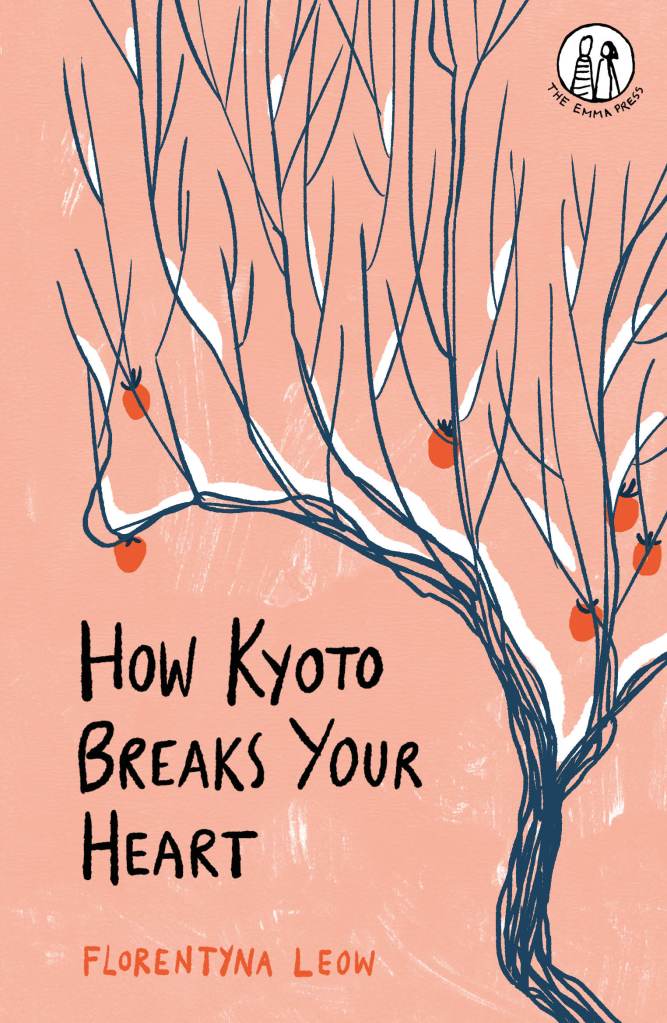
Florentyna Leow, How Kyoto Breaks Your Heart, The Emma Press, 2023. 152 pgs.
One of my most striking encounters with loneliness was back in 2020, in the middle of the pandemic. Cooped up in a dormitory in a foreign country, thousands of kilometres away from everyone I loved, I remember breaking down all of a sudden—the trigger being, of all things, a sad lo-fi track. This would happen repeatedly over the next two years. If there was an upside to these experiences, however, it would be that they’ve shaped my appreciation for books such as Florentyna Leow’s How Kyoto Breaks Your Heart. Poignant, meditative, and lyrical, this collection of autobiographical vignettes explores what it means to connect with the people around us.
Kyoto was published last February, and revolves around Leow’s years as a resident and tour guide in Kyoto before moving to Tokyo. As readers, we meander with her from one place to another: her apartment, the local jazz kissaten (a cafe that also serves alcohol), the banks of the Takano river. At the heart of it all is her former housemate, with whom she once shared a close bond until an inexplicable fallout. She interweaves her memories of the city with musings on their split: why did it end so abruptly? Was it her fault? Images of her housemate come back to her, and to us, in flashbacks. She’s laughing, trying to catch falling fruit, “haloed by sunlight”. She’s leaning over an elaborate dinner they’ve made. She has her back turned to the house, running towards a moving van after a brusque goodbye. Permeating Kyoto is a deep yearning for the friendship they once shared. Leow leaves many questions unanswered rather than settling on assumptions; some relationships, after all, simply lack closure.
But this is only part of Leow’s story. Her essays are filled with the ghosts of other people who have briefly entered her life and then left. There’s the centenarian Yamaguchi-san, who always greeted her with a sweet and a bowl of tea; there’s Michael Sōzui, the tea master she met as a tour guide, and there are the regulars at the kissaten. She ends up separated from all of them, either by their death, or by her own departure from the city. Adding to her loneliness is her identity as an “other” figure; Malaysian-born but fluent enough in Japanese to just pass for a local, she is simultaneously immersed in and barred from the heart of Kyoto’s culture.
It would be wrong to say, though, that Kyoto is a 139-page long elegy. Leow’s bonds with the people around her and with the city itself are transient, but she invites us to celebrate in them—and the loving detail in which she reminisces about her time in Kyoto is proof of this. She dwells on many experiences with fascination and delight, be they the mountain view from the local bridge—“a dream on the edge of memory”, she calls it—or the calmness of Michael’s tearoom. This applies especially to the people she describes; a particularly moving aspect of Kyoto is the intimacy with which Leow describes her loved ones. She lingers on her housemate’s face, which is “illuminated by the glow of her laptop as she tapped away from her futon under a duvet”, and the kissaten barista’s wrists, which rise and dip as she prepares the coffee. Yamaguchi-san’s intermittent streams of speech fade in and out. The effect is a sense of closeness that is aching in the joy it brings.
Food, especially, takes on a powerful presence in the vignettes; it connects people, delights them, heals them. In her descriptions of food, Leow has a way of engaging all of your senses in every sentence. It’s hard not to be entranced by her description of the persimmons in her backyard: “blushing orange in autumn, like a thousand little suns festooning the tree”, with “crimson or sunset-golden hues”. They taste, she writes, “like the sound of a clarinet”. With her poetic lyricism, her attempts to connect with other people through food become all the more poignant. We see her making jam, trying to make hochigashi (dried persimmons) for her housemate, and cooking up a feast. Leow brings in cooking as an act of nurturing, and her list of the dishes she makes is infused with warmth and affection. We have to put our love somewhere, and for Leow that somewhere is a glass jam-jar, neatly wrapped up for a friend.
In this light, the autumnal imagery running through Kyoto is all the more fitting. The season, Leow says, “breathes shades of fire, rust, bronze into the leaves, which blanket the ground as the cold creeps in”. Cold, death, rust—this is a time of decay, but the decay is so beautiful that to lament seems like an inappropriate response. At this time of the year, the sun turns persimmons into “chains of fire opals”. The luminosity of the autumn moon is reason enough to make yourself a cup of tea and enjoy the view. This is the season in which Leow meets an ailing Yamaguchi-san for the last time and hears of the death of the local shopkeeper’s girlfriend, but also the season in which she has feasts with her friend Z and admires the ethereal beauty of her kimono-clad housemate. There’s a reason, I think, why we first see Leow’s housemate haloed by autumnal sun; just as death is intermingled with beauty in autumn, the eventual loss of their friendship doesn’t negate the joy that it has brought. Life, then, is one long autumn.
By bringing in the seasons, Leow also shows an awareness of the way time—and human relationships—are cyclical as well as linear. Some friendships are irreparable once broken, and sometimes death separates individuals. Each relationship seems linear in the sense that it has a beginning and an end. But after the season of loss comes the season of renewal; the cycle of making and losing friends goes on for the rest of one’s life, and indeed for the entirety of human history. We see that the loss of her housemate doesn’t break Leow forever. She eventually finds a partner who loves her, and she has friends who know exactly how she likes her eggs done. That’s not to say that people are replaceable; quite the opposite, in fact. Leow seems to argue that relationships, like the seasons, are brief and valuable in their beauty—and when each has inevitably run its course, we look to the future in the hope that there will be more precious friendships to come.
It might be that I have a soft spot for this book because Leow and I have certain things in common. I, too, have a penchant for matcha cake. I, too, have moved across the globe. Uncertainty, loss, and departure after departure; all of this hits close to home, especially now. Though the events of Kyoto happened just before the pandemic, I see the book as a timely response to the past three years of alienation and loss. At the same time, the feelings she describes are timeless—Leow understands that loneliness is universal, and the essays are dedicated to “anyone who has ever lost a friend”. Kyoto speaks to all of us who have experienced isolation, who have shared fruit with someone, and who have been soothed by a hot meal prepared by a loved one.
Yes, Kyoto breaks your heart, but it also fills it up in the most beautiful ways possible—with steaming cups of tea, kissaten gossip, and persimmons. Through the brief, eggshell-fragile connections we share between people, we break, we heal, we remember, and we love all over again—and share a good cup of coffee with them while they’re still here.
How to cite: Cho, Keziah. “Loneliness is Universal: Florentyna Leow’s How Kyoto Breaks Your Heart.” Cha: An Asian Literary Journal, 9 Aug. 2023, chajournal.blog/2023/08/09/kyoto.



Keziah Cho is a first-year undergraduate studying English at University College London. She was born and raised in Hong Kong. Somewhere around the age of seven she fell down a rabbit hole of creative writing and hasn’t emerged since, although hopefully the writing has increased slightly in quality. These days she writes most of her poetry while airsick and half-conscious on the thirteen-hour flights to and from London. A city girl through and through, she takes most of her inspiration from urban life and the immigrant experience. Some of her poems have been published in Pi Magazine and some are forthcoming in Emerge Literary Journal. She also writes articles for several publications, including Pi Media, The Cheese Grater, and Empoword. In her spare time she can be found in her dorm kitchen, painstakingly kneading bread by hand and mixing cake batter with a fork because she can’t be bothered buying a mixer. [All contributions by Keziah Cho.]
 Cha
Cha 