

📁 RETURN TO FIRST IMPRESSIONS
📁 RETURN TO CHA REVIEW OF BOOKS AND FILMS
Click HERE to read all entries in Cha on The Impossible City.
Karen Cheung, The Impossible City: A Hong Kong Memoir, Penguin Random House, 2022. 352 pgs.
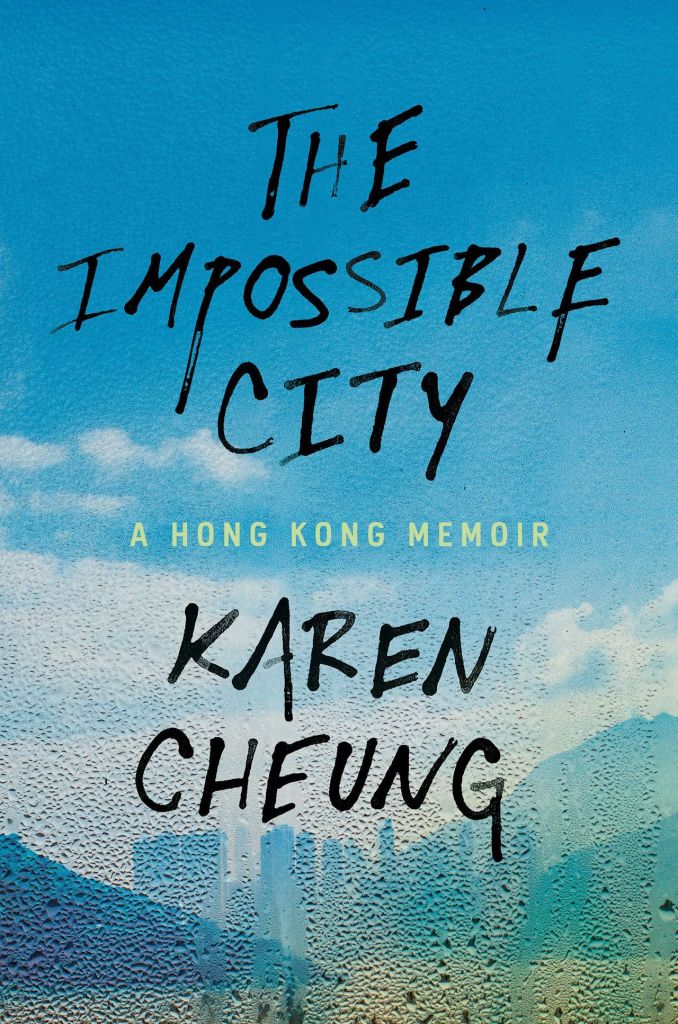
Karen Cheung’s memoir, The Impossible City, opens by sketching out “A Map of Hong Kong, 2021”, charting the beginning of “her own stories” in the neighbourhood of Sai Wan 西環. Her textual map winds over the Praya, Instagram Pier, Hill Road and High Street in its opening paragraphs: a lush and deft evocation of Cheung’s university memories, irrevocably frozen in the year appended to her map. If The Impossible City’s subtitle, A Hong Kong Memoir, suspends Hong Kong in this space of memoria, then its titular epithet configures Hong Kong in the monolithic stone of paradox, “impossible” and yet evidently existing, hanging over Cheung’s map of space and memory. Too critically self-aware to hold Hong Kong up to nostalgic idealisation, yet too emotionally exacting to discard her personal history of Hong Kong, Cheung’s memoir of her city follows its paradoxes through, absorbing Hong Kong’s polyphonic voices into the structure and language of her narrative whole.
Immediately succeeding Cheung’s 2021 map of Sai Wan is “The Tourist Map”, a pithy verbal route over Hong Kong’s “quintessential” sights, unbracketed by year, as timeless as tourist Hong Kong itself. The two maps—one highly intimate, instinctively tuned by years of muscle memory and quotidian habits; the other in the second person singular, jolting from Victoria Peak to Chungking Mansions in a vicious textual mimicking of disoriented footsteps—each open in the Western District, foiling each other as they proliferate over the time and space of Hong Kong.
While the second map stretches shallowly over Hong Kong’s named places, Cheung’s 2021 sketch swells into time, into the space that has no map and no coordinate grid except the (0;0) of 1997, writing a city where, “for the first time, I felt like I belonged.” The streets, indie bookshops and underground music venues that unravel through The Impossible City, pinned down on a digital map, signify Cheung’s chain of events, the narrative of past experiences that brought her to where and who she is now. Perhaps inadvertently, The Impossible City becomes a kind of guide to Cheung’s dimension of Hong Kong: in Wan Chai 灣仔 one rainy June afternoon, I wander into ACO on Hennessy Road because I’ve just read Cheung write about it.
If The Impossible City is the record of Cheung’s Hong Kong experiences, it is also the intertextual shelf on which she collects the nodes that link into her Hong Kong, splicing novels, poetry collections, academic essays, films, buildings, and music into an ever-expanding repertoire of her subjectivity. She hits all the typical touchpoints of Hong Kong culture—Leslie Cheung, Wong Kar-wai, Anita Mui—and then more. On the literary front, she references Atlas: The Archaeology of an Imaginary City by Dung Kai-cheung, a seminal classic of Hong Kong literature, first published in Taiwan in 1997. He writes, layering words over metaphysical maps of Hong Kong, that “the making of maps […] has to pass through a period of time pervaded by external change”. Maps are “places buried under time”; maps are “time frozen”.
Cheung’s own atlas, unfolding into the full scope of her memoir, blooms so fiercely with memory that she shatters the ice of time. The opening section of her tripartite structure unfreezes the scribbles her childhood shoes drew between “old, sluggish” To Kwa Wan 土瓜灣 and Aberdeen 香港仔, where the expatriate groups populating its space almost seem to lift Aberdeen off the earth into the “parallel universe” of the “global citizen”. Her authorial “I” evolves from this intense recounting of childhood traumas, whether small or looming, into the measure and self-possession of an adult narrator. Cheung’s voice gains authority as Hong Kong loses it. Though the sequence of her childhood is written retrospectively, her verbal recreations of To Kwa Wan smart with the same childhood pains, transposed into the adult voice of nostalgia: “restaurants that served steaks seasoned with too much tenderiser; the cluttered façades of public housing… And I am the abandoned child”. Cheung’s map might be frozen, but Cheung is not, an “I” versed in the expression of loss. As she gradually moves away from the starting point of the map, sparks of profound hurt sting their way into the present tense.
In the same year as Dung, Ackbar Abbas, former chair of comparative literature at the University of Hong Kong, problematised the modes of Hong Kong’s “dis-appearance” in Hong Kong: Culture and the Politics of Disappearance. To disappear is not necessarily to be absent but “misrepresented”, sliced into falsifying binaries that neglect the delicious nuances of subjectivity between. Cheung’s subjectivity “develops precisely out of [this] space of disappearance” in the binary of “local” Kowloon and “international” Hong Kong Island. Her images develop in the negative space between postcolonial, capitalist, and Communist clichés, reclaiming the light of subjective representation.
For Cheung and the Hong Kong writers nestled in her pages whose ranks she now joins, Hong Kong is no “cultural desert”, no “borrowed place on borrowed time”, but the “one home” they’ve known and the “space-time” they belong to. At the same time, reading this guide in its own “space-time” feels dangerous now: showing its cover in public might bring unwanted consequences. Published in the USA and unavailable in Chinese translation, The Impossible City’s existenceis an act of reclaiming disappearance from actual political disappearance. The book itself is a paradox, impossible in post-2020 Hong Kong, and yet it is sold and read across Hong Kong’s indie bookshops, in the spheres of the city that Cheung loves most.
Though her style is dense with a determined pursuit of emotional truth, Cheung flat-out refuses the assumption that her writing might represent an authentic, all-encompassing narrative of the territory she grew up in, palatable to Western perspectives: “Do not read this and believe that I am the one who can give you the story of… this city and all its beautiful, chaotic contradictions. Never trust anyone who holds themselves out as such.” At the beginning of her memoir’s third section, Cheung discusses the polemic of Anglophone writing in Hong Kong literature, where language, expression and audience intertwine with the social problems of poverty, classism and racism. To write in English in Hong Kong has been a way of encoding colonial inequalities and biases into its literature, and therefore into representations of Hong Kong society destined for the foreign gaze. Cheung wrote The Impossible City, of course, in English, in the paradoxical “liminal space” between the “local” and the “international” that echoes substantively as well as linguistically through the memoir.
But through the journalistic interviews that uphold the narrative as much as Cheung’s subjective experiences, she integrates an innovative approach to writing in English for Hong Kong, Chinese-facing readers. Her friend and fellow journalist, Holmes Chan, condemns a deliberately “insular”, opaque writing style. “To [make] the reading process as smooth, as frictionless, and as painless as possible”, one might shed convoluted metaphors, abide by a clear logical structure, and construct a robust lexicon of accessible, unambiguous words that serve her narrative. Cheung achieves this in a “high” standardised English that refuses to sacrifice clarity and emotional authenticity to satisfy Orientalist aestheticism. She incorporates Chinese characters for Romanised transcriptions, for instance in place names, “next to the English text, no italics, no parentheses”, verbalising a map that not only spans space and time but also language.
Abstract as that might sound, Cheung’s narrative grounds itself in the real dimensions of her life, covering culture, music, and mental health struggles in Hong Kong, welding all of these tributaries into the vast sea of Hongkongese politics, that figure of disappearance haunting every corner of the territory. Cheung stresses the impossibility of apoliticism down to the very segments of her words, writing in the colonial language for postcolonial readers who engage with their own local cultures. In doing so, she colours in the space between the post-1997 binary of “pro-Hong Kong” and “pro-China”, “un-disappearing” the daily stories and rituals of Hongkongers simply pursuing their dreams and passions in their home city, walking a narrowing ridge of decreasing freedoms.
They are beautiful stories, from musicians, activists, poets, and journalists alike, and more often than not these people wear at least a few of these hats. Moving away from Dung and Abbas’s intellectual rigour, Cheung opens to ironic humour in Nicholas Wong’s “If we anagram capitalism to I am plastic”, then slips into a grassroots elegy for Hong Kong. Two successive political systems that were never designed to enable belonging confine seven million people on two islands and a peninsula, trapped between a border river and a sea. The question of home—not only what it might be, but if it is even possible—rears across the range of Cheung’s friends and acquaintances in Hong Kong’s subculture scenes, as well as in her scathing political analyses of governmental approaches to Hong Kong’s “land problem”. She quotes a Hong Kong rapper: “7K for a house like a cell and you really think that we out here are scared of jail?”
Governmental failures to bolster the quality of life in Hong Kong meld inextricably with Hong Kong’s suspension between ex-colony, Special Administrative Region and “Southern Chinese city”, inseparable from the dystopian political response to Hong Kong’s struggles for democracy. In the sense of future stability or the status quo, Hong Kong is an impossible city. To record these conversations for posterity is to document the paradox of this city in a profound yet ordinary “act of resistance”, a gesture of “mutual care” for the Hong Kong community that subsists beneath the veneer of impossibility.
Cheung’s personal thread in The Impossible City refuses to refrain from articulating her intimate subjectivity in Hong Kong’s post-2014 space, and never once does she succumb to moralising Hong Kong. That would be didacticising it, diminishing it, disappearing it. Cheung has mastered the sharp dictum at the end of each section: the lancing throw, specifical in its equivocality, of “a person can mean so many different things when they say they love a place”, or “in a place that had never allowed you to write your own history, even remembrance can be a radical act”. Her cartography, connecting space, time, and language, are ripe for communication but also interrogation. What does it mean to write Hong Kong? Are there ways of writing it without the gloss that explains 1984, 1989 and 1997 in so many stories, articles, essays and songs?
Even Cheung’s title, The Impossible City, mires Hong Kong in the inevitability of disappearance before she deconstructs this inevitability into a state of definite being, of persistence in memory. And what does it mean to write a memoir of a place, not only a city but a whole territory of its own? Cheung can come across as nostalgic in some sections, but her tone mostly focuses on mapping Hong Kong out on the paper of her self. To write a memoir is to assert her authority over her version of Hong Kong in the very root of the word, auctoritas, pragmatic and unsentimental. Her authorial “I” is simultaneously anchored in the idiosyncrasy of what only she can say and a source of propulsive power for a post-2020 Hong Kong cultural subjectivity. Only the tourists are nostalgic.
The paradox is this: to write about Hong Kong’s encroaching disappearance is to counter that disappearance with each inscription of the name “Hong Kong” in the canon. What might initially have appeared as an elegiac obituary for the city morphs into a literary space that rejects the touch of colonisation, or at the very least, attempts to thrive within the extant strictures of (re)coloniality. The concluding section of “A Map of Hong Kong, 2021” is titled “A Map, Erased”, and Cheung writes: “Maybe you can’t save this place; maybe it isn’t even worth saving. But for a moment, there was a sliver of what this city could have become.” In writing out the map, “erased”, Cheung subverts the disappearance of history in the fine transparency the eraser leaves behind. To write about the death of Hong Kong is to extend its hold on life. In The Impossible City: A Hong Kong Memoir, the sliver of Hong Kong’s possibilities remains.
“Everything is clearer when viewed from behind closed eyes.”
How to cite: Suen, Michelle. “The Possible Map of The Impossible City: A Review of Karen Cheung’s Hong Kong Memoir.” Cha: An Asian Literary Journal, 4 Aug. 2023, chajournal.blog/2023/08/04/possible-map/.


Michelle Suen is from Hong Kong and lives in Dublin, Ireland. She is studying English literature and history at Trinity College Dublin and is an assistant editor of fiction for Asymptote. [All contributions by Michelle Suen.]
 Cha
Cha 