

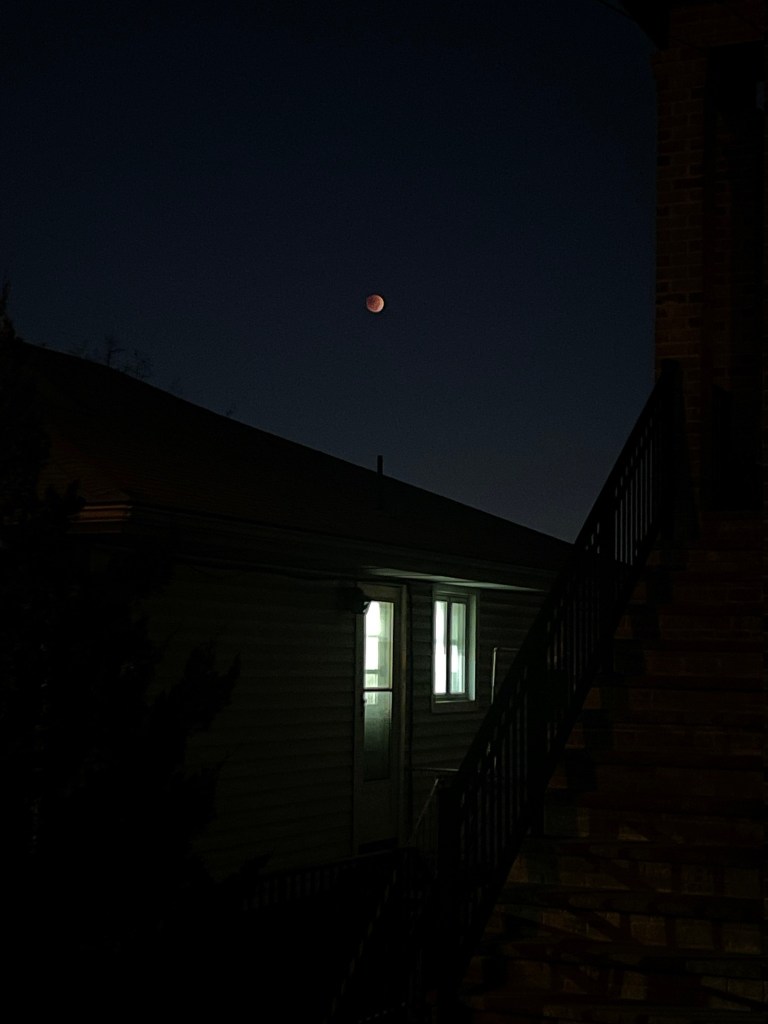
“4AM, Fort Lee”, photo by Matt Turner
In the Fall of 2022, there was a gas leak in the building I lived in in Brooklyn. ConEd Power came by to take a look, and by the time they left we had no heat or hot water. Our landlord asked everyone in the building to quickly leave. We found an apartment in Fort Lee, New Jersey, just across the George Washington Bridge, and soon my wife Haiying and I, and our dog Xiao Chou, were experiencing suburban life (thankfully with Manhattan just minutes away).
These poems were all written after moving to Fort Lee, and all represent a self-conscious break with the register and experimentalism of my earlier work. In Brooklyn I had already begun to be influenced by the coldly emotional work of my neighbour, the poet Wang Yin. I wanted to write what I saw as a slower, more thought-oriented mode of poetry. These poems are the results of this shift in the way I wrote while under the duress of finding a new mode of living in a new geography.

STADIUM
A few dozen people, late afternoon
at the university stadium
demanding an answer
the release from the responsibility of time
like we’re floating over the risers
flesh redistributed through athleticism
slowly falling petals
color fading out of the stadium seating
the release from the responsibility of time
mountains in the west
a cube
.

.
OLD CITY
Look at all the buildings
they go on forever
they remind me of the sun
the sun is fixed behind them
everything ends
All the buildings
they all said to me
“Do towers, obsidian-like…”
I wondered if they thought they were beasts
like the Fauves
Did the city say anything
does sound exist
it all exists without you
you’re nothing to it
that isn’t your name, either
can you change your name
Beasts can be followed by a dream
life’s subdued like that
at the limit of sight
do people look so far
Hello, Dr Death
the city in the child is never born
the question inside
is the dynamic life of its image
it loops around the
fiberoptic cable of the city
.
.
HOSPITAL
I race to you from a suburb
it takes 15 minutes by cab—max
Outside the peace of the hospital
outside, strolling through
the smoothly functioning gates
Hey! To become a city means to offer, in plain daylight
a landscape that never changes
that attracts the ill and the well
You wait on the bench
the doctor waves
at noon a nurse lets you in
Wave after wave of newcomers
shyly demand our focus
city institutions have never done so much
Neurons fire
like fireflies
.
.
AT THE MARKET
Integrate the market into policy and bypass inspection.
sliding door
little red door
little beige door
little door
larger door
etc
(roof sagging like a Song roof)
(incongruous image of towers)
.
.
SHORE
the gauze of snow over the dark waves
exaggerating the mucuslike body of water
in early spring, it oozes into towns
the gooja-gooja of steps muffled by the water
even the clumsiest movements go under
even the sky goes under
life becomes something like a crystal vase
life becomes something like a screen
cutting through the tall weeds
between the foosh-foosh of the weeds
you can still hear the oosh-oosh of a turbine
.
.
CITY LIFE
a thousand people
are taken up pink into the sky
where they drift slowly with the pink wind
some shove down into corners
transit the world aimlessly
I look at myself, turn and alone continue
antedating myself, preceding myself
reflecting in the shop windows
.
.
THING
From the outside, it didn’t happen
and what continuity could continue
clung to itself, binding itself with sudden force
the scale became what it had not been
as if it insisted on abandoning us
But the thing, refusing the handle of how it could
and, failing to know the thing, the film continuing
Lazy. Lying. Active. Awakened. The room has lots of incense
there are several lights shaping the room
aware the same was not the same
between eye and screen that looks back
.
.
APPROACH
A circuitlike lip stretches back
and the sinking voice
comes out of the intercom
The ropes were tied to the cornices and
fastened to the concrete field,
and we would be able, as planned,
to hoist the weight over our shoulders
and, with forward movement, the whole
thing would lurch forward
.
.
BANKS
In theory, the suburban banks will continue
a canopy of tall banks
pushing up against the clouds
Public banks will increase
with the bank that comes after the megabank forgotten
and the bank will retain the name megabank when forgotten
the country bank is like this too, but worse
.
.
CITY WITHOUT DEATH
Cities where people never die
Is that a thing?
It’ll be the same when the city-world is released from death
just as the world appears outside of the city
and the landscape of the place
just won’t get off the back of the back of the city
won’t let it die with or without death
Can the decision be made again?
spotlight brushes our faces and our expressions change
like a membrane the sky strung over the window
motion in the dream spheroid while apparent motion continues
.
.
142 THINGS A POET SHOULD PROBABLY KNOW
Inspired by Michael Sorkin’s “250 Things an Architect Should Know”, I put together my own list of things a poet should know. Not as hubristic as I expected it would be (otherwise there would be like six entries on Baudelaire), but definitely limited by my own experience.
1. Why night is sublime
2. The difference between deconstruction and literary deconstruction
3. Will Alexander
4. Mallarmé
5. Xi Chuan
6. A thorough outline of Chinese history
7. Why Citizen was as good as the hype
8. Why Ocean Vuong is not
9. The literary style of Bruce Chatwin
10. The Tale of Genji
11. The difference between a translator and an author
12. When to say “fuck it” and carry on with the translation anyway
13. A basic understanding of contemporary art from the developing world
14. Chores
15. Willingness to get along as a very last resort
16. How to make a fast buck
17. Why seniority is usually bullshit
18. Advanced knowledge of wines
19. The isolation of the suburbs
20. How to make it work to your advantage
21. How to lie through your teeth
22. Quantitative verse
23. The Autobiography of LeRoi Jones
24. Essay on Exoticism
25. The (more or less) history of the prose poem
26. And why it’s still the most modern form
27. The Golden Peaches of Samarkand
28. Any great city just before it rebounds
29. The idealism of the megacity
30. The awful countryside
31. Rich poets
32. And why you avoid them
33. Admiration for the business class
34. And their limitations (many)
35. The constellations
36. Working for a daily
37. To trust your intuition
38. That it’s not yours to trust
39. Bus routes
40. And subway routes
41. How to let your guard down
42. And speak with total sincerity
43. But only to a close friend
44. The pleasure of a cold beer, without food
45. By yourself, in the middle of the day
46. The extreme difficulty of writing fiction
47. And its limits
48. How to write rhyming song lyrics
49. How to go on your nerve
50. The long road to spontaneity
51. And when you’re just fooling yourself
52. At least one other language
53. How to build furniture
54. The pleasures of inarticulate speech
55. Most of the dialogues of Plato
56. And why he’s a great dramatist
57. Knowledge of French and/or Chinese
58. The differences between German and English Romanticism
59. The problems of German Romanticism
60. Other people’s song lyrics
61. The ability to recite a handful of poems from memory
62. Different kinds of rhyme
63. Basic formal/symbolic logic
64. How to play an instrument
65. Principles of typography and design
66. Principles of concrete construction
67. Ashbery
68. How to edit a magazine
69. How to write for a newspaper (not a magazine)
70. The distance between your description of a blood moon and the actual blood moon
71. How to get the fly out of the bottle
72. At least 20 different non-flowering plants in the wild
73. Shame for having messed up
74. Or having done the wrong thing
75. How to sell your words
76. Distrust of national literature
77. An understanding of why it’s there
78. When to give your editor what they want
79. When not to
80. The Analects
81. Zhuangzi
82. Your own theory of alienation
83. The distance over the bridge over there
84. Why not to waste time on townies
85. Buddhist logic as developed by Nagarjuna
86. Why Ted Berrigan is fun
87. But very overrated
88. Laura (Riding) Jackson
89. Onomatopoeia as used by Yuichi Yokoyama
90. Basic macro and micro economics
91. Having no options
92. Slowly getting better
93. Having to care for a pet/child/parent
94. Why punk is a guilty pleasure
95. The dangers of writing drunk
96. The pleasures of sobriety
97. How to pick someone up on the subway
98. Reasoning by analogy
99. When to clarify
100. Gertrude Stein
101. Some geology
102. When to mystify
103. Public presentation
104. Why you’re actually an anarchist
105. Brecht, inside and out
106. Little galleries
107. Journalists
108. How to Cook a Wolf
109. Thick summer humidity
110. Why winter is the best season
111. The Gunslinger
112. The people who run little galleries
113. The people who run small presses
114. The inadequacy of electronic communication (rather serious)
115. The Berlin Key
116. The power of reality television
117. Irma Vep (all versions)
118. How to bargain
119. The Diamond Sutra
120. The New Criticism
121. Why it’s done
122. When to avoid direct speech
123. That you’re a small minority
124. That the New York School (all generations) is over
125. How to get around when you don’t speak the language
126. Platform
127. When to not be a faithful translator
128. Yuichi Yokoyama’s narratives
129. Why materialism is actually pretty shallow stuff
130. Close reading
131. How to get past it
132. Poemas de terror y misterio
133. Real modernism (the 19th century)
134. The Dream House
135. The beauty of density
136. A bit about modular practices
137. Why you probably feel uncomfortable at poetry readings
138. And if not, why wouldn’t you?
139. Dependent origination
140. The Oppens
141. Why naming a clothing boutique “Hemistitch” and keeping, Thai-royalty like, a portrait of Mallarmé above the register, is a bad idea
142. The Césaires
.
How to cite: Turner, Matt. “City Without Death: Poems.” Cha: An Asian Literary Journal, 25 Jul. 2023, chajournal.blog/2023/07/25/city-without-death/.


Matt Turner is the author of the full poetry collections Slab Pases (BlazeVox, 2022), Wave 9: Collages (Flying Islands, 2020) and Not Moving (Broken Sleep, 2019), in addition to the prose chapbooks City/Anti-City (Vitamin, 2022) and Be Your Dog (Economy, 2022). He is co-translator, with Weng Haiying, of work by Yan Jun, Ou Ning, Hu Jiujiu and others. He lives in New York City, where he works as a translator and copy editor. [All contributions by Matt Turner.]
 Cha
Cha 