

📁 RETURN TO FIRST IMPRESSIONS
📁 RETURN TO CHA REVIEW OF BOOKS AND FILMS
Click HERE to read all entries in Cha on The Impossible City.
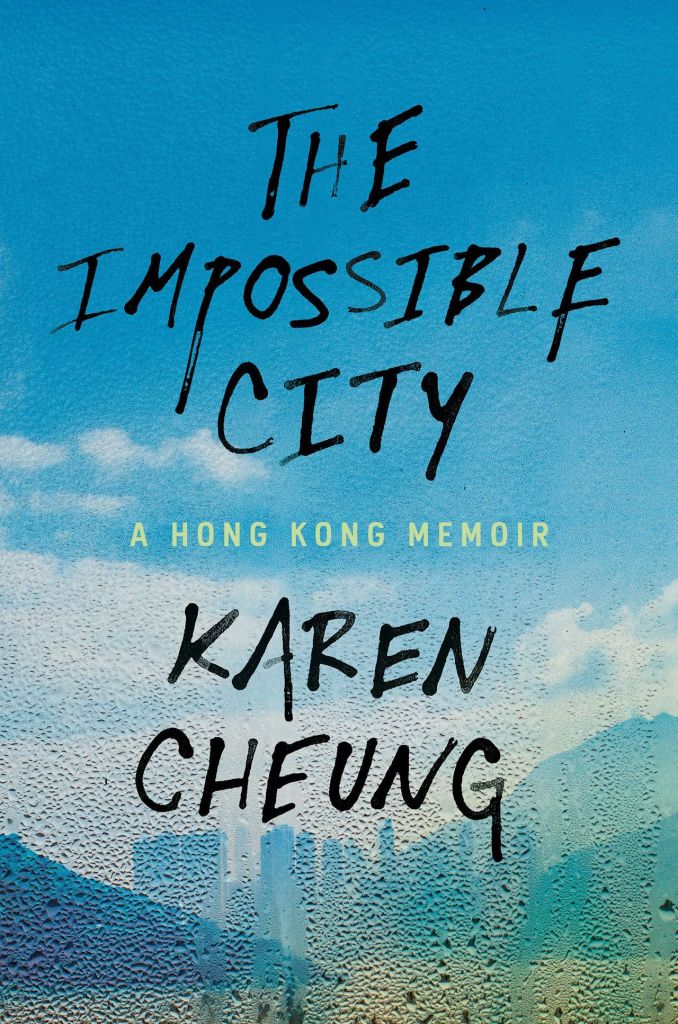
Karen Cheung, The Impossible City: A Hong Kong Memoir, Penguin Random House, 2022. 352 pgs.
When I was younger, my friends would ask me where my parents came from.
“Hong Kong,” I would reply.
“What do you call people who come from Hong Kong?” They would ask.
“Hongkongers.”
I hated the term “Hongkonger”. It felt grammatically incorrect. A weird phrase that denoted a sense of belonging to another place.
Often, I found it was easier to refer to myself as an ABC—“Australian-born Chinese”. It was the safer option; an attempt to assimilate and remind others about my priorities. I was Australian first and foremost. Hong Kong was simply the place where my extended family lived. A place that we visited every two years over the summer holidays.
❀
Karen Cheung’s memoir The Impossible City opens with an almost identical experience.
If you had asked me when I was eighteen what I thought of Hong Kong, I would have told you that I was ambivalent. Hong Kong was a place in which I just happened to find myself… I was not a Hongkonger because I did not yet know what that meant. (7)
In these opening lines, Cheung identifies the central question that she explores in the chapters of her book, a question that I have long asked myself: “What does it mean to be a Hongkonger?”
Published in 2022, The Impossible City is a seminal contribution to contemporary discussions around Hong Kong people and their unique identity. Importantly, Cheung’s memoir accompanies and extends upon the ideas of several English-language books published since 2019 in which local and diaspora authors have given voice to ordinary Hongkongers. Reading The Impossible City in conjunction with these sister texts, such as Ho Fung Hung’s City on the Edge and Louisa Lim’s Indelible City, is invaluable to the understanding of the pain and hopes of Hong Kong people in recent years.
In her memoir, Cheung’s personal experiences are diverse and distinct. She is both a “local” and an “outsider”, able to navigate the intricacies of writing in Cantonese and English, and having the perspective of experiencing Hong Kong before and after the 1997 Handover. These experiences position her exceptionally to explore the notion of “déjà disparu”—the feeling that “what is new and unique about the situation is always already gone and we are left… holding a handful of clichés” (67). This term was popularised by Ackbar Abbas in describing Hong Kong as a “space of disappearance” (65) in his iconic Hong Kong: Culture and Politics of Disappearance, published in 1997.
The chapters within The Impossible City function as vignettes where snapshots of Cheung’s personal life are intermingled with the wider historical and social context of Hong Kong. It is important to recognise that the book is not a political narrative featuring stories of student leaders or elderly protesters, but Cheung’s chapters “often end in 2019, when a protest movement imbued these topics with a new urgency” (18). Her voice is raw and honest, creating a sense of authenticity that only comes with having lived out the trauma and dissonance of having lost one’s home. She writes:
Documenting disappearances is a defeatist line of work: I can never write fast enough to keep up with the changes of my hometown… But in a place that had never allowed you to write your own history, even remembrance can be a radical act. (19)
In Part I, Cheung uses her childhood as a lens through which she explores several common anxieties and experiences that are uniquely part of being a Hongkonger. She recounts the feelings of shame at not being successful in Hong Kong’s competitive schooling system, the embarrassment of not conforming to her Confucian traditions, as required by her father, and the guilt of not showing proper honour to her grandparents. In these chapters, Cheung also vividly describes the inevitable conflicts and tensions that come with living in almost suffocating proximity to family members—a ubiquitous problem in a city that so often lacks individual space, both physical and emotional. Her recollections about her family life are intimate and personal—almost as if you were living in the same flat as them. In detail, Cheung recalls the criticism of her divorced parents: her father’s Confucian reproaches that she is “unfilial” and her mother’s apathy after moving to Singapore. This trauma sparks the beginning of her journey with mental health troubles—a recurring topic in her memoir as she struggles to reconcile the assumptions that others have imposed on her.
However, the dysfunctionality of Cheung’s parents is in direct contrast to the kindness of her grandmother, whom she describes as “the only reliable presence in my life” (34). Evoking the experience of many Hong Kong kids who grow up under the care of their grandparents, Cheung composes an intimate portrait of her grandmother—a ninety-year-old lady who walks five flights of stairs daily to get her groceries from the local wet market. I cried when Cheung describes her final conversation with her grandmother as she recalls a phrase that so perfectly exemplifies how Asian elders communicate their love:
得啦,都話送你去車站囉 Enough. I told you I was going to accompany you to the bus stop. (60)
Cheung’s varied recollections of her childhood and adolescence reflect her self-imposed title as an “outsider”, compounded by her brief time in an international school where she befriends children of expatriates who regard Hong Kong as “merely a transit stop and not a destination” (75) and jokingly call her “local”. Cheung’s feelings of apprehension and isolation during her youth mirror the wider uncertainty experienced by Hongkongers in the years after the Handover. Cheung references this anxiety as she recounts watching the Handover ceremony:
Hong Kong has always been obsessed with the notion of its own death… I am there too… but no one sees me… The world looks different. For now, everything is possible. (33)
Cheung’s formative childhood experiences can be read as a symbolic commentary for Hong Kong’s identity—seemingly struggling to delineate itself as a Chinese city or former British colony, of being a trilingual language space and perhaps most fittingly, China’s continued criticisms that Hongkongers must be “filial”.
Later, in Parts II and III, Cheung explores her memory of recent events in Hong Kong: the 2003 SARS Epidemic, the death of the beloved pop star Leslie Chung, the 2014 Umbrella Movement, and the 2019 Protests. The chapters intertwine the personal with the public—Cheung’s challenges in her own life mirroring the ongoing challenges faced by Hongkongers.
In “Twenty-Two Roommates”, Cheung details the numerous flats that have been her “home” since moving out at the age of eighteen. Each flat offers a unique perspective of the city, emphasised by the unusual assortment of roommates that accompany her. Some become dear friends, like Kit, who later becomes her emergency contact. Others remain on the periphery as side characters known for their odd quirks and habits. Cheung argues that Hongkongers have always had a yearning for their own space—be it physical or symbolic—where, in the words of Liu Hsiuwen, they can “call home… and feel safe” (119). Cheung posits that this desire can be seen through the protests against the government’s reclamation of villages in the New Territories, against the destruction of the Queen’s Pier in 2007, and the “occupation” of Central and Mong Kok by student protesters in 2014. One wonders whether this continual struggle for space is epitomised in the “Lion Rock Spirit”, something so central to Hongkonger identity and made famous through its sitcoms and TV dramas.
In “Through the Fog”, Cheung also reveals her vulnerability, namely in her struggle with mental health since adolescence, exposing the lack of mental health care in Hong Kong. Amid the backdrop of constant political unrest in the 2010s, her mental health alternates between periods of medication, hospitalisation and relational breakdowns. Her honesty reinforces her plea for increased mental health supports, especially for Hong Kong’s post 2019 generation who continue to struggle with the trauma of having friends in jail, disrupted schooling and the question of whether to leave their home. Whilst this chapter is difficult reading, Cheung’s frankness and willingness to speak about her own life reinforces the words of Brian Leung—former protester, now exile abroad—“What unites Hongkongers is pain” (177).
In Part III, “Language Traitors” and “International School Kids” form a self-reflexive commentary as Cheung seeks to reconcile the role that English speakers play within the identity of being a Hongkonger. A poignant conversation with her friend James expresses the frustration that many have at the disparity that exists between expatriates and “local” Hongkongers:
You know what grinds my gears… People who say Home Kong… And yet they won’t even know who their district councillor is… The people who claim to love a place by posting photos of their hike in Sai Kung but aren’t interested in becoming part of a community… You get a choice to care and it may not ever affect you, until it inconveniences you. (190)
In the aftermath of 2019, Cheung describes how foreign media outlets and news corporations compartmentalised her identity as a writer and journalist. They do not want an “insider’s” or “local’s” perspective on the situation but rather a palatable version that can be read by “Texas Grandfathers” (202) that portrays Hong Kong as a “semi-autonomous region, an international financial centre or Southern Chinese city” (201). These outlets fly reporters in and out depending on whether there is a “newsworthy story”, where local reporters are not even given credit for their contributions as “fixers”. Cheung asserts that this is a form of disappearance:
When we cease to present a narrative comprehensible to Western audiences, we are forced out of the pages of the newspaper. We are wiped off the map. (202)
Yet, in her very act of writing in English about Hong Kong, Cheung symbolically models what it looks like to find a resolution to this dichotomised cultural identity. Hong Kong’s history and identity has always been hybrid and Cantonese and English speakers share a responsibility to communicate its richness to their audiences. Although Cheung argues that using English to convey her opinions and tell her stories has always felt like a sense of “betrayal to her mother tongue” (208), it is an important form of remembrance.
It is for this purpose that Cheung—and indeed this journal, Cha, in which this review has been published—are seeking to achieve: the creation of a distinct Hong Kong literary space and identity that includes both English and Cantonese writers. Arguably, this is what makes The Impossible City so unique: we can hear Hong Kong stories being shared by a “local” Hongkonger. Cheung’s epiphany is clear at the beginning of Part III:
I’ve lived here all my life and did not once describe myself as a Hongkonger until my first extended trip away from home… Where else could I be from? I have only known one home. (192)
The final chapter of The Impossible City is perhaps its most emotional and fitting in today’s climate. Titled “A City in Purgatory”, it is an elegy to a city that is rapidly disappearing—through the widespread migration of its people, Government enforced changes and self-censorship. Cheung describes her fear of the “darkest timeline” that:
one day… the Hong Kong cityscape will physically be unchanged… but the only ones left are those who believe this is the best version of Hong Kong there could ever be. (284)
However, Cheung’s fear thankfully remains unproven.
There will always continue to be Hongkongers who seek to preserve and remember their history and identity. Indeed, the number of memoirs, essays and novels that have been published about Hong Kong in the years post 2019 are clear evidence of this fact. The success of these stories written by Hongkongers, whether they are written in English or Cantonese, demonstrates that a new cultural identity is being constructed both inside and outside Hong Kong.
❀
For me, I’m no longer apprehensive when people ask me where I’m from.
“I’m an Australian-born Hongkonger,” I tell them proudly.
In black pen, I write the words: “Hongkonger” under my parent’s nationality in the recent census. This small act becomes a symbol of remembrance.
When I returned to Hong Kong earlier this year after five years away, the words of The Impossible City echoed in my head. Being a Hongkonger goes beyond an affection for its numerous gold stores, love of street food and the sight of the elderly doing tai chi each morning. Being a Hongkonger is no longer just restricted to residing in Hong Kong.
This is what Karen Cheung gets right in her memoir: Being a Hongkonger is to really fucking love this place—to “recognise all of its imperfections and still refuse to walk away” (16).
How to cite: Chen, J. “Being a Hongkonger Is to Really Fucking Love This Place: Karen Cheung’s The Impossible City.” Cha: An Asian Literary Journal, 24 Jul. 2023, chajournal.blog/2023/07/24/impossible-city/.

J. Chen is from Sydney, Australia. He is an English teacher and second generation Hong Konger. His parents immigrated from Hong Kong after June 4th 1989. [All contributions by J. Chen.]
 Cha
Cha 