

Click HERE to read an essay by Agnes Chew and an excerpt from Eternal Summer of Homeland.
📁 RETURN TO FIRST IMPRESSIONS
📁 RETURN TO CHA REVIEW OF BOOKS AND FILMS
Agnes Chew, Eternal Summer of My Homeland, Epigram Books, 2023. 184 pgs.
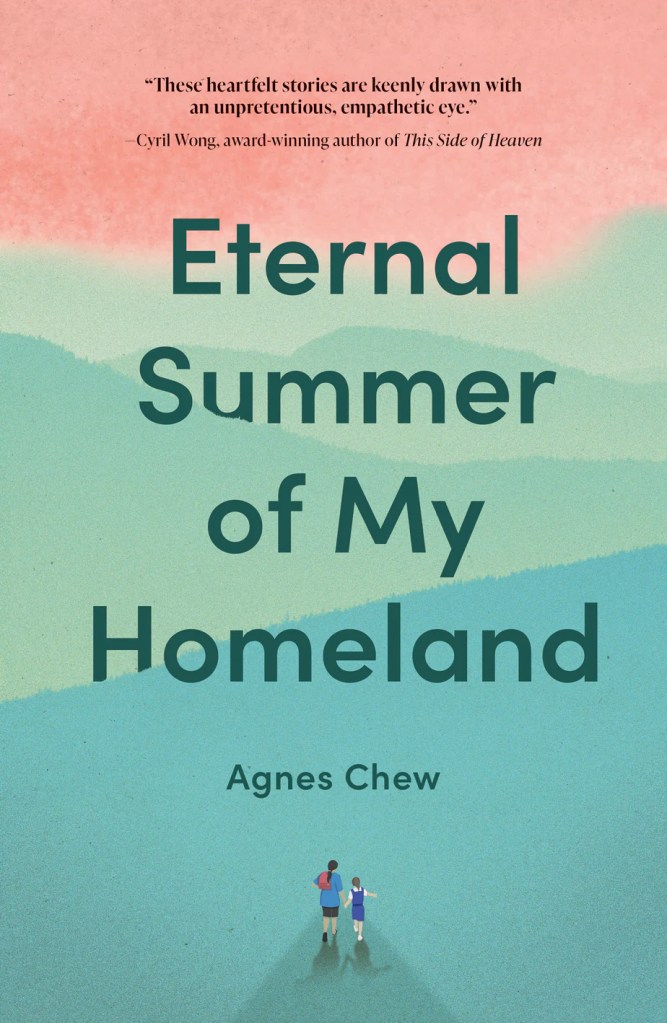
Agnew Chew’s short story collection Eternal Summer of My Homeland highlights the lives of everyday Singaporeans as their friendships and familial connections help them wrestle with heartbreak, grief and loneliness. The characters’ rich psychological journeys are often contrasted with mundane social restrictions: for example, in “Garden City”, an elderly man’s development of a magnificent fruit garden is curtailed by Singaporean Land Authorities. Food and references to health are motifs that invite readers into the characters’ domestic and inner lives. Eternal Summer explores people’s struggle for physical and emotional nourishment, all while the characters attempt to display a public front of contentment.
Amid grief and illness, some stories consider the maladaptive and helpful ways that characters try to regain a sense of internal wholeness. The collection opens with “Garden City”, which centres on Hui Shan and her aging father’s attempt to cope with Hui Shan’s mother’s death. Hui Shan herself is a mother who struggles to bond with her new-born son and act as “the sole interpreter of his distress” (9). In contrast to the dreariness of Hui Shan’s domestic confinement, the nature imagery associated with Hui Shan’s mother emphasises the spiritual and emotional energy that the mother brought to the family. For example, Hui Shan’s father remembers his and his wife’s favourite spot as “surrounded by foliage that ‘grew dense, richer and wilder… The clamour of the city falling away’” (7), “under the shoulder of a large tembusu tree, the gentle spray on their faces” (8). He tries to relive her vitality by fulfilling hr wish of planning a garden filled with “pandan, lemongrass, chilli padi, Thai basil and curry leaf plants” (5). The seamless connections between life versus death and nature versus urban landscape through recollections of the mother highlight the enduring enrichment she brings to her husband and daughter’s life.
“When What Is Linear Meanders” and “For One Minute on Stage” explore the struggle of daily life following medical interventions. In the former story, 10-year-old Sonya’s childhood is disrupted after a diagnosis of congenital scoliosis. The doctor’s rushed manner after such a devastating diagnosis suggests the dire state of healthcare available to Singapore’s working class. This story considers the family’s folk-psychological responses and sense of denial towards Sonya’s illness and outsiders’ exploitation of their fear. In an attempt to avert risky but life-changing surgery for Sonya, her father “installed a monkey bar in her room” (31) in the hopes that hanging from it would straighten the “lump of twisted flesh she had been carrying all her life” (30). Outsiders play “scoliosis experts” (31) with some charlatans peddling false treatments. As a young adult, Sonya surrenders herself to the margins of society after falling behind in Singapore’s academic and professional rat race. “For One Minute on Stage” works like an inversion to “When What Is Linear Meanders”. While Sonya’s story is about how her life dims to a weak flicker after her scoliosis diagnosis, Jia Hao does everything to fulfil his musical ambitions, even at the detriment of his physical state, to overcome the restrictions that his new braces put on his performance.
“The Only Constant” is about Nadine, a chemical engineering student who is visiting home in Singapore after studying in London. The story traces her long-distance relationship with Matthias, a law student in Berlin, who began sending letters to Nadine after reading her poetry in a magazine. Despite Nadine’s external success as a scholarship student, Nadine longs for the romance of poetry amid her “initial struggles to keep up academically… and manage her finances and the intermittent bouts of homesickness” (120). Her creative spirit propels her through the dreariness of everyday life which she translates “into lines, into imagery, into poetry” (121). Admittedly, “The Only Constant” was my least favourite story: the romance was unconvincing. The characterisation of Nadine as a daydreamer is overplayed and somewhat unbelievable given her lengthy experience living abroad alone. Nevertheless, I enjoyed the descriptions of daily routine as she struggles to adjust to settling in a new country and spritely character of her friend Mo.
“Did You Know” shows how mismatched psychological needs between a couple, Lena and Kai, can be literally fatal. The two people arguably represent clashing values between western progressive individualism and a collectivistic Asian mindset. Lena is of European descent and a passionate climate researcher. Kai is Asian and determined to start a family. At first, Kai is attracted to Lena’s exotic beauty and hippie-like fascination with the natural world. Soon however, the novelty wears off as Kai expects Lena to settle into her role as a dutiful wife and child bearer. His concern for Lena hinges on her function as a vessel for their baby (e.g., “Kai worries her tantrum will affect the foetus” (132). The organisation of the space also suggests a disregard for Lena’s intellectual interests in his assigned role for her as mother: “the half-empty room—space he’s cleared in the last two weeks to accommodate the impending arrival of the cot, the nursing chair… the other half of the room is still cluttered with Lena’s books and folders, which he needs to start clearing away soon” (p. 139). Their conflicting notions of family culminate in a macabre turn.
The final story, “Don’t Be Foolish”, tracks an Indonesian maid, Yulia, as she adjusts to life in a Singaporean household. She befriends the two children, especially the older sibling Lynette, by introducing them to nasi goreng. The scrumptious description of “pieces of cubed meat, vegetables and a fried egg on the side” (146) in contrast to the madam’s bland “variations of steamed fish and vegetables” (146) suggests that food’s role as social bonding rather than merely nutrition transcends class differences. Yulia becomes an older sister to Lynette, guiding her through her crush on a classmate while progressing through her own romance with another migrant worker, Kamrul. The parallel nature of their romantic lives illustrates the universality of emotional experiences across racial and class disparities.
Other stories focus on the elaborate charades that characters engage in to hide their psychological and literal starvation. These pretences are arguably a criticism of Singaporean society’s focus on the notion of saving face. In “All We Are at the End Is Ash”, an ambitious businessman, Jonathan, returns to Singapore after work in Frankfurt. He expresses regrets about prioritising his career progression “in his windowless office with no air-conditioning” (43) over being with his late grandmother before her death. The contrast between the descriptions of the food at his grandparents’ hawker stall (“chopping of choy sum, the wrapping of minced meat into coin-sized dumplings… pork shoulder with its sweet, sticky, red glaze”, 44) and his grandfather mourning as he picks out the “first bone from his wife’s ashes” (49) emphasises the family’s spiritual void.
Also featuring Changi Airport, “Home” tells of a homeless woman, Lim Bee Geok, who develops lifestyle techniques to “blend in with the ever-flowing sea of people” (64). Her impoverished reality is a contrast to Singapore’s reputation as “home to the world’s best airport” (p. 66) and the “sleek business travellers in their impeccably pressed suits [and] the radiant families going on holidays in their colour-coordinated outfits” (p. 68). During an encounter with a market researcher, Bee Geok reflects on the way she concentrated resources into her son and husband at the expense of her daughters, only to have both men betray her while the daughters resent her.
“Under the Same Sky” juxtaposes two girls, Yan Ling and Cherie, who (for a time) share friendship while mutually envying one another’s upbringing. The story begins with Yan Ling’s awe at Cherie’s family’s embrace of European influence. Through details such as Cherie’s anglicised name, the family’s British food choices and Christian leanings, Yan Ling yearns for Cherie’s internationalised social position. Only closer to the story’s conclusion does the point of view switch to Cherie, whose life has descended into “empty wine bottles” (93) and “pepperoni greying with mould” (p. 94), and reveal her envy of Yan Ling for having discreet but supportive parents.
“Alone in Punggol” features a copyeditor, Lilian, struggling to adjust to independent adult life in an unfamiliar area. The recurring musical imagery captures crowded Singaporean living in its chaos: “the soprano of a baby’s woes” (96), “Schumann’s ‘Kreisleriana, Op 16’” (95) playing in the background, “the staccato of slamming doors” (100). In an attempt to cope with disruptive neighbours, Lilian adjusts the tune of her schedule to theirs: “she ate when they ate… She stayed up when they stayed up” (97). In mimicking their behaviours, Lilian gains insight into the identities and arguments, only to have their dysfunction reflect on her own sense of estrangement from her parents.
Structured as a series of diary entries, ‘The Diary of An Employee’ illustrates an office worker’s gradual decline into delusion as she sacrifices familial connections and personal well-being to assimilate into her ruthless workplace. At the outset, the narrator highlights her desperation to fit in by assuming the accessories (e.g., a loyalty card to a ground-floor café) and corporate clichés of office life. The boss too engages in a charade of being an upstanding, successful leader through the display of “shelves filled with books, files and awards [and]… framed family photographs” (p. 105). Throughout the course of the entries though, the narrator continues to deify the boss even as he reveals his dismissiveness towards her.
While the young romances did not always feel convincing, Eternal Summer’s stories capture the complexities of multigenerational family dynamics and racialised class structure. Chew’s celebration of enduring love between old married couples, childhood friends and family members are refreshing antidotes to a world that frames dysfunctional and alienating sexual relations as edgy and progressive. Through the rituals attached to everyday activities, Eternal Summer celebrates the lushness of Singapore’s multicultural prosperity while still giving a microphone to its stragglers.
How to cite: An, Frances. “Stragglers in Singapore: Agnes Chew’s Eternal Summer of My Homeland.” Cha: An Asian Literary Journal, 22 Jul. 2023, chajournal.blog/2023/07/22/eternal-summer/.



Frances An is a Vietnamese-Australian fiction and non-fiction writer based in Perth. She is interested in the literatures of Communism, moral self-perception, white-collar misconduct and Nhạc Vàng (Yellow/Gold Music). She has performed/published in the Sydney Review Of Books, Seizure Online, Cincinnati Review, Sydney Writers Festival, Star 82, among other venues. She received a Create NSW Early Career Writers Grant 2018, partial scholarship to attend the Disquiet Literary Program 2019, and 2020 Inner City Residency (Perth, Australia). She is completing a PhD in Psychology at the University Of Western Australia on motivations behind “curbstoning” (data falsification in market research). [All contributions by Frances An.]
 Cha
Cha 