

📁 RETURN TO FIRST IMPRESSIONS
📁 RETURN TO CHA REVIEW OF BOOKS AND FILMS
Tang Shu-wing (director), Bhagavad Gita, West Kowloon Cultural District, 2023.
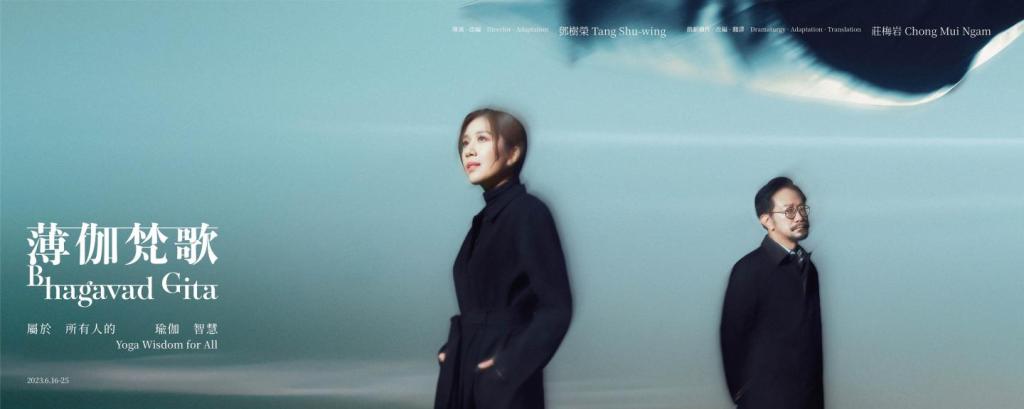
One of the most thought-provoking stage performances of the summer of 2023 is Tang Shu-wing’s Bhagavad Gita. Shown in West Kowloon Cultural District from June 16 to 25, this performance stunned the audience by seamlessly merging ancient Hindu wisdom with contemporary life in Hong Kong. The Bhagavad Gita is the most important chapter in the Hindu epic Mahabharata, where Lord Krishna provides wisdom and guidance to warrior Arjuna on the eve of an epic battle, in which a kingdom is lost and won. The world of the Bhagavad Gita is cyclical and ephemeral, created by Brahma, maintained by Vishnu, and destroyed by Shiva. In this world kingdoms rise and fall, individual lives are empowered and shattered, destruction is but a prerequisite of creation. This contemporary incarnation of the ancient story invites the audience to consider the same questions that tormented Arjuna on the eve of the battle—in this vast universe of endless cycles of birth and death, of construction and destruction, what can I, must I, should I, a man, a human being, do?
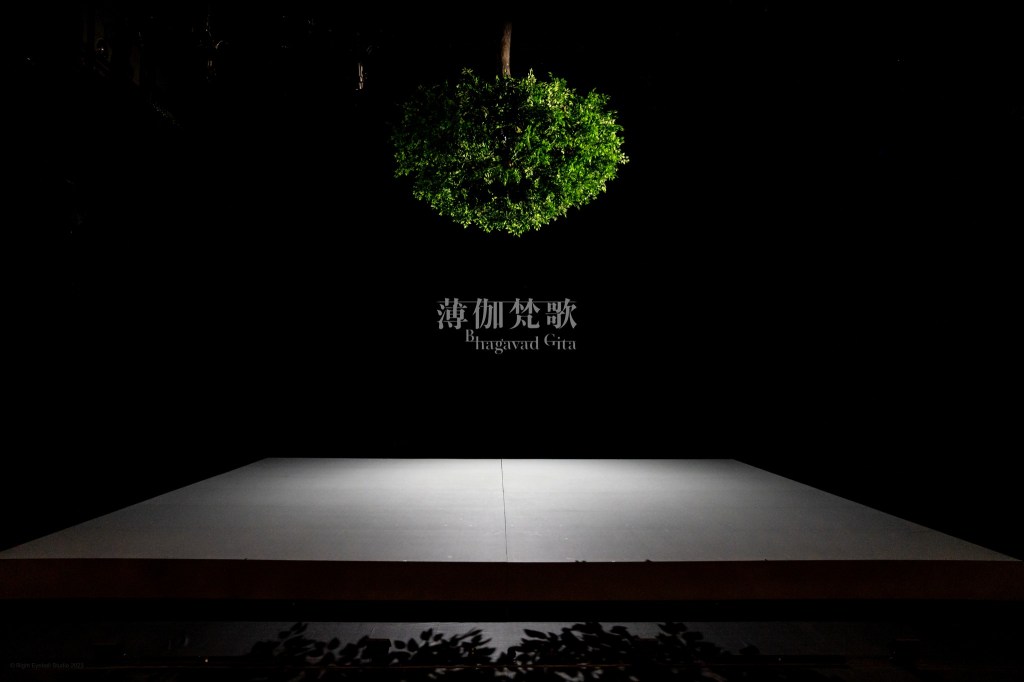
The show opens with a dark, rectangular, and empty stage. The only visual is an upside-down tree hanging above centre stage, a symbol of a world overturned, all laws lost, all morality in decay. The lead actors Mandy Wong and Chu Pak Him orient the audience by alternately narrating the background of the central conflict of the story. Hindu mythology conceives time in four Yuga cycles—Krita (Satya) Yuga, Treta Yuga, Dvapara Yuga, and Kali Yuga. In Krita Yuga, the golden age, people respected Dharma, the law that governs human behaviour. Dharma is typically symbolized by a bull. In Krita Yuga, the bull is in perfect health, with all four of its legs intact. In each Yuga cycle, humans gradually deviate from Dharma, and become progressively corrupted, and a leg of the bull is lost. We are in the fourth cycle, the actors declare, the cycle of Kali Yuga, the dark age, characterised by vice and sin. The bull of Dharma now balances on merely one leg.
With a restrained poetic eloquence Mandy and Pak Him unfold the tangled family history of the warring cousins, the Kauravas—the 100 sons of a blind king, and the Pandavas—the five brothers who share one wife. Both houses believe they are entitled to the Kuru kingdom. The central story of the Bhagavad Gita happens on the eve of the battle, when the warrior Arjuna, the third brother of the five Pandavas, is suddenly paralysed by doubts. “Why should I slay my cousins?” he wonders. “How can my arrows draw blood from my beloved teacher?” “Why must I drench the land with the blood of family and friends to lay claim to rock and dirt?” Krishna, presently Arjuna’s charioteer, then reveals his divine self, a vast, dark being that has swallowed countless lives. He explains that all that is born must die; the fate of your cousins, your teacher, the fate of everyone that ever lives and breathes is already preordained. Krishna commands Arjuna to be an instrument, to bring about what is bound by fate to happen. But Arjuna hesitates. “Show me a man,” he requests. “What is man? What is Faith?”
The dialogue sinks into a solemn silence.
At this point in the play, six dancers dramatically take over the stage. They display a world populated with a people so attached to their mobile phones that they experience physical convulsions when they are parted from their handsets. With great difficulty, they learn to let go of the phones and discover the joy of play. But just as they are learning to enjoy themselves, an angry authority figure abruptly ends their frolicking, shouting loudly and barking orders. The fun-loving, mobile phone-free humans are put to work, tasked with endlessly, randomly arranging chairs. After the dancers experiment with putting the chairs in random order, all on the same level, as equals, a gradual change occurs. One chair is elevated, equality is lost, but a somewhat stable hierarchy is established. Dancers take turns sitting in the elevated chair. All is well until one member breaks the routine and refuses to give up his seat. All hell breaks loose. Battles are fought; jails are built. People became their own jailers. Some managed to find their balance in the wreckage of broken chairs, but others were lost in an endless, fruitless, vicious struggle against… nothing.
The dancers retreat and clear the stage. The stage divides in two, revealing a pool of water underneath. Sitting in the pool, Mandy narrates the turning point of Mahabharata. Draupadi, the one wife shared by the five Pandavas is lost in a wager with a toss of a dice, in a game between the Kauravas and the Pandavas. Though bleeding and scantily dressed, Draupadi is dragged to the Kauravas and publicly stripped. “Yudhishthira has already lost himself when he wagered me,” Draupadi reasons. “But having already lost ownership of himself, he no longer owns me. The game is not fair. Yudhishthira has no right to give me away.” Her protest is met with silence. No one comes to Draupadi’s defence. “Is there any law left on this land?” Draupadi asks as her sari is unravelled. But the sari continues to unravel endlessly, without disappearing.
Mandy informs the audience that Draupadi is no ordinary women. She was born to avenge an insult her father had suffered at the hands of the Kauravas. The abuse of Draupadi sealed the fate of the Kauravas, and her five husbands swear revenge and refuse to relent until the day she washes her hair in her abusers’ blood.
Arjuna picks up his bow and arrow. The Kurukshetra War ensues. A teenage boy dies in battle; his father slaughters an entire army in his revenge. For victory, the most honest man learns to mislead his enemy; for victory, Arjuna shoots and kills his lost brother Karna while his chariot is stuck in mud. For victory, all honour is lost, and all the rules broken. The dancers get into the pool and begin barking like dogs. They snarl and snap at each other until one lays dead. Rain falls from the tree above and the surviving dancers stand up, walk through the rain, their beastliness washed away, and they are reborn. Another cycle has begun.
What is man? What is Faith? The play offers only resounding silence. Tang Shu-wing’s Bhagavad Gita gives the audience a world where play is interrupted by shouts, where equality is replaced by hierarchy, where hierarchy is broken by chaos. In this world of never-ending wars, songs were choked by silent whispers. When Pak Him sings “Every day, I sit and ask myself, ‘How did love slip away?’” No one is there to answer. “Be patient, hold on to faith, just a little while longer” Pak Him sings. His song is interrupted. Mandy announces, this is the first 5000 years of the 4,320,000-year Kali Yuga.
We will have to be very, very patient.
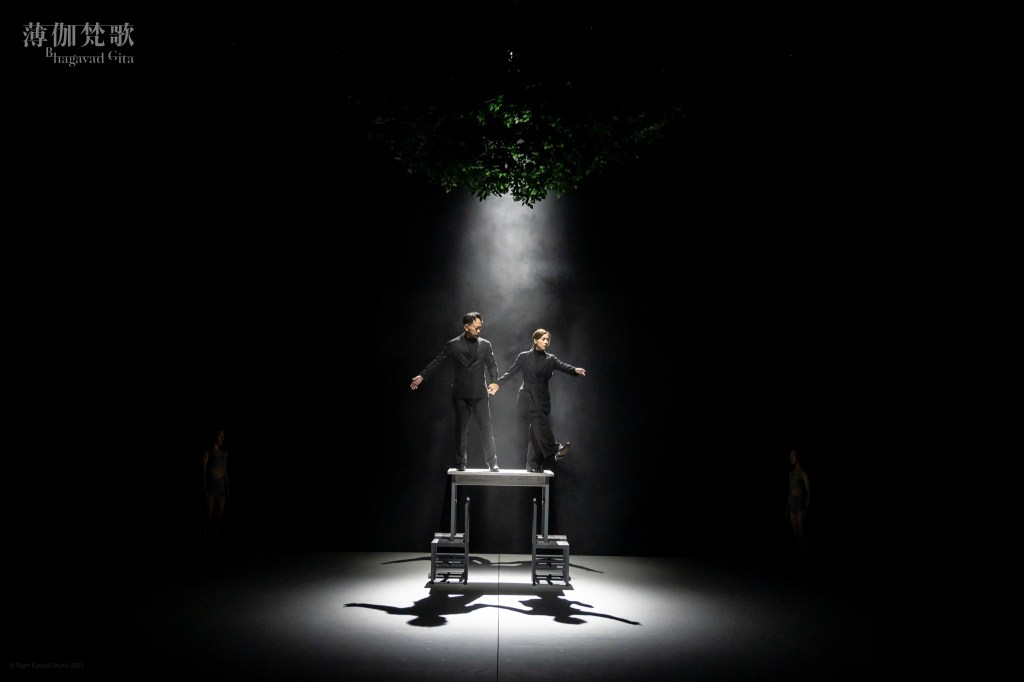
The vision of Tang Shu-wing’s Bhagavad Gita is thought-provoking, relevant to our age, and bleak. In the grand scheme of the ever-deteriorating universe of Kali Yuga, individuals are insignificant. Their joys and sorrows, lives and deaths, are nothing to fate. Arjuna’s questions are left hanging in the air, for the audience to consider. The stage design is minimalist; the props and dancers’ moves are not representative but symbolic; and the performance unfolds at a slow, contemplative pace. Yet, in this story about moral decay, war, and inevitable death and destruction, Shu-wing nonetheless allows a glimmer of hope. The two lead actors narrate together, they move as a pair, and when the world melts beneath their feet, they rescue each other from the edge of despair. Surrounded by wreckage, some dancers find balance that makes them appear to defy gravity. Shu-wing’s play affirms that even in the era of Kali Yuga, choice and action continue to matter. Friendship and support strengthen people in a crumbling world. Personal grit and discipline allow an individual to rise above the wreckage. Individual action may not affect the grand scheme of things, but it can make all the difference to the individual and their companions.
Chung Mui Ngam has once again proven herself to be one of Hong Kong’s most compelling playwrights. She captures essential themes of Mahabharata and tells the story—likely unfamiliar to many in the Hong Kong audience—in a way that resonates deeply. The humiliation of Draupadi is not technically a part of the Bhagavad Gita, it occurs in an earlier chapter of Mahabharata. But when she adapted the play for the Hong Kong audience, Mui Ngam had the insight to make the dialogue between Krishna and Arjuna the background of the story, allowing Draupadi to take center stage. Mui Ngam highlights the moral strength of a woman whose fate is determined by a toss of the dice. Draupadi’s rational self-defence of her dignity moved the blind king, and he allows her to free her five husbands. The fate of the Kuru kingdom is therefore not won by Arjuna’s lethal arrows, but by the power of Draupadi’s reasoning and her moral courage.
The lead actor Mandy Wong is brilliant in her role. She narrates Draupadi’s humiliation with the force of a one-woman show, personifying vividly the cunning Shakuni, the vulgar Kauravas, the dignified Draupadi, and the outraged Pandavas in turn. By changing the register of her speech, her facial expressions and her body language, Mandy brings to life a scene that involves a dozen characters. Chu Pak Him is equally on point as he orchestrates the emotional landscape of the entire play, alternately playing the piano, singing, narrating, and dancing. He is a dictator in one moment, a freedom-fighter the next. He is the man of wisdom; he is the confused, lost soul. He is the last man standing, he is an android devoid of emotion. No matter which role he is playing, he transforms the mood and character of the performance to command the audience’s attention and sympathy.
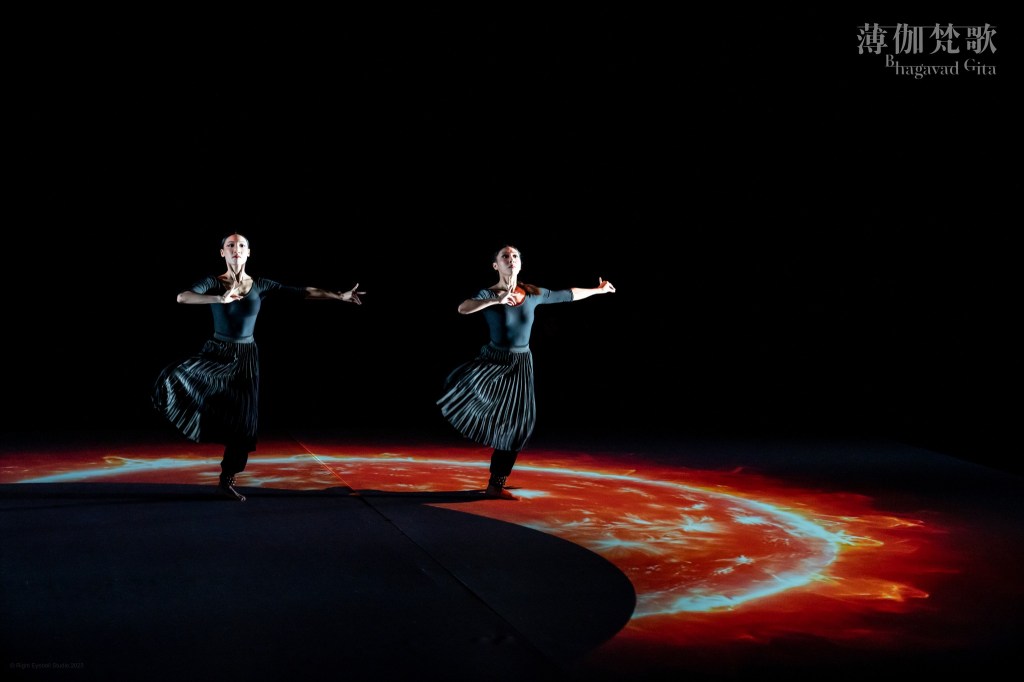
At the start of the show, lead dancers Peggy Chow and Jasmine Lam transported the audience back to ancient India as they illustrated Krishna and Arjuna’s dialogue with Bharatanatyam dance, paying homage to the origin of the epic. Then the music and lighting changed, and Lau ting Kwan, Tseky Tse, Elvin Cheung, and Cassandra Tang rushed on stage clothed in modern attire with mobile phones in hand. The modern incarnation of The Bhagavad Gita in Hong Kong had begun. The six dancers collectively infused the stage with an explosive energy. Never uttering a single word, their movement conveyed the timeless story of men and women’s collaboration and competition, crime and redemption, a civilisation’s birth, growth, and decay. Through Tang Shu-wing’s vision, Chung Mui Ngam’s script, and the talent of this troupe of actors and dancers, the wisdom of an ancient Hindu epic is briefly transformed into a palpable tale for a cosmopolitan Hong Kong audience. Such a balm may help heal this pandemic stricken, traumatised city.

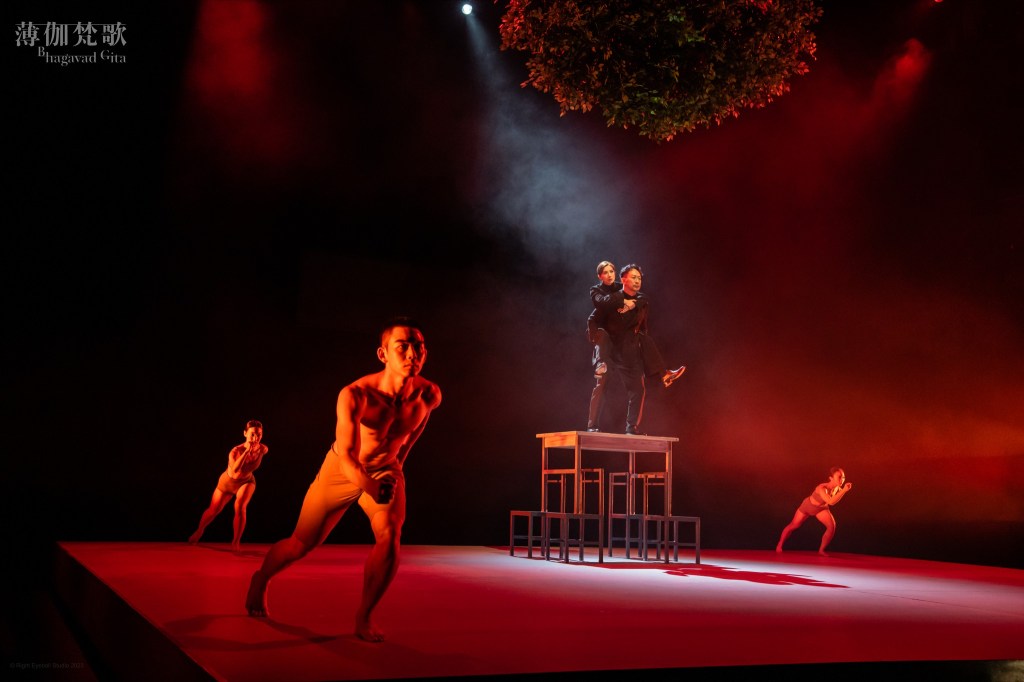
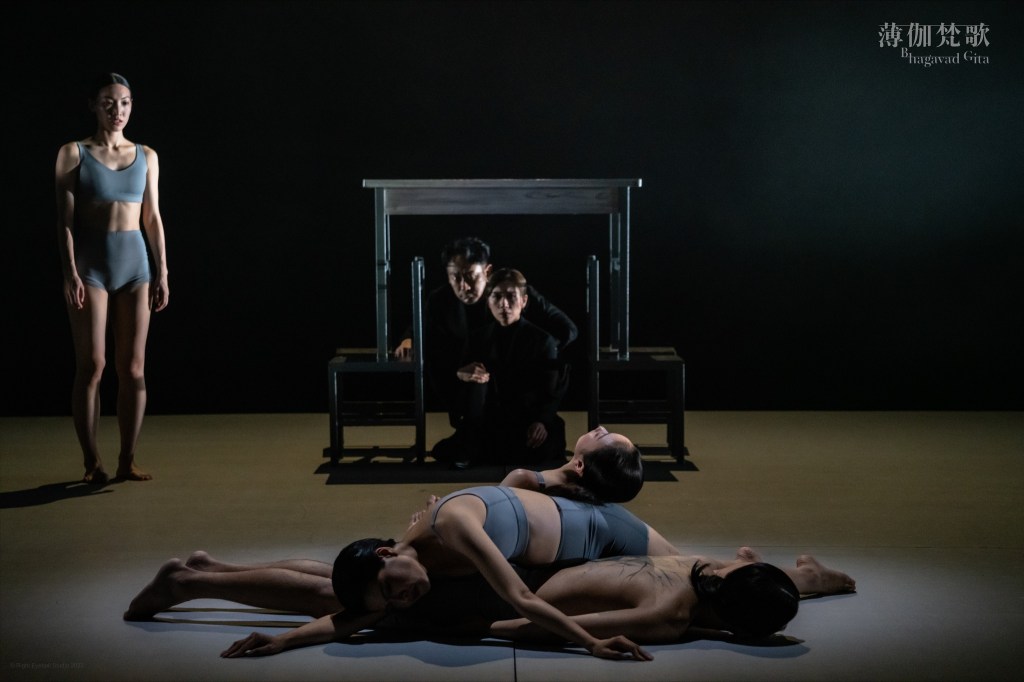
Photographs via the Facebook page of Tang Shu-wing Theatre Studio. PHOTOS: Carmen So
How to cite: Zhang, Emma. “Poetry of the Nomads: Jennifer Wong’s Identity, Home and Writing Elsewhere in Contemporary Chinese Diaspora Poetry.” Cha: An Asian Literary Journal, 22 Jul. 2023, chajournal.blog/2023/07/22/bhagavad-gita.

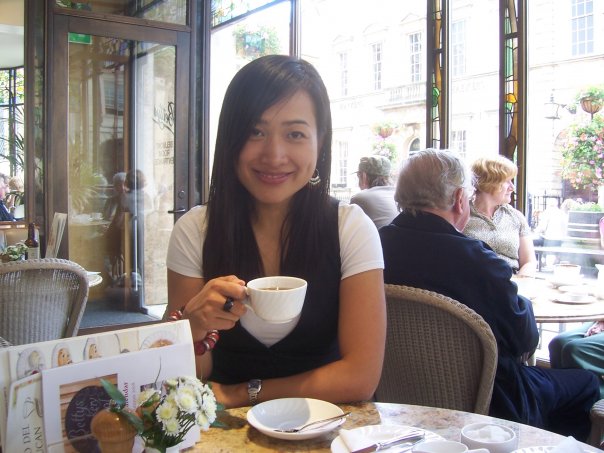

Emma Zhang teaches in the Language Centre at Hong Kong Baptist University. Her research interests include comparative literature and comparative mythology. Her doctoral dissertation Domination, Alienation and Freedom in Ha Jin’s Novels (2015) analyses Ha Jin’s novels in connection with contemporary Chinese society. Her other works include “Father’s Journey into Night” (2013), “No End in Sight—the myth of Nezha and the ultra-stable authoritarian political order in China” (2018), and “The Taming of the White Snake—The oppression of female sexuality in the Legend of the White Snake”. She is currently working on translating ancient Chinese legends Nezha and The Legend of the White Snake. [All contributions by Emma Zhang.]
.
 Cha
Cha 