

📁 RETURN TO FIRST IMPRESSIONS
📁 RETURN TO CHA REVIEW OF BOOKS AND FILMS
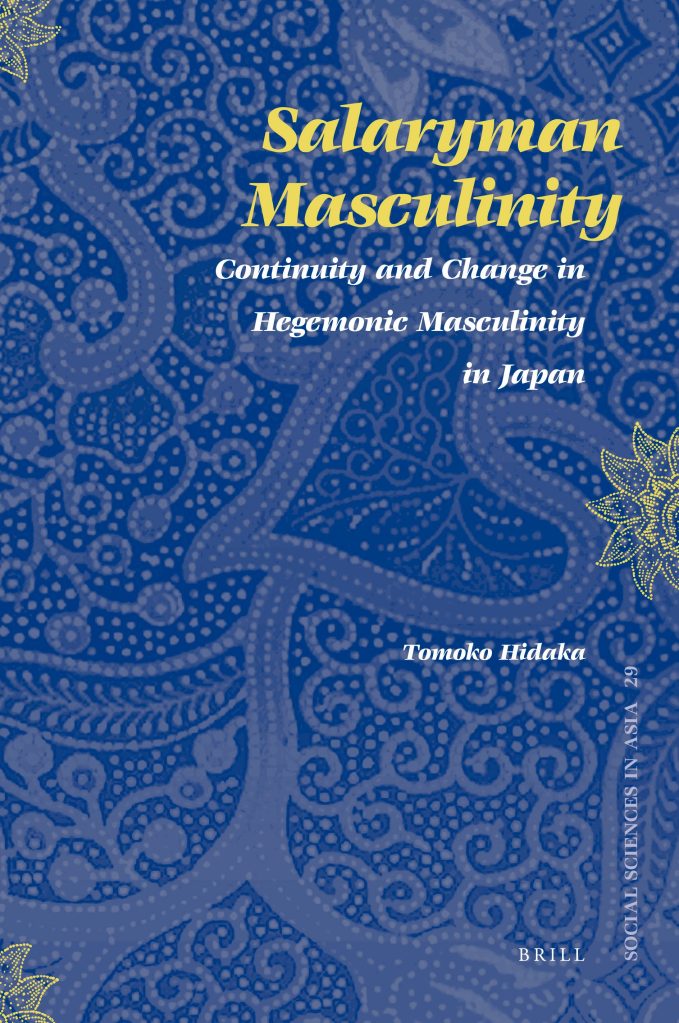
Tomoko Hidaka, Salaryman Masculinity: Continuity and Change in Hegemonic Masculinity in Japan, Brill, 2010. 224 pgs.
“Salaryman” is a word that’s uniquely Japanese, even if the concept is not. Every nation today has white collar workers with fixed compensation paid periodically, along with holidays and benefits. But no Indian or Italian accountant is called a salaryman, and neither is a Japanese doctor or lawyer not identified as a salaryman. Female Japanese managers are not called salarywomen. A salaryman works for the government or for a corporation as an insignificant part of the hierarchy.
Despite the gendered moniker, a salaryman is not necessarily associated with masculinity, even when he is male and is expected to have masculine sexuality and gender expressions. A salaryman wears masculine clothes, socialises with male colleagues, and drinks with them after work, and is projected to become a husband and a father.
On the other hand, he is not expected to be muscular, stylish, or assertive. His suit is a symbol of conformity and uniformity, not of power and style. He drinks and plays golf for his boss and client, not for his own social circles. The company wants him to be a family man instead of a fun-loving bachelor. In every aspect, he’s the opposite to the American yuppie.
And yet, throughout the history of modern Japan, the salaryman is the desired occupation of most Japanese men. Sure, the boys dream of being baseball stars, or pilots, or tycoons. They idolise famous samurai and European inventors of the past. But they know that the path to a good life is getting into a top university and then working for a major corporation. As a salaryman. Why?
Tomoko Hidaka wanted to investigate the masculinity of salarymen based on a peculiarity she observed when she worked at the official overseas development assistance, presumably of the government of Japan. Japanese men usually present clean-shaven faces, but her male colleagues there kept moustaches. This was because they dealt with South Asian aid recipients, and the Japanese men believed that the locals would respect them better if they adopted a recognised symbol of masculinity, the moustache (British officers during the colonial era supposedly grew moustaches for the same reason). For Hidaka, that meant Japanese men were willing to tweak their values of masculinity against the grain of Japanese culture.
Hidaka wrote this academic book on the continuity and change in salarymen’s masculinity throughout the 20th century, which she believed represented hegemonic masculinity in Japan. Sure, in Japanese pop culture the alpha male is a long-haired rock star or a world-beating athlete or maybe a stylish yakuza, but Japanese men in general after their 21st birthdays are not encouraged to emulate a rockstar or a yakuza. The paradigm to emulate is the salarymen.
The term “salaryman” has a long history. A series of cartoons on “the salarymen’s heaven or hell” were published in 1916, and the wasei-eigo pseudo-loanword was popular in the 1930s. After the end of the Second World War, salarymen believed that they were responsible for the rebuilding of Japan, both as company men and family men.
Their golden days came in the 1970s, when those seemingly passive, expressionless, and overworked men led Japan to be the most productive and most technologically advanced country on Earth. Salarymen and their families began to appear in Western cities working for Japanese companies as Japanese brands—cars, home entertainment sets, and appliances—became ubiquitous worldwide.
Japan was proud of the salarymen and their corporations, until the bubble burst in the early 1990s. International business commentators praised and envied the salarymen in the 1980s, and then criticised and pitied them. Their image is yet to be rehabilitated.
In 2004, Hidaka interviewed about a dozen former salarymen from three different generations. She groups them into three cohorts: Cohort 1 began their career after the Second World War. Cohort 2 created the Japanese miracle after the 1964 Tokyo Olympics. Cohort 3 grew up comfortably as the sons of Cohort 2 but saw that salaryman promise taken away from them in the 1990s.
Cohort 1 grew up with the doctrine of the divinity of the emperor, and had their masculinity shaken by the American occupation in the 1940s. They became the new soldiers, the corporate warriors, sworn to rebuild Japan.
They set up the systems of modern Japanese capitalism: pay grade according to seniority, lifetime employment, and company welfare. Cohort 2 entered this system in the 1960s and the 1970s and worked themselves to death. The English term “workaholic” and the Japanese term karoshi, death by overwork, entered the Japanese vernacular in the 1970s. While Cohorts 1 and 2 believed in their missions to advance Japan, Cohort 3 lost that vision in the Lost Decade.
Hidaka believed this development of hegemonic masculinity began in childhood. She asked the interviewees to describe their childhood, while discussing the traditional ie family system. Abolished in 1947, this system lived on for the next few decades. Ie was built on filial piety, where the eldest son was expected to take care of his elderly parents. Ironically, a rebuilt Japan weakened the filial piety, as doctors and modern health systems provided better health support for seniors by the 1970s.
Men of Cohort 3 also lost their filial purpose, as a post-industrial Japan no longer needed the family business. They studied not to continue their fathers’ trades, but to enter a top university and then a major corporation.
Even parental roles changed over the three generations. Cohort 2’s mothers were strict disciplinarians in the absence of the father (Readers of the manga series Doraemon will be familiar with how both Nobita and Giant fear their mothers), while Cohort 3 salarymen grew up with more distant mothers and stricter fathers in the 1980s, as more women took jobs. They also played indoors thanks to the arrival of video games and action figures, as well as more protective parents and governments. Gone were the days of swimming in rivers and playing in bomb shelters.
Then the children became teenagers. Talking to female students became more accepted in the Cohort 2 generation, and they became the first generation to be taught by female teachers. The boys were expected to love baseball, but according to Hidaka, self-control and obedience were more emphasised in Japan than among sporting cohorts in the West, where arrogance and belligerence were the norm.
Teenage sex was uncommon in 20th century Japan, until a big bang happened in the 1990s. And it was not a sexual liberation event, but the commodification of enjo kōsai, where girls traded dates and sex with gifts from older men, including salarymen. Ironically, many middle-class boys swore off sex and even dating, believing it could distract them from their exams.
So how did the salarymen find love? Through arranged marriage, with the companies often playing matchmaker, using the sinister philosophy that an adult man (the salaryman) is married, while an adult woman (the secretarial “office lady”) is a mother. Still, by 1997, two-career households had become the norm in Japan.
Hidaka then moved to the corporate world and asked salarymen about “freeter”, men who worked part-time and were happy about it. A freeter in Japan is always a man since a woman who works part time or doesn’t work is not judged. Interestingly, older men sympathised with the freeters while younger men despised them. The older men believed they were victims of a weak and careless government, while younger men believed freeters were lazy, selfish losers. As salarymen, they believed the freeters were not leading happier and freer lives.
Then Hidaka addressed the elephant in the room: the absence of women among Japanese business leaders. The interviewees didn’t understand her concern, as they took it as a given that a salaryman’s life was not for women. Aggressive and ambitious women might be taken as one of the boys at the office, but not after work. They also claimed that they never understood the definition and instances of sexual harassment, a phrase that only entered American consciousness in 1979 and reached Japan in the late 1980s.
In short, this book shows the gap between Hidaka’s world, which examined Japan through gender studies theories, specifically Raewyn Connell’s gender order theory, and the salarymen who professed not to get the concept of sexual harassment.
Finally, Hidaka questioned the salarymen about their ikigai, purpose of life. For Cohort 1, it was the rebuilding of Japan. For Cohort 2, it was the success of their companies. For Cohort 3, it was their families—then their work. As she suspected, the salarymen spent minimum time with their children, and they admitted that they also hardly knew their fathers, especially the post-war Cohort 2.
The government took and the government pleaded. Japan had a six-day working week until 1980, and even Sunday was a golf day to entertain clients and superiors. By the turn of the millennium, the government started a campaign entitled “Father takes childcare leave”, which was largely mocked by salarymen. They argued that working hard for the family was their form of childcare, and their wives didn’t want them to be around the home anyway. In fact, available husbands were described as “wet leaves” and “big rubbish” in the 1980s, since Japanese couples didn’t expect to do things together, unlike American couples, who were expected to attend company functions and school plays together.
This different concept of romance played out into retirement. Japanese seniors might take overseas trips together, but at home they explored their hobbies and social circles separately. Many salarymen, including the young Cohort 3, also lamented retirement instead of feeling a sense of liberation.
Hidaka puts important and enlightening data in the appendices instead of inserting them into the chapters, which is unfortunate because they are less accessible as a result. For example, the salarymen’s employers offer a picture on the evolution of Japanese economic strength: From steel and manufacturing after the war, to oil and manufacturing in the 1970s and 1980s heyday, to the evenly spread industries of oil, manufacturing, information technology, and consultancy in the 1990s. Ironically, Japan lost its competitive edge at the same time it diversified beyond industrialisation and manufacturing.
This is an academic book intended for academic research, not for everyday reading. Hidaka, however, believed the book had addressed the topic of hegemonic masculinity in Japan which was still overlooked before the book’s publication in 2010. What has changed more than a decade later? Like elsewhere in the world, technological advances offer little respite and few alternatives for the Japanese. Part-time work and self-employment have become more socially acceptable but offer small economic and social comforts to workers. Japanese brands keep losing their edge, first to South Korean and then to Chinese rivals. South Korean and Chinese equivalents of the salaryman, meanwhile, experience the same burnouts.
As the concept of ikigai became popular internationally in the 2010s as a Japanese rival to the Scandinavian concepts of hygge and lagom, Japanese young workers lowered their expectation of life. The “Satori generation” jokes that they’ve reached the Buddhist enlightenment, freed from want. And yet, those who can, will pursue the career of salaryman, if only to secure that coveted hegemonic masculinity.
How to cite: Rustan, Mario. “The Paradigm to Emulate is The Salarymen.” Cha: An Asian Literary Journal, 4 Jul. 2023, chajournal.blog/2023/07/17/salaryman/.



Mario Rustan is a writer and reviewer living in Bandung, Indonesia. [All contributions by Mario Rustan.]
 Cha
Cha 