

📁 RETURN TO FIRST IMPRESSIONS
📁 RETURN TO CHA REVIEW OF BOOKS AND FILMS
❀ Michihito Fujii (director), The Journalist, 2019. 113 min.
❀ Michihito Fujii (director), A Family, 2021. 136 min.
❀ Michihito Fujii (director), Village, 2023. 120 min.
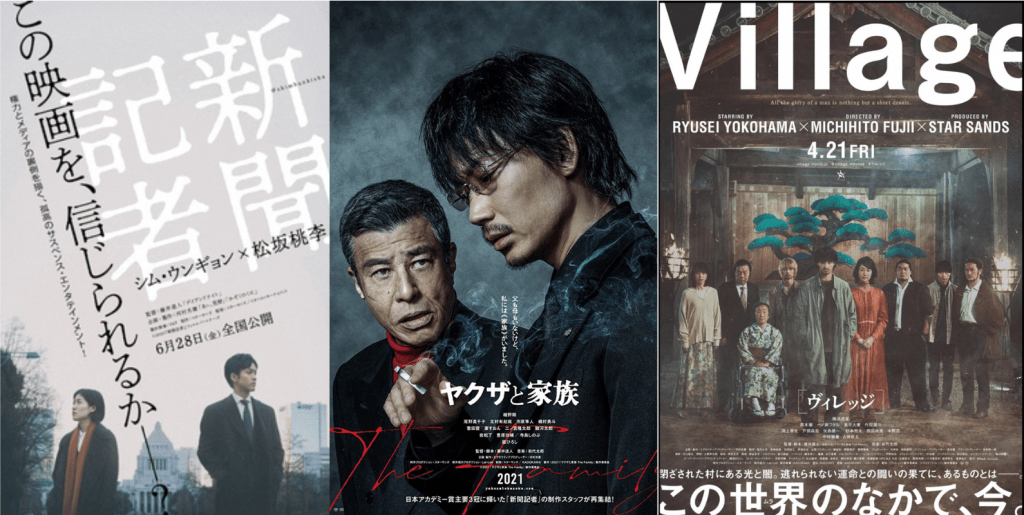
In these days of ever fewer choices at the cinemas—the dominance of blockbusters, the squeeze on independent picture houses—we are forced to rely evermore on streaming services. Tucked away on Netflix are any number of older and more recent Korean and Japanese goldmines. Primary among these for me is the work of the director Michihito Fujii, a number of whose latest works (The Journalist, A Family and Village) have premiered overseas on Netflix.
Fujii combines contemporary issues and storylines with some gorgeous cinematography, even if his locations are often run-down provincial Japanese towns or villages despoiled by ground fill. The Journalist (2019)—based on the book by Isoko Mochizuki—looked at deep corruption in government. His most recent film, Village (2023), got mixed reviews in Japan where perhaps shining lights on corruption and environmental issues didn’t go down so well with some more traditional-minded reviewers. Fujii (who is here director and screenwriter) portrays a small hamlet through the lives of Yu Katayama (Ryusei Yokohama), a worker at a recycling plant designed to bring life, and money, back to the community, once known for its Noh drama traditions. Yu, who’s been in trouble in the past, lives with his pachinko-addicted, loan-shark-indebted mother. The plant is being abused by criminals, in league with local politicians.
But, for me, Fujii’s masterpiece is A Family (2021), which is beautifully written, shot and acted. The story covers two decades in the small-town drab provincial life of Kenji Yamamoto (Go Ayano), starting in 1999. Twenty years in which the yakuza moves from a feared position in Japanese life to being desperate for money, openly disliked, locked up, and seemingly down for the count. It’s a film that eschews glamorous or “cool” portrayals of organised crime to show it in all its grubby declining reality in a grubbing declining town.
Fujii’s movies strike a chord with viewers, if not always the critics. Audiences live in the dramatically changing world of intergenerational disconnect, troubled small towns and villages, perceived high levels of corruption, nepotism and criminal/police/politician collusion. A Japan of waning traditions and uncertain futures. A Family and Village are also meditations on Japanese masculinity with lots of ennui, melancholy and anger management issues. Boys become men and pay for youthful transgressions while seemingly fragile women discover hidden strengths.
Michihito Fujii is just 37—nothing in movie director years! If sometimes his movies are a little patchy, the storytelling a tad convoluted then it is because he is just finding his stride as a director and a screenwriter. The coming years will, I’m sure, bring some truly great work from Fujii.
The Journalist, A Family and Village are all on Netflix.
How to cite: French, Paul. “Michihito Fujii on Netflix.” Cha: An Asian Literary Journal, 4 Jul. 2023, chajournal.blog/2023/07/04/michihito-fujii.



Paul French lived and worked in Shanghai for many years. His book Midnight in Peking was a New York Times Bestseller. His book City of Devils: A Shanghai Noir received much praise with The Economist writing, “… in Mr French the city has its champion storyteller.” Both Midnight in Peking and City of Devils are currently being developed for TV. [All contributions by Paul French.]
 Cha
Cha 