

茶 FIRST IMPRESSIONS
茶 REVIEW OF BOOKS & FILMS
[FIRST IMPRESSIONS] “Beijing Bubbles: Andrew Field’s Rocking China” by Matt Turner
Andrew Field, Rocking China: Rock Music Scenes in Beijing, Shanghai & Beyond, Earnshaw Books, 2023. 212 pgs.
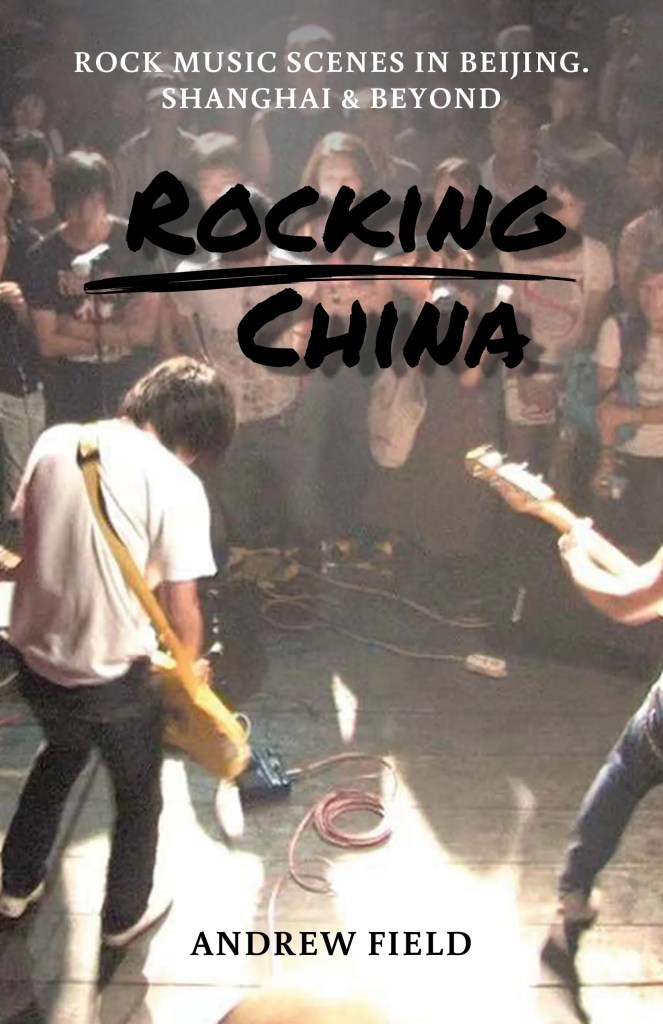
You can listen to the Rocking China playlist HERE.
I went to at least one rock show in Beijing nearly every week between 2006 and 2010. Some of the local bands played so frequently—especially Carsick Cars and Joyside—that I eventually lost interest in seeing them. So it was with great personal embarrassment that I learned that one of Joyside’s staples, “Russian Roulette,” was a Lords of the New Church song.[1] Andrew Field’s new book, Rocking China: Rock Music Scenes in Beijing, Shanghai & Beyond, taught me that.
Somewhere between anthropology-lite and reportage, the bulk of the book is an overview of the Beijing rock scene around 2007 and shortly afterwards. Although portions of the book discuss both Shanghai and Wuhan, the real focus is the foment that produced what are some of the most important (and popular) rock bands in China today. Field, a longtime Shanghai resident, locates the centre of the action at a cluster of venues (and a select group of record labels) in Beijing. Although the Beijing scene was much larger than can be accounted for in a slim non-academic volume, the importance of clubs like D-22 and Mao Livehouse cannot be understated. Field gives venues like these, and the people behind them, ample time to speak.
The book is a series of descriptions of concerts, interviews with bands and other key players, and critical assessments. Field also follows punk band SUBS to Wuhan, in a study of one band’s motivations and their relationship to both an older generation of rock musicians (in their case embodied by Cui Jian, their touring mate) as well as to the public.
Field’s descriptions of live performances remind me of how fresh the music of the time was, and how much it meant. Michael Pettis, owner of D-22, compares the time to New York in the early 1980s for its creativity, and to 1960s San Francisco for its desired social impact. Beijing had crucial support spaces for musicians to develop needed self-confidence, and these spaces also helped cultivate audiences of likeminded people.
Field does a good job of conjuring the image of the then-gritty city of Beijing as a sort of playground for bohemian-types. Interview subjects give direct and in-depth comments about the rock scene at the time, and also its prospects—time has clearly marched on. With the ups and downs of venues, as well as changes in public taste, music styles have expanded stylistically as well as have developed a more nuanced relationship to the international sphere. Field discusses these changes, and the impact of TV shows like The Big Band (乐队的夏天)—which rocketed some of the bands he discusses to arena-filling popularity.
If obstacles to independent expression have been thrown up with increasing frequency in recent years, the prospects for the future nevertheless remain full of surprise. That said, the time period covered in the book was very unique. Much has been written about the watershed period of the 1980s, but at least in one respect the years Field covers were more interesting: there was considerably more, and possibly better, artistic expression, and venues multiplied. That being the case, crucial historical work needs to be done, especially understanding crossovers in music, visual arts, and literature. I sincerely hope that Rocking China leads to more studies of this kind. Even after the tidal wave of politicisation from 2012 on, Beijing remains an undeniably vital and even fun city. But does it still rock? Was it a bubble?
[1] I had been in few punk bands, so I obviously knew who Lords of the New Church were. But until recently I’d written them off because the only song I had heard—and this is embarrassing—was their cover of “Like a Virgin.”
How to cite: Turner, Matt. “Beijing Bubbles: Andrew Field’s Rocking China.” Cha: An Asian Literary Journal, 22 Jun. 2023, chajournal.com/2023/06/22/rocking-china/.


Matt Turner is the author of the full poetry collections Slab Pases (BlazeVox, 2022), Wave 9: Collages (Flying Islands, 2020) and Not Moving (Broken Sleep, 2019), in addition to the prose chapbooks City/Anti-City (Vitamin, 2022) and Be Your Dog (Economy, 2022). He is co-translator, with Weng Haiying, of work by Yan Jun, Ou Ning, Hu Jiujiu and others. He lives in New York City, where he works as a translator and copy editor. [All contributions by Matt Turner.]
 Cha
Cha 