

📁 RETURN TO FIRST IMPRESSIONS
📁 RETURN TO CHA REVIEW OF BOOKS AND FILMS
Nathan Go, Forgiving Imelda Marcos, Farrar, Straus and Giroux, 2023. 240 pgs.
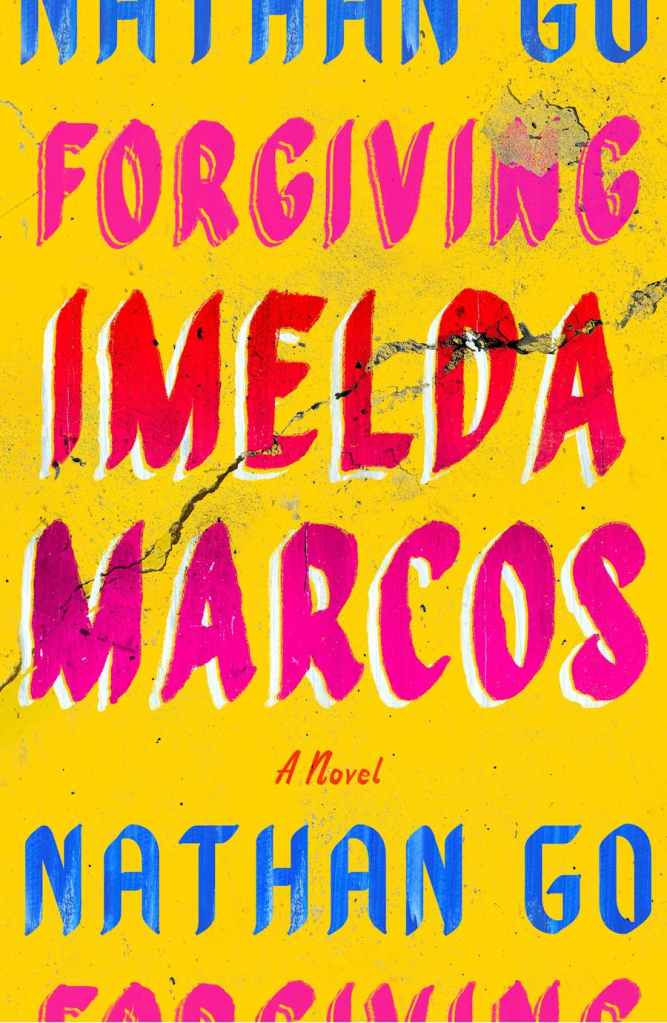
Nathan Go’s novel Forgiving Imelda Marcos comes at a kind of global cultural moment for things Filipino and Filipino-American. At least, that’s what Filipino pundits are wont to say these days. At any rate, no one is disputing them, and it’s very easy to list the things in current popular culture to support the thesis, including David Byrne’s Here Lies Love, playing on Broadway, based on the life of Imelda Marcos, with appearances from both Corazon and Benigno Aquino.
Go’s debut is not a historical novel. It does however make rather brilliant use of historical figures. The author himself says that while “aspects of the novel” are inspired by real life, all the characters, dialogue, locales and events are solely products of his imagination. The book is also not a political novel, even though it does offer some political ideas.
Enter Go’s protagonist, the rather learned and wordy intellectual Lito Macaraig, a man who uses the word “synecdoche” but who never finished high school. Lito is not well; he’s confined to a hospital room somewhere in the Philippines, presumably some years after 2009. He is reading The New Society, the book by former Filipino dictator Ferdinand Marcos. Caring for him is a male nurse, Milo, who confesses he’s apolitical, because his life will remain unaffected no matter who is elected President in the “next election”. Lito is visited now and again by his friend Manang Dionisya. Apparently, Lito also has a son—a journalist in America—from whom he is estranged, and the narration is addressed to him.
Lito reflects on his actions as death draws near and he has much to look back on. From his hospital bed, Lito tells (speaks, writes or records?) his stories to his son, dangling before him one very special anecdote that just might interest the world. For many years, Lito worked as Corazon C. Aquino’s family chauffeur, both long before and after she became president. Lito also tells us how, as a young boy, he grew up without a mother, raised in the countryside by his father, alongside the would-be communist NPA rebel, Ka Noel, who introduced Lito to books, and to thinkers such as Thoreau and Marx.
The novel swings from present to past, as we move to and from Lito’s remembered times, with his father and Ka Noel, in the countryside in the late 60s, to when he worked as Madame Aquino’s driver, as early as before the declaration of Martial Law in 1972. He puts special focus on the time he drove her up to Baguio City, supposedly to visit Imelda Marcos, which would be after 1992. And then the narrative circles back to the present, where Lito lies in the hospital.
Readers who are Filipino in any way, whole or in part, will find that the challenge of reading this book will be sorting through the measures of truth from the fiction, sussing out the things that happened in the national timeline alongside the things Go has invented, conflated, or moved about in time. Or it’s also possible that it is Lito himself who is inventing and conflating. I must admit I wanted to read the book because of the title alone, knowing nothing of either plot or author. However, as soon as Go deliberately changed dates, referring to Ninoy Aquino’s assassination as taking place in May of an unnamed year, rather than on the third week of August 1983, the book stepped off the truth track, and I knew how to take it. This may not matter at all to readers who are not Filipino or who are not otherwise bogged down by the facts.
Neither a political retelling or even an interpretation of the facts, the novel is ultimately the personal story of one father’s regret and search for forgiveness vis-à-vis his son and the mother of his child. It just so happens that this particular father lived at a single remove from a few larger-than-life Filipino political figures. Go has said in an interview that he tried not to put undue focus on the history or current events surrounding the characters, but placed his own hero Lito, front and centre. He creates a compelling, relatable voice and tells his story on the scaffolding of some real events fictionalised just enough. What he imagines has both appeal and verisimilitude.
It was in late May, I remember—because that’s also your birth month—and I was visiting my father up north. He wasn’t doing very well then, and because he’d been upset with me, he’d chosen to keep a vow of silence around me—I’ve already told you about that habit among the men in our family. I prepared him his dinner in the living room and made sure his favourite rattan chair was comfortable. As I did every night, I switched on the TV. That was when my father and I saw the news together.
A man had been shot as he was getting off the plane. He’d been shot right in the head, and the all-white shirt he was wearing bloomed crimson from the neck down. His body lay motionless on the ground. My father kept tugging on my sleeves and asking, Isn’t that him?
In this way, Go’s title is brazenly provocative, a conceit of dissimulation and falsehood, even a ploy akin to clickbait. Yet for whatever reason, possibly Lito Macaraig’s voice itself, the strategy is not ineffective. Those who know what happened, or think they know what happened, won’t be able to keep from their own close examination, checking his fabric for stray tears and threads where the author chose another, different way to go.
Some may also find that a whole novel written in the second person, addressed to one unknown and unseen character, might easily turn tiresome. But Go has wit and a good turn of phrase. While some sections might move at a slow pace—especially the ones involving the characters given less time to develop, things can and do pick up in the specific interactions between Lito and the former President, and certainly, between Lito and his fellow staff member, the household major-domo and caretaker, Manang Dionisya. Readers of a philosophical bent may also enjoy Lito’s random musings on life, faith and its ways, including such ideas as how small stories should fit in with big stories.
The result is a story with which the readers can engage, should they choose. It’s part suspension and testing of belief, and part suspense of anticipation. It piques the reader’s curiosity, keeps them turning the page in pursuit of what happens next, even as it might irritate them. Overall, Lito Macaraig is relatable and sufficiently trustworthy, even if he might raise the eyebrows of sceptics every now and then. There’s no reason to doubt that these are his thoughts, these are his observations, and this is what happened. Lito is adept at anticipating readers’ counterarguments. Well, why can’t a chauffeur be this widely read, this learned, this practical in his own faith, and persistent in his own sense of entitlement for forgiveness? If Go believes it, why can’t we? I for one am eager to see what Go won’t stop at next.
How to cite: De Jesus, Noelle Q. “One Father’s Regret: Nathan Go’s Forgiving Imelda Marcos.” Cha: An Asian Literary Journal, 15 Jun. 2023, chajournal.blog/2023/06/15/forgiving.

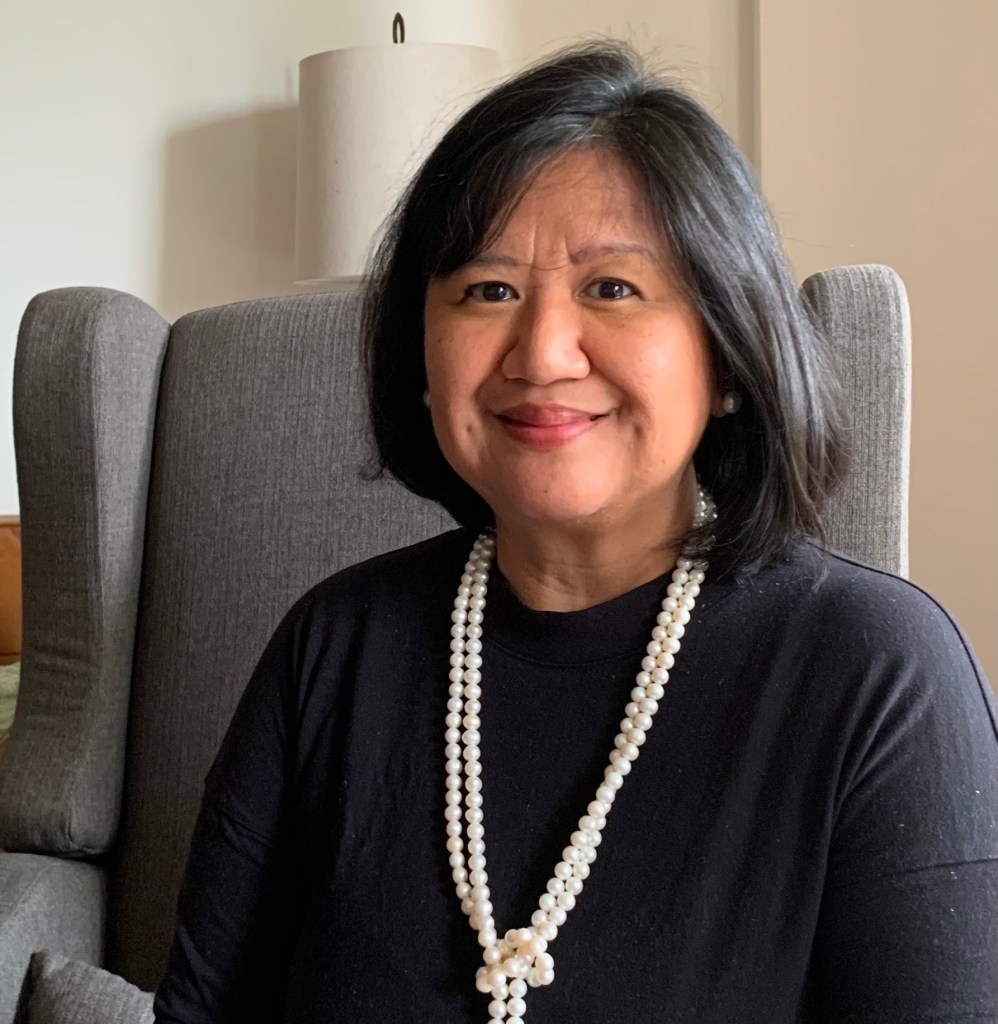
Born in New Haven, Connecticut and grew up in Manila, Noelle Q. de Jesus is currently based in Singapore. She is the author of Cursed and Other Stories (Penguin Random House SEA, 2019) and Blood Collected Stories (Ethos Books, 2015), which won the Next Generation Indie Book Award for the short story and was translated into French under the title Passeport (Editions Do 2020). She also wrote Mrs MisMarriage (Marshall Cavendish International, 2008) under her married name and the children’s book A Summer Day of Nothing but Everything (GK Initiative, 2010). She has edited flash fiction anthologies and her co-edited Missed Connections: Microfiction from Asia is forthcoming from Marshall Cavendish later this year. Apart from fiction and the occasional poem, she translates literature from Filipino to English. Most recently, she translated Filipino screenwriter and National Artist Ricky Lee’s first novel, For B or How Love Devastates Four Out Of Every Five Of Us. Noelle was a fellow at the University of the Philippines’ Writers Workshop and she has won a Palanca Award and helped found Cosmopolitan Philippines. She has read her fiction at the Filipino American Book Festival in San Francisco, the Writers Forum at SUNY Brockport, NY, Yale-NUS Writer’s Center and many times at the Singapore Writers Festival. She considers her son and daughter to be her best work. [All contributions by Noelle Q. de Jesus.]
 Cha
Cha 