

Translated from the Chinese original, also available below, by the author. Drawing of Mimi by the author.
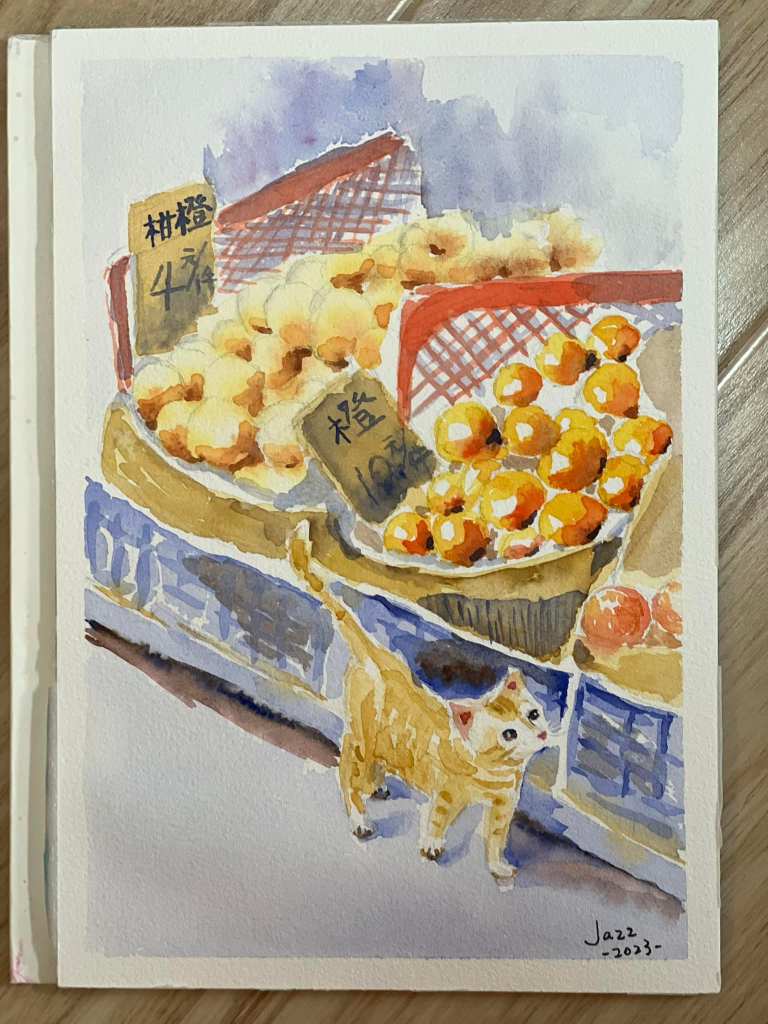
Mimi
I’d like to tell you about Mimi. She’s a cat, the shop cat of Taihing Fresh Fruit Store, downstairs in the Tai On Building.
One day in the late 1990s, a stray kitten wandered into a fruit seller’s house in the Tai On Building. The family had just moved in after several years as street vendors. A few days previously they had acquired their own shop in the building and hadn’t even given it a name yet. The kitten settled down placidly as if it owned the place. The owner thought this feline squatter might bring them good luck, and he found the kitten both majestic and winsome with its dark brown eyes paired with a matching coat of varying shades of brown, so the kitten was adopted as an important part of the shop. Active in the vicinity of the Tai On Building in Sai Wan Ho, it quickly became a heroic part of the scenery among the crowded shop cat landscape of Hong Kong.
The fruit seller and his wife already had two daughters and a young son. Now they also had a kitten, which they called Mimi. By giving the kitten a name, they instantly included it as the sixth member of the family. They had never had a cat before. In the first few years, they raised Mimi in a “sharing is caring” way, just sharing their own meals with the “furbaby”. Mimi turned out to be a very sensible cat and never caused any trouble in the store. During the day, she would sometimes climb up onto the shop’s canopy to inspect the surroundings, sometimes shuttle nimbly between the wooden fruit trolleys, and sometimes take a peaceful nap in a cardboard box. The hard-working owners worked nearly 20 hours a day, and Mimi gradually became an indispensable calming presence in the shop.
The Tai On Building, which was completed in the late 1960s, was initially a desirable residence. It “faced the sea”, that is, it looked out over Victoria Harbour, and had flats for sale at the knockdown prices of HK$17,000 or HK$27,000 and it was even equipped with an elevator, so it was a major attraction for workers at the Taikoo Dockyard—the largest employer in Hong Kong at that time. The building was designed in the shape of an “H” and it is said to be the most-populous single building in Hong Kong. There are at least eight entrances and exits in the ground floor shopping mall, which can be described as extending in all directions. Mimi’s fruit shop is located at one of the entrances, and faces Tai On Street and the Sai Wan Ho MTR Station across the street, enjoying the advantage of a good location. Coupled with Mimi’s innate calm and welcoming temperament, this brought many customers to the fruit shop. Many people came just to see Mimi, and often there would be four or five people crowding around to touch or take pictures of her. Mimi took it all in her stride. Besides being friendly to everyone, she groomed her lovely brown fur, as any cat would, and spent as much time sleeping as any cat might be expected to. Topics of conversation between the neighbours and the owner of the fruit shop generally extended beyond seasonal fruits to include details of the cat’s daily diet, her living habits and specific anecdotes of the day. Mimi drew everyone closer and put a smile on the face of the otherwise taciturn owner.
It wasn’t all that long before Mimi fell in love, and she would go out courting at night, but would always come home before morning. Not much time went by before Mimi became a mother and gave birth to nine kittens. Mimi loved her children very much but, sadly, the owner soon kept only the eldest male with Mimi, and sent the rest away. Whenever her eldest boy went out to fight and came home covered in cuts and bruises, Mimi always licked his wounds; and whenever a stray cat came to provoke him, Mimi would place herself menacingly in front of her eldest. Mimi, who gained weight after giving birth, had an imposing presence and no intruder dared to face up to her. She became known to several customers as Fatcat. Sadly, the pampered eldest son went out to play one night and never came back. Since then, Mimi’s valiant and heroic appearance acquired a melancholy air, and this could not be relieved by the attention of the neighbourhood customers or even the owner himself.
In her later years, what Mimi loved most was taking a nap in the shop as the owner went about his business beside her. Inevitably, one afternoon after sixteen long years in the shop, Mimi failed to wake up from her nap. The family were devastated and avoided even mentioning the word “dead”, so whenever someone asked about Mimi, they would either say “gone away” or simply not answer. Mimi had numerous fans, and everyone had their own understanding and interpretation of the word “gone away” but no-one asked too many questions of the family. Mimi’s sudden departure became a mysterious urban legend. In my mind, there was always a picture of a cat with a huge body and quick feet, wearing sunglasses and carrying her luggage in an enormous suitcase, ready for a long journey.
By then the family were used to having cats around, and they got another kitten that looked exactly like Mimi. However, the new family member’s personality was quite different from the calm and wise Mimi, and it caused an awful lot of trouble, but the family took their usual way of dealing with adversity: “Bearing hardship with equanimity”. In any case, they felt it was worth keeping at least that reminder of the joy that Mimi had brought them. Other things worth remembering include the wooden cart made by the owner himself; the plastic bucket hoisted overhead on a rudimentary pulley, which served as a cash box; the three grown children who now have taken over the shop; the delicious fresh fruit that continues to be sold there and the underlying humanity revealed in the shop.
I hope this landscape of Hong Kong will last forever.

Mimi 是一隻貓,是太安樓下太興鮮果士多的鋪頭貓。
九十年代末的某一天,有一隻小貓走進了太安樓下一家賣水果的人家,當時那家人也剛剛經歷完好幾年的街頭小販,有了自己的鋪位,還沒正式的店名,小貓自顧自地安坐了下來。主人家覺得「自來貓」意頭好,而且小貓那對深褐色的眼睛配上一身深淺褐色相間的毛色,也很威風討喜,於是,就成了他們家鋪頭的一份子,從此活躍在香港東區西灣河太安樓一帶,成了衆多香港的鋪頭貓中一道英姿颯爽的風景。
賣水果的人家本來是五口之家,夫妻兩人再加兩個女兒和一個小兒子,現在多了一隻小貓,他們管小貓叫 Mimi。有了名字就是一家人了。從來沒養過貓的他們在最初的歲月中都是本著「分甘同味」的方式來養 Mimi,把自己的食物分享給毛孩。Mimi 也是非常懂事,從來不給店舖添麻煩,白天時而爬上檐篷視察周圍環境,時而敏捷地穿梭在主人親手做的用來擺放水果的木架手推車之間,時而躲進紙箱避靜。勤奮的主人每天工作近二十個小時,Mimi 的身影漸漸變成鋪頭𥚃一種不可或缺的存在。
六十年代末落成的太安樓,起初因著「面朝大海」,也就是在维多利亞海港邊,再加上設有電梯,價格低廉(當年一個單位售價在一萬七至二萬七之間),吸引了不少當時香港最大的僱主——太古船塢——旗下的員工的入住。整幢大廈以「工」字形設計,據說是香港最多人居住的單一建築物。地鋪商場至少有八個出入口,可謂四通八達。Mimi 家的水果店就位處其中一個出入口,而且面向太安街及街對面的西灣河地鐵站,盡享「地利」。再加上 Mimi 與生俱來的那份面對人群時從容自在、笑看風雲的氣質,為水果鋪帶來了許多人客。許多人是慕 Mimi 的名而來的,常常看到三五個人圍著要摸 Mimi,或幫 Mimi 拍照。Mimi 呢,倒也沒當什麼了不起的事,友善對待各人之餘,該舔毛仍舊舔毛,該睡覺仍舊睡覺。街坊顧客跟水果店主人家攀談的話題也從時令的水果延伸到貓的起居飲食、生活習性,Mimi 讓大家親近了不少,木訥少言的主人家臉上也多了笑容。
後來,Mimi 戀愛了,晚上會去附近玩,但也總是會回家,再後來,Mimi 做媽媽了,一胎生了九個孩子,主人家留下了大兒子陪伴 Mimi,其餘的送走了。Mimi 很愛自己的孩子,每每大兒子在外打架,滿身傷痕回家,Mimi 總是不停地為自己孩子舔傷口;而每每有野貓來挑釁,Mimi 總是站在大兒子身前擋著,生育後身型變胖的 Mimi 自帶一份強大的氣埸,也總能震懾住各方來貓。只是,給寵著慣著的大兒子有一晚出去玩就沒再回來了,自此 Mimi 那颯爽的英姿就多了一份愁容,任是街坊顧客甚至主人家也無法幫忙解愁。老年的 Mimi 最愛做的就是一邊陪著主人家,一邊睡覺。在來到主人家第十六個年頭後的一天午後,Mimi 就一睡不起了。
主人家心中悲傷不捨,口中避忌,凡是有人問起 Mimi,要麼說「走了」,要麼索性不回答。Mimi 的「粉絲」衆多,各人又有各人的理解、闡釋,Mimi 的離去一時竟變得一如都市傳說般神秘。我腦海中就一直有一隻身形龐大、腳步靈敏的貓,戴著墨鏡、提著行李去遠行的畫面。
舖頭養慣了貓,之後又養了一隻外貌酷似 Mimi 的小貓,盡管性格與沉穩睿智的 Mimi 大相逕庭,也給添了很多麻煩,不過主人家一慣的以他們家那種對逆境「安之若素、甘之如飴」的心態來拆解。不管怎樣,至少把一部分的美好留下來,都值得。同樣留下來的還有主人親手做的木架車,還有吊在頭頂、收錢用的膠水筒,還有三個已然長大並且已經接手鋪頭經營的兒女,還有對水果的執着,對街坊的感情。
但願這道風景長久。
How to cite: Tong, Jasmine. “Mimi.” Cha: An Asian Literary Journal, 14 Jun. 2023, chajournal.blog/2023/06/14/mimi.


Jasmine Tong migrated to Hong Kong with her family from Shanghai in the 1980s. She loves painting and telling stories. After spending almost 20 years teaching translation at university level, she is now exploring a different way of celebrating life. While continuing to translate Hong Kong writers’ works into English, she also wants to use her paintbrush and her bilingual skills to capture the beautiful moments of Hong Kong. PHOTO of Jasmine Tong © Heidi Huang. [All contributions by Jasmine Tong.]
 Cha
Cha 