


June 4th! It’s June 4th. For 34 years Tiananmen has loomed especially large around the anniversary. Much of last week I was writing about the period as I finished my review of Julian Gewirtz’s Never Turn Back: China and the Forbidden History of the 1980s. On Friday as I was packing to leave for the weekend I’d retweeted a few of my tweets of commemoration from prior years.
June 4th! I was studying in France that year. I learned of the massacre from the cover of Libération. The text lauded the students protesting for democracy. The photo showed more banners about corruption. BMWs and Rolls Royces, if I recall correctly. Do I? Can I trust my memory from 34 years ago? I didn’t know whether to be more amazed by the protests or by the massacre. Just three years before, I had been studying at Beijing Normal University. I remembered peoples’ fears of the government, even of one another. Where had they suddenly found such courage?
Then I thought of the years meeting exiles, beginning with the poet Duo Duo in Berkeley in the spring of 1990.
How could I have forgotten since Friday? I’d been at Woolman Hill—a Quaker retreat centre—for our Friends Meeting’s annual retreat. I’d been absorbed in worship sharing, conversations, meals, chores, singing and other small-group activities, and walking up and down the long road with the forest on either side. White and pink mountain laurel lined the road, and toward the bottom of the hill was a view of the Berkshires.
On Saturday afternoon I’d joined a drawing group with just three of us and the leader. The leader invited us each to draw one of the flowers she’d brought. Instead of a flower I asked Friend Trudy if I could draw her. For years I had been longing to draw again. Difficult years. Years when I thought that I’d never draw again. The last few months I’d been dreaming of drawing. I would, I told myself, once my grades were in. Then I had turned to the review and other tasks.
Trudy kept moving as she drew her iris. She got up to choose watercolour pencils to colour in the petals. Still, after a half hour I’d rendered a portrait. My drawing looked just a little like Trudy. Yet it did look like a person rendered by someone who could draw. I can still draw. I can focus on seeing, a respite from worry. I walked down the hill—alone this time—and wept.
In our closing Meeting for Worship, Friends spoke about “our beloved community.” One read the poems we had written together on the theme. Suddenly the anniversary hit me again.
June 4th! Could I have forgotten for almost 48 hours? Had I remembered, could I have done my drawing? My effort to honour Trudy—my attention to her—drives home the irreplaceability of each life. How many were lost that June 4th?
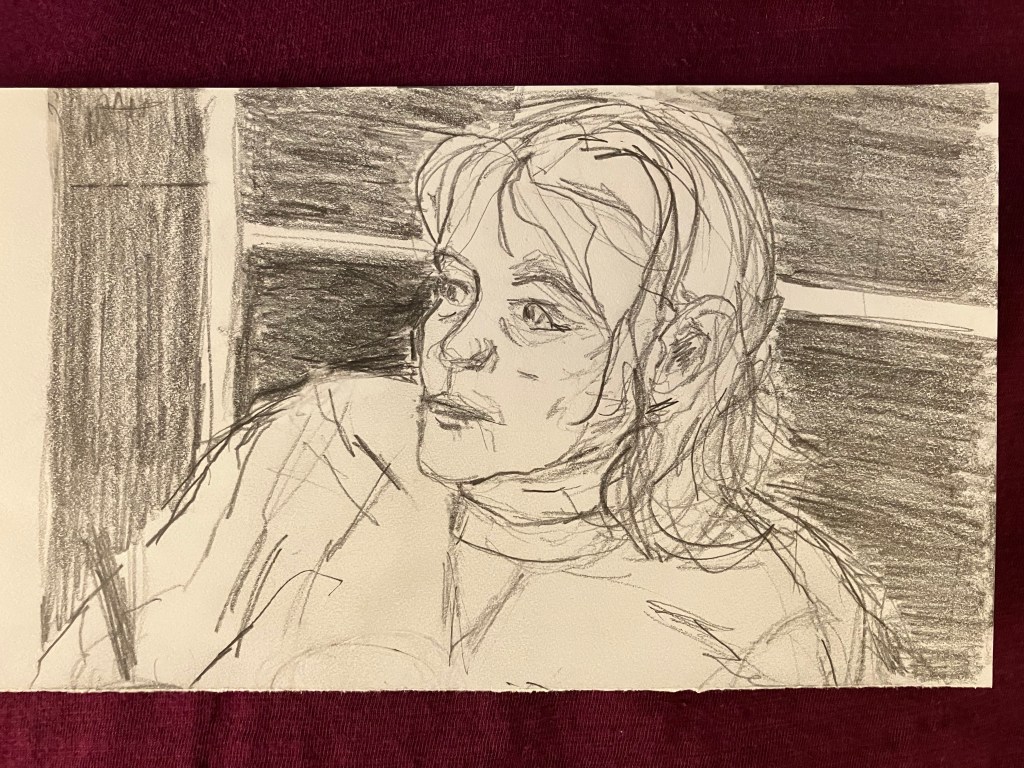
How to cite: Knight, Sabina. “Just Another Day: Sabina Knight.” Cha: An Asian Literary Journal, 4 Jun. 2023, chajournal.blog/2023/06/04/sabina-knight.


Sabina Knight 桑稟華 is author of Chinese Literature: A Very Short Introduction (2012, translated into three languages) and The Heart of Time: Moral Agency in Twentieth-Century Chinese Fiction (2006). She is Professor of Chinese and World Literatures at Smith College. Her current projects consider the politics of translation, non-Han literatures, and media of dissent. [All contributions by Sabina Knight.]
 Cha
Cha 