

Three Paintings with Regard to June 4th
Night Ritual (2011) oil on canvas, 25×100 cm
People burning paper to send thoughts to the dead. In the painting there are six people on the left, four on the right, and eight or nine (if we count the shadow on the umbrella) in the middle.


Festivity (2020) oil on canvas, 100×100 cm
Only three days separate June 4th to the International Children’s Day celebrated in China on June 1st.
I deliberately painted in a style similar to children’s books illustration.
The face of Madonna has been replaced by a surveillance camera.
Throughout my childhood until my adolescence, I saw notices with a big red check mark √ announcing executions for capital punishment pasted in the street.

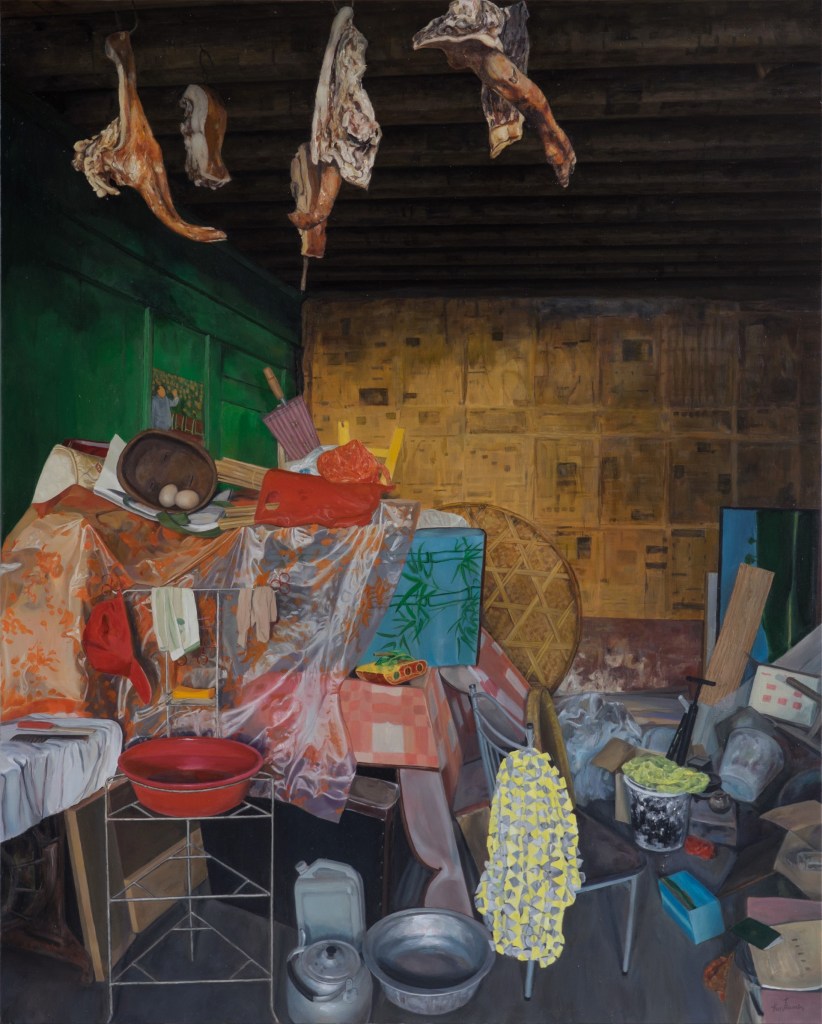
Vanitas (2022) oil on canvas, 162×130 cm
Among the typical decorations of Chinese rural interiors is the Mao poster that used to be very common after it replaced the Stove God in households. The smoked ham (臘肉) is partly an ironic reference to Mao, the nickname netizens use to refer to the embalmed Chairman to elude censorship and (on many occasions) to deride him and the regime’s ideology. The umbrella is a reference to a popular propaganda painting showing Mao with a red umbrella under his arm; it also refers to a famous statement by Mao describing himself as “a lonely monk walking in the rain under a leaking umbrella”—a romantic image which actually was the result of a mistranslation by the American journalist Edgar Snow. What Mao actually said was a Chinese expression “和尚打傘”, in the form of a riddle, which calls for the conventional answer “no hair; no sky” (無髮無天), a homophone for the expression “I know no law, I hold nothing sacred” (無法無天). The toy tank, obviously, alludes to June 4th. The common use of newspaper sheets as wallpaper in old houses also points metaphorically to the normalisation of history within Chinese households.
How to cite: Jiamin, Hu. “Just Another Day: Hu Jiamin.” Cha: An Asian Literary Journal, 4 Jun. 2023, chajournal.blog/2023/06/04/hu-jiamin.

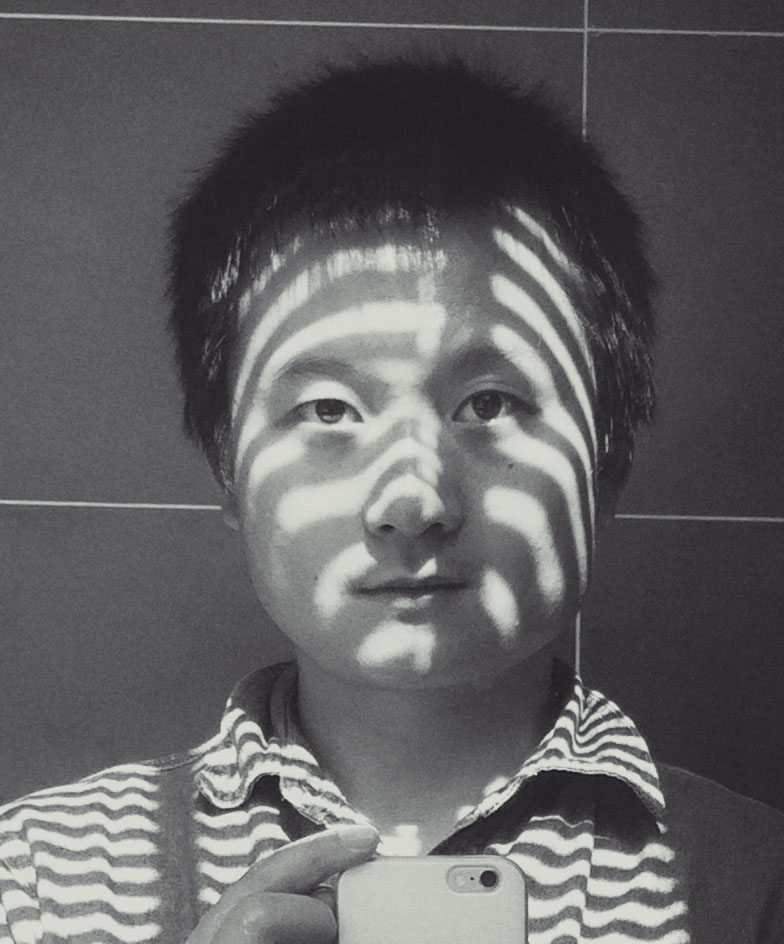
Hu Jiamin (b. 1983) grew up in Yichang, China on the banks of the Yangtze. After graduating in biology in 2006, he decided to abandon his scientific career to devote himself fully art. From 2007 to 2009, he worked in an international artist residence in the countryside of Yunnan where he assisted other artists and began developing his own practice. His experiences in rural China profoundly influenced his sense of artists’ social responsibility. In 2010, he returned to the city (Shanghai and Beijing), where his work continued to evolve, enriched by the cultural resources at hand and his encounters with the social complexities of metropolitan life, as he devoted himself to a number of projects in various media (painting, design, writing), both individual and collaborative. Frustrated by the social and political direction taken by China, he left for France in 2016. The censorship and officially ordered destruction of the mural he painted for the 2017 Shenzhen-Hong Kong Biennale validated his decision to emigrate. He now lives and works in Lyon.
 Cha
Cha 