
📁 Return to First Impressions
📁 Return to Cha Review of Books and Films
Isabel Sandoval (director), Lingua Franca, 2019. 90 min.

In the gloaming hour, light leaves remnants of ambiguity everywhere. Nothing of consequence has asserted itself, at least not yet. Cynicism seems near impossible when confronted with this twilight, that imminent horizon of longing. Over time, you get used to waiting, the same way you might wait for a date in a crammed cafe, your capacity for observation heightened to the point of discomfort. You can’t bear to stay a moment longer, but you must.
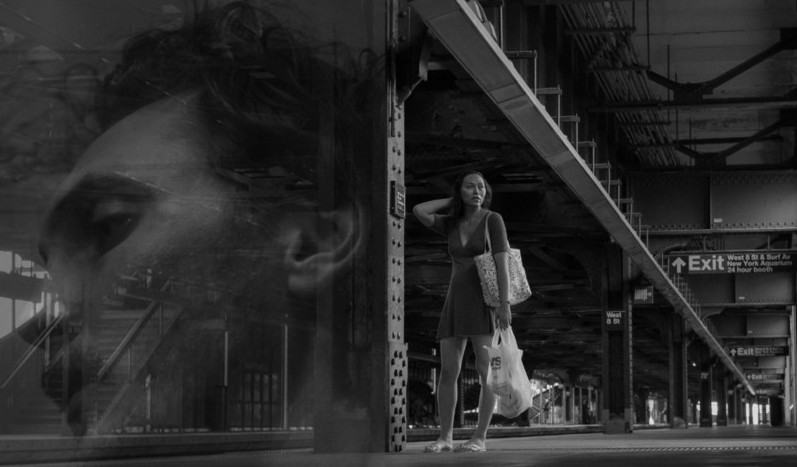
That anticipatory ache, equal parts uneasy and affirming, is the nerve centre of Isabel Sandoval’s Lingua Franca. It’s all over Sandoval’s Olivia. In her mannered ambivalence. Across her estranged glances and fluorescent smiles. When, lying in bed, in a darkly lit room, her presence can render a tentative intimacy. Her entire life, it seems, orbits around tentativeness. Living in a country where every aspect of her existence is policed and judged by punitive forces, Olivia is a blip in the machinery. ICE (Immigration and Customs Enforcement) haunts her waking moments. Her identity as a Filipino transgender domestic worker becomes a source of public intrigue. The men in her life repeatedly fail her. Her circle of friends grows smaller and smaller as they too face the threat of deportation. Time, skewed time, always seems on the verge of running out.

How does one even begin to gather the inner resources to navigate these dangers? Sandoval’s film doesn’t offer much in terms of easy answers, if it does at all. Her approach instead thrives on an underbelly of anxiety, capturing tiny moments that, piece by piece, reveal facets of Olivia’s struggle. In one scene, she sits with her close friend Trixie as they contemplate the difficulty of getting a green card, a slip of paper with the power to draw the line between dangerous precariousness and abiding security. A disappointed Trixie returns Olivia’s passport to her. An “immigration crackdown” is alluded to, as well as a law in the Philippines, which bans transgender people from changing their name and gender markers. It’s a scene that betrays a system of discrimination whose weight is most intensely felt by someone like Olivia.
Lingua Franca is not a film about despair, though the acting and the tonal palette can sometimes register as dull and joyless. Too much grey in the canvas. There’s a weariness to Sandoval’s direction that reflects Olivia’s exhaustion with the world around her, but it also fails at times to offer other windows for perceiving this complex character. It’s refreshing, then, to encounter scenes of intimacy where we are given a chance as viewers to observe Olivia in her most secluded moments. Whether she’s arranging and pasting photographs in a scrapbook, her back turned to us, or in a bed by herself staring at the ceiling. Her melancholia pulls us in, allows us to linger with her.
Throughout the film, light is scarce; each character, through their own efforts, attempts to hold on to it as they find ways to sustain its source. In Olivia, we witness the corroboration of urgency and grace, that searching shimmer in her eyes, fatigued but unerring. There, in the approaching dusk, she flickers, yearning still towards the faithful night.
How to cite: Carballo, Sean. “Intimating Emergency in Isabel Sandoval’s Lingua Franca.” Cha: An Asian Literary Journal, 29 May 2023, chajournal.blog/2023/05/29/lingua-franca/.


Sean Carballo is an arts writer based in the Philippines. He recently completed his bachelor’s degree in English literature from the Ateneo de Manila University. His writing has been published in Cartellino, Plural Art Mag, and Heights.
 Cha
Cha 