

📁 RETURN TO FIRST IMPRESSIONS
📁 RETURN TO CHA REVIEW OF BOOKS AND FILMS
Click HERE to read all entries in Cha on Not Written Words.
Xi Xi (author), Jennifer Feeley (translator), Not Written Words, Zephyr Press and MCCM Creations, 2016. 152 pgs.
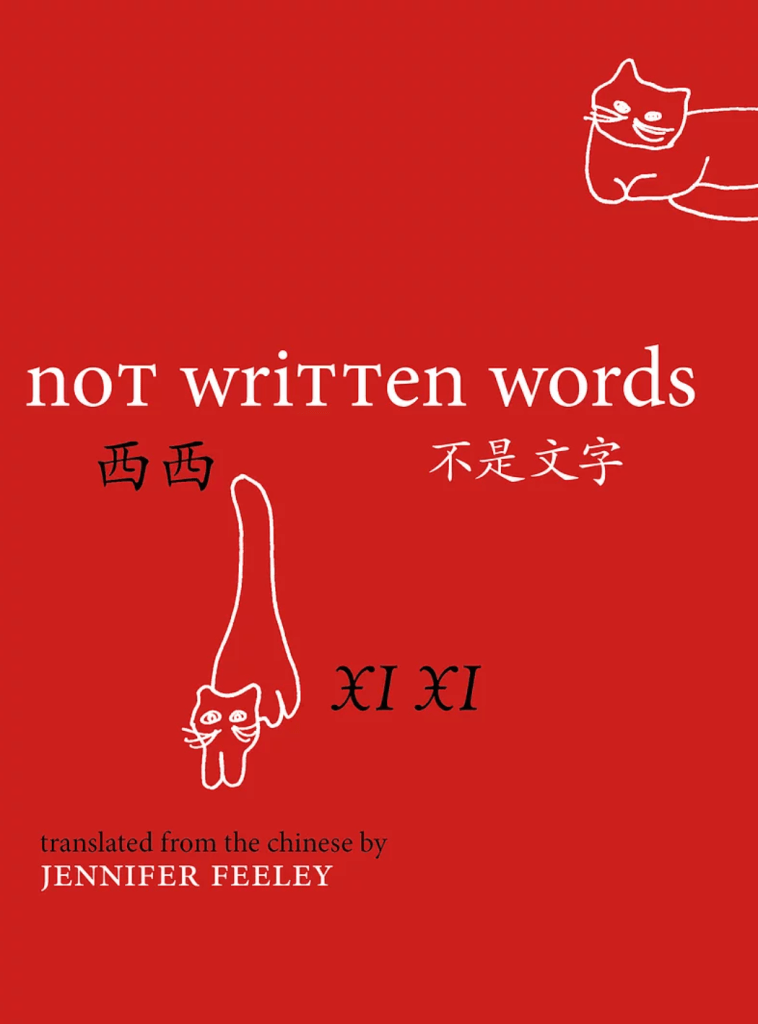
.
“When I grow up,” writes Xi Xi in the poem “Water Heater”, “I’d like to be a water heater”. As a water heater, she could make sure her mother had water to wash dishes; the tiles in the kitchen would always be clean, and her mother could use her water to cook up a “big-headed fish”. As time passes, the child believes, she might make friends with other water heaters, and together they would make sure all mothers have hot water to wash clothes. They would even band together to melt the winter ice, so that “streams / muddy roads & bird’s nests / glass windows / cross eyed cats/faucets and scallions / thumbs and toes / could all / sleep / warmly / and slyly.”
This whimsy and enthusiasm—a warm play with language and reality—is typical of some, but not all of the poems in Not Written Words. Winner of the Lucien Stryk Asian Translation Prize in an impressive translation by Jennifer Feeley, this is the first collection by this major Shanghai-born Hong Kong writer to be available in English. Xi Xi is the author of seven novels, 21 short-story and essay collections, as well as countless standalone articles. Many of these works have won awards; notably, her essay “Steps” was adopted as reading material for the Hong Kong Certification of Education Exam. But amid all this wandering between so many mediums and genres, what makes her poetry special?
Reading other reviews, I noticed a constant emphasis on the colourful borderline surreal imagery of many poems. Here, “Butterflies Are Lightsome Things”:
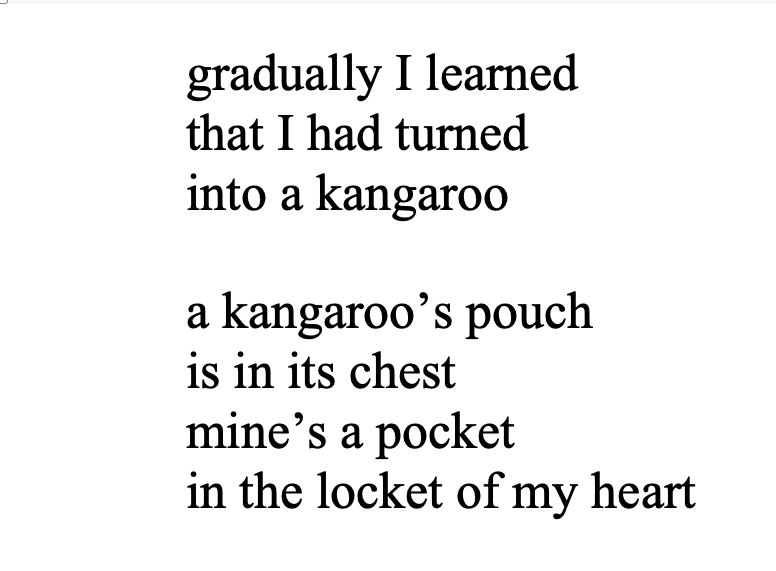
Poems in this vein brim over with airy lightness, as images bloom and transform and combine. At first, Xi Xi’s free-form creativity reminds me of Richard Brautigan, with his straightforward tone and tendency to juxtapose metaphors. Like Brautigan, Xi Xi’s poems feel light-hearted and fun, playful even—but even Xi Xi’s most comical poems are, in truth, very serious. These poems aren’t jokes, or games either. Instead, her best works feel like waking dreams: a transformed vision of life somehow more real than any memory.
Further departing from Brautigan’s relaxed minimalism, I noticed a reoccurring formality to many of Xi Xi’s poems. The vast majority have their own unique pattern, a kind of internalised stamp, as if Xi Xi wanted to guarantee that each poem sits unlike the others on the page.
Sometimes this takes the form of simple, layered repetition, as in “I’m Happy”:
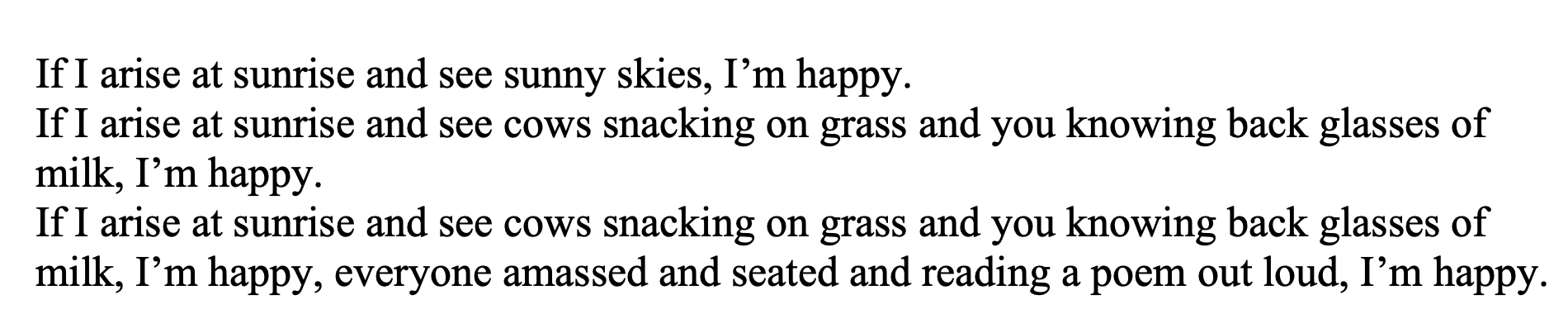
Elsewhere, in “Ichiro”, Xi Xi plays with more elaborate configurations of space and reoccurring shapes or phrases:
 Throughout the collection, Xi Xi experiments with lists of unusual word combinations. She presents the reader alternate translations of a Yeats poem, provides excerpts from a “feminist dictionary” in which familiar words are feminised, and even lists names as they might be recorded in a phone book. Again and again, these forms are introduced and fade away, without ever repeating. In fact, the more I read, the more unalike the poems appear—even as their straightforward approach grows quietly more radical.
In her introduction, translator Jennifer Feeley mentions that Xi Xi had “become increasingly frustrated by the lack of intelligibility of numerous poetry collections and decided to create her own style by ignoring literary trends and other people’s opinions”. But aside from the poems’ unusual clarity and openness—at least in Feeley’s smooth, highly naturalistic translation—I appreciate their attitude: a notable absence of the high seriousness (some might even call it “pretence”) of much poetry. Dozens of the poems seem to record momentary passing thoughts; a few even feel like jokes. There is minimal dressing up or veiling of the subject: no attempt to impress the reader with writerly profundity. Yet somehow, something about them remains elusive.
As the poems become longer and more narrative-driven in the second half of the book, their simplicity verges on prose. One of my favourites is “Moon”, where Xi Xi imagines what the moon—after millennia as the subject of poems—might think when it looks back at us.
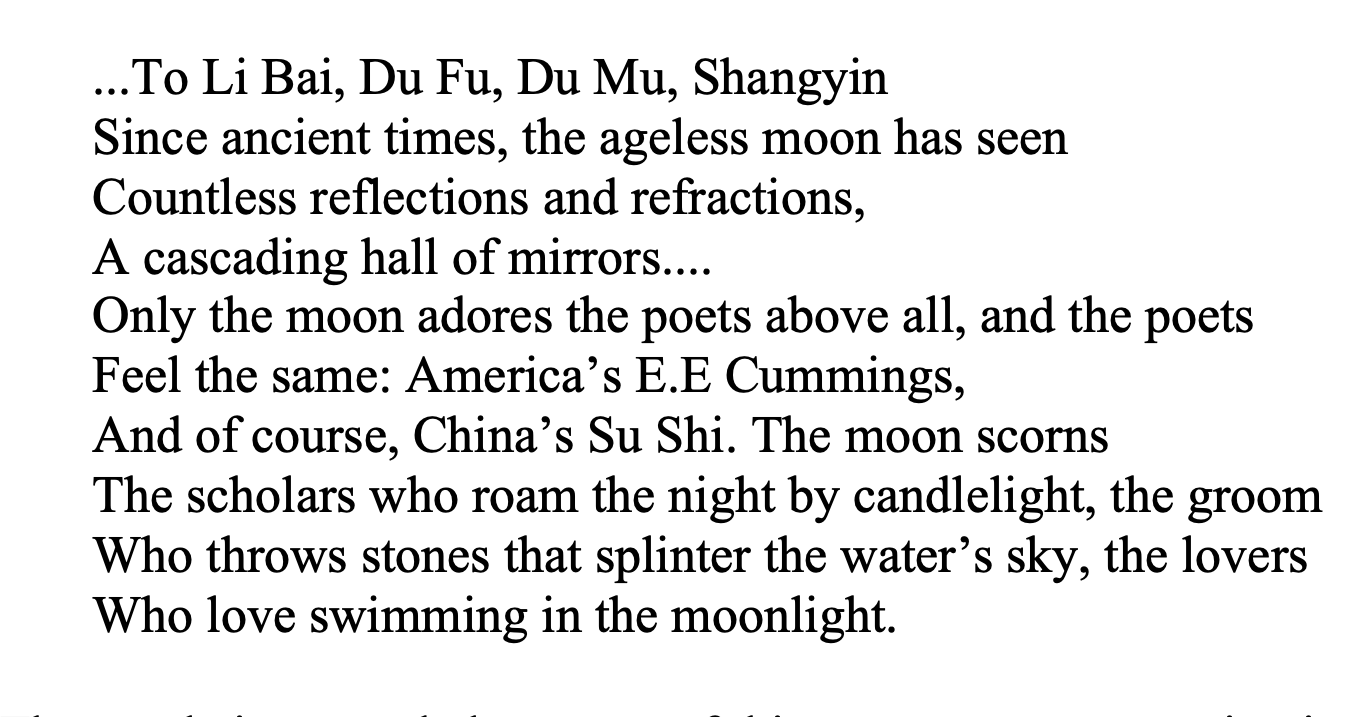
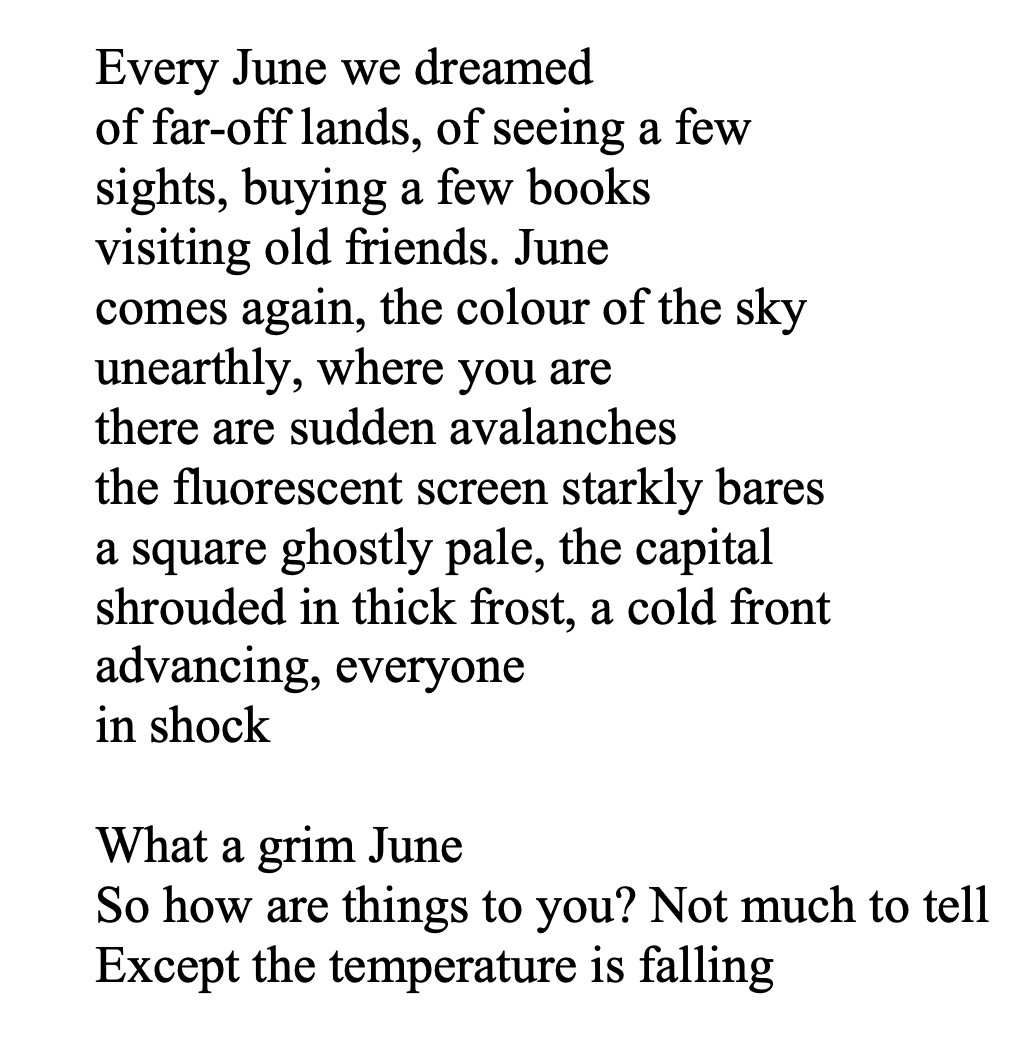
The gentle irony and cleverness of this poem—not to mention its lack of reverence for certain cultural touchstones—is just as typical of the collection as its childish earnestness: and in time, a voice emerges from this all. The voice is gentle, friendly, familiar, like the memory of an old friend, speaking to you from a great distance. Without even knowing it, we realise childhood has already passed: now the poems are about aging and the passage of time. The writer’s friends have children now; she has travelled the world, read widely, lived in the same neighbourhood—To Kwa Wan—since 1979. But the memories of those early poems are still with us as we read, such as in this excerpt from “June”:
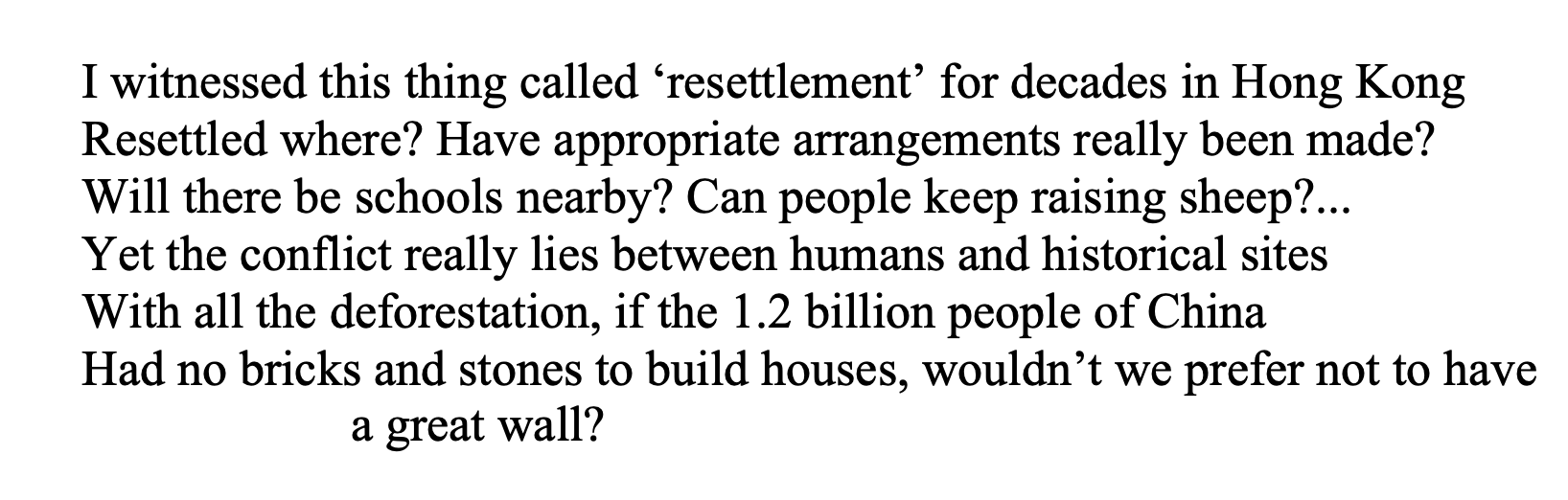
In the last third of the book, the poems become longer, more erudite and political, often stretching to two or three pages. Whole poems meditate on figures such as Thomas Mann or Gary Snyder. The writer visits the Middle East; she discusses politics; contemplates literature. She thinks of old friends (or old lovers?) with a tone that grows increasingly wistful. I appreciated the lucid focus of these poems, where at last the writer seems to deal more directly with certain issues that trouble her. For example, in “Children among the Ruins”:
I skipped reading the introduction my first time through this collection, but I was unsurprised to later discover it includes work written between 1961 and 1999. Not Written Words is far from a focused volume, but this sense of growth, of exploring the progression of a life, keeps the book luminous and fresh… even as, at the end, I found myself hungry for more. Like Xi Xi’s body of work as a whole, her poetry seeks constantly for new forms: new games to play. I haven’t read enough to know if poetry is the highlight of her oeuvre—but it’s certainly a nice place to start.
How to cite: Muntz, Kyle. “Quietly Radical: Xi Xi’s Not Written Words.” Cha: An Asian Literary Journal, 23 Feb. 2022, chajournal.blog/2022/02/23/not-written-words.


Kyle Muntz is the author of The Pain Eater (forthcoming July 2022 from Clash Books) and Scary People (Eraserhead Press, 2015). In 2016 he received an MFA in fiction from the University of Notre Dame, in addition to winning the Sparks Prize for short fiction. Currently he teaches literature and writing at the Guangdong University of Foreign Studies in Guangzhou, China. [All contributions by Kyle Muntz.]

 Cha
Cha 