

{Written by Wong Yang, this review is part of Issue 46 of Cha.} {Return to Cha Review of Books and Films.}
Daryl Lim Wei Jie, A Book of Changes, Math Paper Press, 2016. 65 pgs.
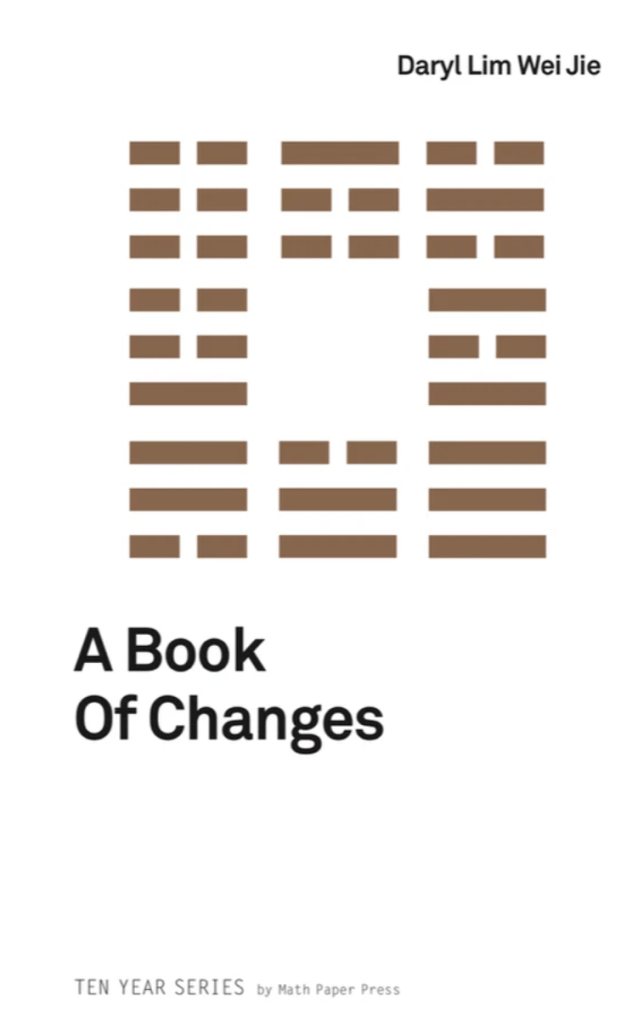
Few collections coming out of Singapore literature’s “new wave” of poetry are as steeped in history as Daryl Lim Wei Jie’s A Book of Changes, published in 2016 by Math Paper Press under the Ten Year Series imprint. Over the course of its 33 poems, Lim’s debut chapbook both discovers and disrupts Singapore history in assiduous fashion, pursuing and revitalising lost or receding voices to page-turning aplomb. The poet’s de-familiarisation of the otherwise recognisable images of the country not only deconstructs official narratives of the past but also invites readers to question their own position in the ever-changing present.
This being the third collection that I have picked up in the Ten Year Series, I expected the same tight and coherent read I found in David Wong Hsien Ming’s For the End Comes Reaching and Amanda Chong’s Professions. True to the critical discussions spanning over a year, and the rewrites and rigours of a manuscript “boot camp” that were all part of the series’ inception, the title A Book of Changes reflects precisely that process. The product of Lim’s revisions and the input of a collective—the acknowledgements span one and a half pages—is yet another collection that punches from front to back with purpose, and in which no poem is a superfluous bystander. To this end, this collection—like its sister chapbooks—avoids the meandering awkwardness that local poetry volumes are sometimes prone to.
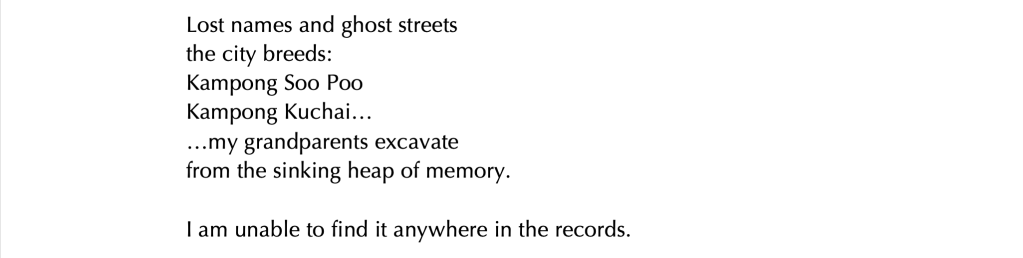
If anything meanders in A Book of Changes, it is the Kallang River in “Running by the Kallang”, a poem midway through the book that perhaps epitomises Lim’s inventive poet-historian verse. The speaker conjures early Bugis settlers from the 19th century while on his evening jog and juxtaposes their trade of gold and spices with today’s consumerist Singapore:

If the “godless ark held / aloft by three cenotaphs” that Chong describes in her own collection is a monument to the island-state’s modern-day prosperity, then the absence of the Bugis’s former enclave expounded in Lim’s piece—“in what was once Kampong Soo Poo, / a name lost to these gentle waves”—attests to the erosion of heritage in post-colonial Singapore. Lim’s personification of feisty, war-mongering plants and architecture in “Ang Siang Hill” further points to development and heritage being at odds: “foot-soldiers / of shrub and weed creep forward … / … the backs of shophouses form / a fortification of their own”.
Historical absences are not only physical, but cerebral, too. The collection’s third poem, “Scattering”, portends this common thread when pre-colonial Chinese merchants get a “foretaste of the forgetting to come.” Lim then lays bare the forgetting and the forgotten in “21 July 1964”—titled for the country’s first race riots—in which a failed Konfrontasi attack by Indonesian militants “will just be another day / in this island’s diminishing annals”:
In “The Event”, Lim critiques the erasure of less-than-convenient narratives by officialdom, and it is with this poem that he is perhaps at his most political. Collective amnesia is fostered by media censorship and missing documents. Parodying a Speakers’ Corner gathering deemed unlawful by authorities, Lim also suggests the complicity of the people in condemning anti-establishment activities to mere historical footnotes:

The subject matter of Lim’s poems may at times be reminiscent of Alfian Sa’at, who also evokes history in his oeuvre and subverts social studies-type accounts. But while Alfian writes unabashedly about Singapore’s longest-serving political prisoner Chia Thye Poh (among other dissidents), Lim seems to shy away from explicit nods to the more contentious points in the nation’s history such as Coldstore or Spectrum. Where Alfian is sardonic and at times angry, Lim’s light satire achieves a critical distance, opting instead to interrogate the tenuous nature of historical truth. “Even the historians demur” on the question of “who was fighting, and why” in his aforementioned poem “21 July 1964”, and in “The Event”, too:

There are no absolutes in the worlds that Lim constructs, even when he reincarnates long-gone historical figures. Seemingly incongruous elements are fitted together, contributing to the poet’s de-familiarisation of well-worn tales. In “Sang Nila Reclaims the Throne”, Lim invents an alternative timeline in which the mythical ruler returns to Singapore in the 21st century, except he is now Buddhist, and his followers make taxi bookings for him. The poem’s epigraph borrows the last lines of Alfian’s “Singapore You Are Not My Country”, which also conjure Sang Nila. In Lim’s poem, Alfian’s crownless prince re-emerges and looks for a goldsmith to make him a crown. He eagerly seeks markers of his legacy, only to find little of it in this city of forgetting:

I am reminded of Daren Shiau’s 1999 novel Heartland, a bildungsroman interspersed with tales from the Sang Nila mythology. It appears Lim’s Sang Nila could have done with Shiau’s advice: “Fires in candles lose their brightness in time. So it was that the glorious legacy of Utama faded with the Rajas after him.”
Founding fathers Lee Kuan Yew and S. Rajaratnam are similarly re-imagined in “Garden City” and “Dreaming of the City of Books”. But while Rajaratnam is given life by an anecdote of him reading on the toilet at night, LKY speaks as himself in “Garden City”, a poem injected with pithy sayings that the man could very well have uttered himself:

In this poem, LKY responds to criticism of his “top-down” style of governance, invoking his famous tree-planting campaign. Yet, there is a recognition on his part that, “like the wife” and “the mempat (he) planted in sixty-three”, his time is nearly up. Lim gives a sense of his own green fingers in the collection; many of his poems are rooted in his knowledge of botany, whether it is in the natural imagery of “Kangchu” or the “bracts” in “Bougainvilleas”.
It is in the former poem “Kangchu” where Lim pits the past and the present against one another, using a more expansive form to place the contemporary speaker’s stanzas on the left, and the colonial labourer’s on the right. The colloquial speak of the office-bound MRT commuter who laments “Khatib to Yio Chu Kang so far” contrasts sharply with the less expressive, formal voice of the plantation worker. That said, both parties are joined by their subjection to the passage of time, to which the enjambment of their lines lends further weight.
Within this city of constant flux, Lim’s voice is that of a millennial who searches for remnants of history and heritage, and in so doing unearths an irrevocable distance between himself and the past. His retellings carry a sense of loss and absence. In Adnan, the poet’s “If I had seen you…”, “I cannot help seeing you…”, and “I do not know what was augured” imply a superficial distance from the Malayan war hero, but the final quatrain offers a harsher reality check. Lieutenant Adnan’s courage has been lost on an apathetic populace:

Even when Lim pays his respects to an ancestor in his most personal poem of the collection, “a visit to choa chu kang columbarium, 12 jan 2014”, the trademark pragmatism of Singaporeans is evident:

A coffeeshop passed down in a family for generations is sold for eight million dollars (“Coffeeshop”), while a deceased vegetable seller’s coffin “costs too much / and weighs too much” (“Last Rites”). And yet Lim reveals the contradictions within The Singaporean—he or she is at once calculative and logical, but also deeply superstitious. A hawker wears a “chain / that rings his neck, guarding him from demons” (“The Wonton Noodle Seller”) and the speaker in “The Prophet” avoids sleeping beneath trees on Thursdays. The local 4D lottery compulsion is referenced at least thrice, too.
While I found the occasional anastrophe in Lim’s verse abrupt at times, and I wonder if the conversational fable “Coffeeshop” would have worked better as a prose poem, the poems in A Book of Changes achieve their persuasive quality without being too heavy-handed. Published before a fiery debate took place between a historian and a minister on the state’s justification for Operation Coldstore in 2018, and public criticism of the 2019 Singapore Bicentennial for its celebration of colonial history, Lim’s writing even seems prescient. In marrying the quotidian with the eccentricities of Singaporean life, and staging anachronisms amid modernity, Lim provokes a reflection on the country’s state of perpetual change, and the personal and national histories lost along the way.
Also see this review in Cha:
How to cite: Wong, Yang. “No Absolutes: A Review of Daryl Lim Wei Jie’s A Book of Changes.” Cha: An Asian Literary Journal, 15 May 2021, chajournal.blog/2021/05/15/daryl-lim-book-of-changes/.

Wong Yang is a Comparative Literature undergraduate and a keen reader of Singaporean prose, poetry and drama. Apart from writing the occasional poem, his journalistic work has been published in The Straits Times, The New Paper, AsiaOne, and Vox Sports.
 Cha
Cha 