

{Written by Jennifer Anne Eagleton, this review is part of Issue 46 of Cha.} {Return to Cha Review of Books and Films.}
Click HERE to read all entries in Cha on Aftershock.
Holmes Chan (editor), Aftershock: Essays from Hong Kong, Small Tune Press, 2020. 93 pgs.
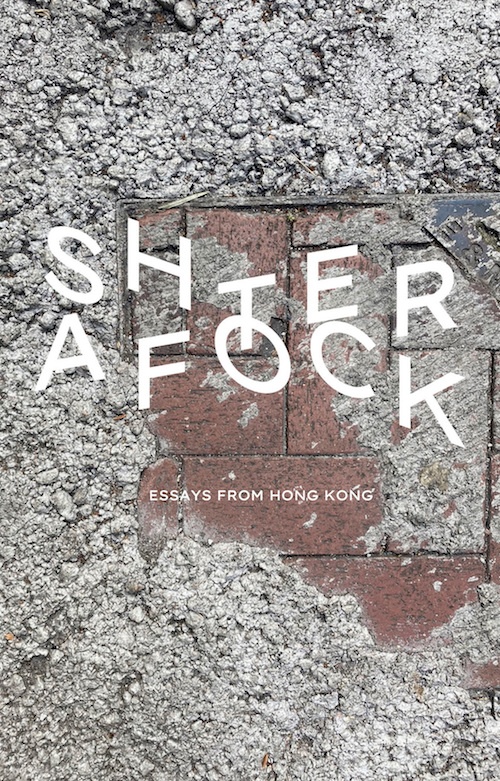
Aftershocks are small earthquakes that occur in the same general area during the days and even years following a “mainshock”. They arise a couple of fault lengths away and before the background seismicity level has normalised. Aftershocks represent minor readjustments along the length of a fault that slip at the time of the mainshock. The frequency of these aftershocks decreases with time.
In the political sense, Hong Kong’s “aftershock” does not fit the definition. Slippage occurred at the unstable fault line of “One Country, Two Systems” during the extradition bill saga of 2019 (the “mainshock”) and the resulting protests. Unfortunately, the aftershock(s) have been not been minor and led to the infamous National Security Law of June 2020 (another “mainshock”), and so it goes on.
Aftershock is also the title of an emotional volume of reflections on the 2019 protests by Hong Kong journalists. Written not as wearers of journalistic “hats” but as personal reflections, and with “less armour and baggage”, as Holmes Chan, the editor of the book, writes in the introduction. Since these journalists work “in the spaces between protesters and the police”, these essays provide us with an interesting perspective on the sensitivities and social contradictions that were thrown up by the protests.
The piece “New Territories” does not refer to the location, the lease expiry of which led to the 1997 handover, but to the new territory of extreme alienation. The 2019 protests solidified past divisions to an “us” and “them” mentality, but also reinforced camaraderie on both sides, with hardly way of breaching the “cold war” between the two. There is hardly anyone in Hong Kong who did not have a permanent rupture of friendship or a family falling-out during 2019. Even though the protests to some have now stopped, there are reminders everywhere in the streets. We may not discuss these things now, directly, but they linger.
In “Faces at a Distance”, Hsiuwen Liu, a Taiwanese working in Hong Kong, takes the catchphrase “today Hong Kong, tomorrow Taiwan” as a future possibility for her homeland. Highlighting the links between the two places, with one having a “demonstration” effect on the other and both sharing the commonality of keeping one’s distance from the mainland. Liu says that this feeds on fear and she wants to draw a clearer narrative of the complexities of the struggle, one that transcends this fear.

Elaine Yu in “Feathery Down” reminiscences about her own school days in more innocent times, with the contested youth of 2019, reflecting on the hi-vis jackets she wears as a journalist as a barrier of sorts—“my type of uniform gave me a layer of protection”.
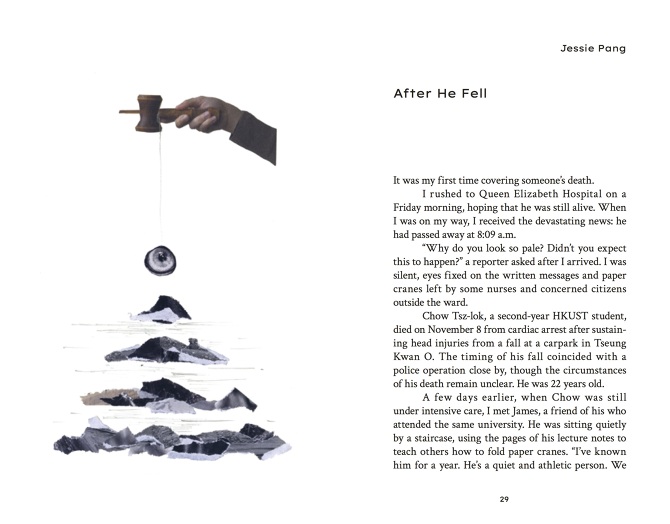
“After He Fell” by Jessie Pang concerns the consequences of Chow Tsz-lok’s fall from a multi-story car park after tear gas was fired by police. This led to an outpouring of grief and desire for vengeance and a slogan change from “Hongkongers resist” 香港人反抗 to “Hongkongers avenge” 香港人報仇. This change in sentiment ultimately led to the occupations and sieges at the Chinese and Polytechnic Universities, and a cancellation of the “be water” strategy. The “war-like” atmosphere of these sieges bring to mind Pang’s past aspirations to become a war correspondent, never realising that “war” would find her at home.
Ezra Cheung’s “Missing Person” refers to the person who really started it all, Chan Tong-kai, who murdered his pregnant girlfriend while visiting Taiwan. Waiting for his release from a Sai Kung prison, truly it could be said that he “……as the butterfly whose flutters eventually resulted in a tornado”, that is, the extradition bill. Ripple effects of the case are still with us, in the stealth introduction of the extradition bill in the National Security Law of 2020.
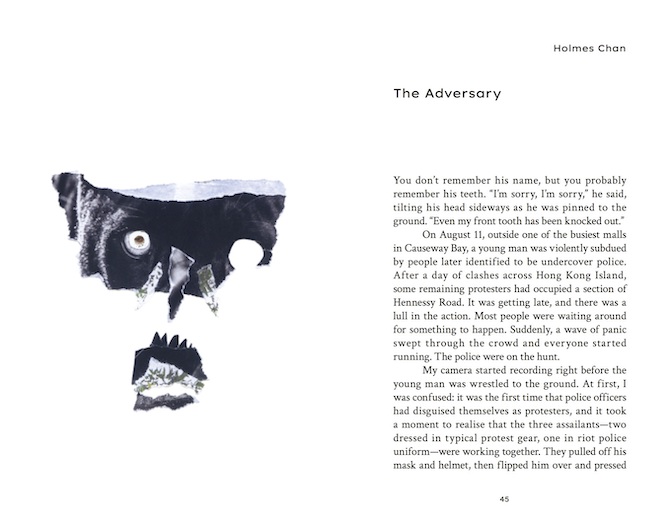
Holmes Chan’s “The Adversary” tells of his need to record the street protests—even as they became more frequent—and each episode of violence. It also testifies to a failure to capture the “essence” and the rawness of the violence, spurred on by one specific incident of police brutality, witnessed first-hand. Chan wanted his words to fight back rather than just detail acts of violence.
For me, perhaps the most moving piece was “Voiceless”, by a contributor who did not wish to be named. Clearly a mainland Chinese reporter, you can hear their pain, their distress and questioning of the point of it all. The most poignant part of the narrative was the following: “To them, we the press have asked for years: Why did you do it, or why did it happen to you? Why there, why then, Why you? But all of them became just me”. This reporter’s voice has fallen silent, just as others have and more continue to do so with the introduction of the National Security Law.
The “fish tank” in Karen Cheung’s “My Fish Tank Days” was the newsroom where she tried to recapture the “intangible weight of a historical movement”, the tear gassing of 28 September 2014, that heralded the start of the Umbrella Movement, an event that she missed. Not wanting to miss out on other significant events, she became a reporter. Rather than getting the “big story”, she learned the value of patience, and the small, “slow” stories that eventually mount to something in the long run.
“The Cost of Living” by Nicolle Liu muses on a kind of “return to normality” after the start of the coronavirus outbreak. But it was only a return to normality for some. For those on the frontlines, the possibility of arrest and the trauma of what they had seen had not dissipated. For those who were not on the frontlines, “moving on” was somewhat easier. For some of the wealthy professionals of Hong Kong, for example, “normal times” could return in a flash—as if nothing had happened. And it is these people who also need to get on board if fundamental change is to occur.
Rachel Cheung in “A Day’s Work” focuses on the dilemmas of how to provide “balance” and presenting both sides of a story in response to her editor’s statement that there are “victims on both sides”, yet when one side is inflicting suffering on one side, how can equal space be given to both sides? Newsroom fights over presenting the police and establishment side saw journalistic principles “weaponised” to bring writers into line. As an applied linguist, I know the tools that could be used: euphemism, selective use of quotations, ambiguity and gaslighting—things we are experiencing experientially ever since June 2020.
The volume ends with “Homefront” by Sum Lok-kei, who grew up and continues to live on the Chinese University campus, and experienced protests there both as a reporter and as a resident. While Sum had a surreal existence growing up in such a place, it was even more surreal when his home became a site of siege. Layers of memories for me also, as I walked past the university the day after the siege and the blockage of the adjacent highway (see my narrative here).
Writing for themselves, these journalists are at times quite poetic since they write from a deeply personal perspective. And although Chan in the introduction writes that “there is no big takeaway, no call to action” arising out of these essays, we do take away something important: how intimately the events of 2019 affected everyone and continue to reverberate along Hong Kong’s unstable fault lines.
Also see these reviews in Cha:
- “Traces that Haunt the Scene: A Review of Aftershock” by Cherrie Kwok (27 April 2021)
- “Testimony Will Always Prevail: A Review of Aftershock” by Jimin Kang (8 April 2021)
How to cite: Eagleton, Jennifer Anne. “Hong Kong’s Unstable Fault Lines: A Review of Aftershock.” Cha: An Asian Literary Journal, 08 May 2021, chajournal.blog/2021/05/08/aftershock-hong-kong/.

Jennifer Anne Eagleton, a Hong Kong resident since October 1997, is a committee member of the Hong Kong Democratic Foundation and a Civic Party member. She has been a close observer of Hong Kong politics since her arrival in the city. She was an adviser to the University of Hong Kong’s “Designing Democracy Hong Kong” project (2011-2013), and in 2012 completed a PhD on how Hong Kong talks about democracy using metaphor. Jennifer has written a number of language-related articles for Hong Kong Free Press and is currently compiling a book combining Hong Kong culture, photography, and political metaphor. A previous president of the Hong Kong Women in Publishing Society, Jennifer is also a part-time tutor of stylistics/discourse analysis at OUHK as well as a freelance writer, researcher, and editor on cultural topics. In her spare time she collects Hong Kong political pamphlets and artefacts. [All contributions by Jennifer Eagleton.]
 Cha
Cha 