

{Written by Ari Santiago, this review is part of Issue 46 of Cha.} {Return to Cha Review of Books and Films.}
Zafar Anjum (editor), The Best Asian Short Stories 2020, Kitaab, 2020. 268 pgs.
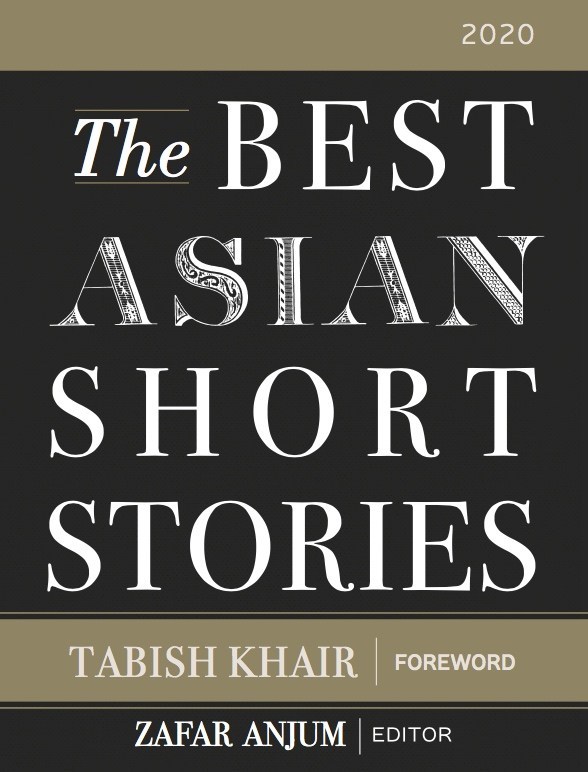
Collections titled “the best” are always kind of presumptuous, which is to say they entail certain presumptions that need to be untangled in reading them. In The Best Asian Short Stories 2020 (TBASS 2020), for example, one might ask what is presumed by “best” or “Asian” or if “Asian short stories” are judged better or worse by standards uniquely their own.
The latter is worth pondering in light of Tabish Khair’s foreword to the anthology. The short story, he explains, has a different historic significance in Asia than it does in the West. For while Europe attaches novelty to, well, the novel, much of Asia’s formative modern fiction has been in short form. In their brevity, short stories resist the “monopolistic” tendencies of the novel: a single book of short stories can provide multiple authors a chance of publication, and a single reader the chance to encounter a multitude of voices.
TBASS 2020 is certainly diverse in some regards. Its 17 stories—by writers who count themselves Asian either by heritage or residence—span over a dozen cultures and nearly as many countries. It has romance, drama, suspense, and an apocalypse seen through the eyes of a dog. Yet, in other regards, it’s painfully narrow. It has a decidedly South and Southeast Asian bent, with other parts of Asia scarcely, if at all, present (but curiously, one story from Australia and one from the West, all dressed up in the trappings of touring in Asia). There’s only one story dealing with queer experience and only one about disability, and, dog-apocalypse aside, there’s no speculative fiction to speak of.
Yet, there was a more immediate issue I encountered when reading the anthology, which was that around half its entries are not particularly good stories—Asian or otherwise—let alone the best. Some of them are, like postcard snapshots, self-consciously Asian but in a superficial way. Others fall short in matters of craft, with plots diminishing into stilted, contrived conversations.
While the anthology falls far short in its claim to being “best,” it offers much to think about in terms of the “Asian” in most of its stories. Going by the numbers, for instance, a number of themes emerge across different Asian cultures and countries. The most obvious is the persistent menace of chauvinism in mainstream Asian cultures. Yet another is the way socio-economic fortunes are so often dependent on geographical mobility, on journeying to distant shores and enduring all the ordeals it entails. And, finally, connected to this is the issue of relationships among Asian peoples—or to put it bluntly, the ubiquity of intra-Asian racism.
The best among the anthology’s entries engage with a mix of these themes and their own more particular concerns. Despite my overall disappointment with the collection, these stories made the read worthwhile, and I’d like to focus my attention on them.
Adeline Tan’s “Babel” is, in a sense, emblematic of the collection’s major themes. The story’s central conflict is the fate of a Singaporean family’s ancestral home. Only the family’s eldest son wants to keep the home in accordance with the wishes that their father voiced but never wrote into his testament. The other two siblings—a daughter, relocated to Australia, and a younger son trying to escape his criminal past by clinging to monkhood—want to sell it.
The younger siblings’ disregard for their father’s wishes is unsurprising, considering he beat the two of them often when they were young. The eldest was spared his wrath only because of their father’s twisted adherence to cultural norms that favour firstborn sons: reserving for them not only an eventual inheritance, but also the lion’s share of basic childhood comforts. It’s not hard to see that the struggle for the house represents a larger struggle over culture and legacy, and the difficulties the disenfranchised face in wresting it from the privileged incumbents.
Moazzam Sheikh’s “Sunshine” portrays another form of struggling against patriarchal traditions. The story is told from the point of view of a father as he and his son, each armed with Nerf guns, engage in a bout of play-fighting. The narrator’s experiences of true violence intrude into this otherwise joyous moment, however, and serve as the gateway for his broader fears regarding the kind of man his son will grow into. These fears are grounded in his experience living as Pakistani in the United States—where one is scarcely understood and widely reviled—but balanced by his awareness of what he risks by imposing his own trauma on his son. The story is tender and grim in equal measure, both sides balanced by a masterful handling of the narrative.
Another interesting take on Asia’s interaction with the wider world is Karen Kwek’s “Borungurup Man”. Here, an Airbnb in Australia sets the stage for a clash between the local Noongar culture and the cosmopolitan advance of an ambiguous cosmopolitanism with the trappings of Buddhism. The would-be champion of the indigenous traditions, however, is a White Australian who has absorbed them from growing up in the area—leaving doubts about the firmness of his grasp of Noongar beliefs and customs. Reading this (and looking back at the anthology later on), it occurs to me that this is the only story directly engaging with the plight of indigenous cultures, even if they are not Asian. That said, the concept of indigenous encounters its own stumbling blocks when discussed in an Asian context, where mainstream cultures, despite having displaced or absorbed certain minorities, are often nonetheless native to the regions they inhabit. “Borungurup Man” offers no clarity regarding such matters, but does a great job at showing the murk that surrounds such intercultural conflicts.
Finally, there is Sarah Soh’s “Lingua Franca”, which is easily my favourite entry in the anthology. The story takes place on a snowy afternoon in Scotland, where the Singaporean narrator is weathering the loneliness of her university’s winter break. There’s not much happening on the surface: she tries and fails to get her ang mo boyfriend to understand why getting one’s ears cleaned is relaxing; the two follow a rumour to try to spot Prince William as he visits the school; she stumbles on her limited Mandarin as an elderly Chinese couple ask for direction in an unfamiliar dialect; she talks to her ailing grandmother on the phone. Yet each of these minor encounters deepens her sense of loneliness and disconnection. She is caught between on the one hand, a childhood spent learning only English and Mandarin so that she might chase economic superiority, and, on the other, the absurdity of “writing three thousand words on ‘Eighteenth-Century English Satire’… when [she] can’t even muster up three Hokkien ones to say goodbye to my grandmother”. Separated from family by the gulf of space and language, and from her boyfriend by the rigid barrier of culture, what is there to do but simply make it through the day?
The story reminds me of something a friend of mine tweeted about Asian (among other) stories and their protagonists: “Western editors and readers often mistake protags written by BIPOC as ‘inactive protagonists.’ … Survival is an active choice, you know. Survival is a story. Choosing to be strong in the face of the world ending, even if you can’t blast a wall down to do it, is a choice”. In the replies, other writers came forward with their stories of facing publisher rejection on account of so-called passive or inactive protagonists—and I find myself wondering: how many other stories might there be like “Lingua Franca”, with such subtle pain and strength, kept from a wider readership simply because their protagonists are judged as passive? For choosing simply to survive in a world that is too much for a single person to change?
It’s not a question I’ll ever know the answer to, but given that TBASS 2020 has provided a space for such stories—and, indeed, for many others, even if many left me unimpressed—then it has already succeeded as an Asian story anthology in one vital regard: pushing back against the pressure of mainstream anglophone standards, carving out a space for stories like this to survive.
How to cite: Santiago, Ari. “Asia in So Many Words: A Review of The Best Asian Short Stories 2020.” Cha: An Asian Literary Journal, 13 Mar. 2021, chajournal.blog/2021/03/13/asian-short-stories-2020/.


Ari Santiago graduated with an MA in Literary and Cultural Studies from the University of Hong Kong, and is currently based in Metro Manila, doing freelance and independent work in content marketing, tabletop game design, and narrative design for games. Their work has been published on Play Without Apology. [All contributions by Ari Santiago.]
 Cha
Cha 